Category Archives: Comedy

Hugo (2011), directed by Martin Scorsese

Hugo posterI recently had a conversation with a friend who moved to Israel ten years ago. I asked him why he made the move at the age of 50 when he was gainfully employed in a senior technology position with a well-established company. He told me that, in spite of the outward perception of his success, he saw the handwriting on the wall in terms of his professional life in America. Younger people were rising in the company who were more adept and knowledgeable, and he knew it was simply a matter of time before he was let go. That reality motivated him to move to Israel and reinvent himself here where he started a “quickie-lube” automobile service center, which is now thriving.

I thought about my friend as I watched Hugo, an engrossing, imaginative story of an innovative businessman, Georges Melies, who is left behind as the world changes and technology advances. Unlike my friend, he is unable to reconcile his creative past life with a future that is changing every day, and so he becomes depressed and sad over a fate of which he has no control.

The agent of his emotional redemption is Hugo Cabret, a 12-year-old boy orphaned when his widowed father dies in a museum fire. A bond between father and son is the movies. In particular, the imaginative films of Georges Melius, whom Hugo’s father adored, is the favorite of father and son.

After his father’s death, Hugo is taken in by his alcoholic uncle who maintains the clocks in the railroad station, and Hugo learns how to maintain and repair them. While managing all the timepieces, he tries to fix a broken automaton, a mechanical man, which his father bought many years ago. It is this project which animates Hugo, who senses that his father has left him a message which only the automaton can reveal. Desperate to keep his father’s memory alive, Hugo steals mechanical parts to repair the automaton, but he is eventually caught by a toy store owner named Georges Melius who makes and fixes toys. Their relationship is at first tense, but when Hugo discovers that the toy store owner is the same Georges Melius, the moviemaker and creative genius who was beloved by his father, he wants to repair not just the automaton but Georges Melius as well.

We learn that Georges was a master filmmaker, who introduced clever and original special effects into his silent movies. Unfortunately, the advent of World War I changed the entertainment landscape in France where the story takes place, and Georges is forced to sell his movies in order to survive financially. Hugo discovers that Georges actually created the automaton, which was the only surviving remnant of his creativity. Hugo, of course, possesses it and wants to return it to its creator. How he does that is the stuff of a magical movie, with exquisite art direction and cinematography which makes Hugo a contemporary masterpiece.

King Solomon tells us in Proverbs that “the righteous fall seven times and rise again.” The message to all men is never to despair after setbacks or tragedy. God is orchestrating things behind the scenes, and one can find meaning even in the most dire of circumstances. The proper response to adversity is to learn from it, not to give in to it. When Georges Melius finally has his emotional awakening, he acknowledges his debt to a brave young man “who saw a broken machine and, against all odds, fixed it. It was the kindest magical trick that ever I have seen.” The reference is both to fixing the automaton and to Hugo’s rekindling of Georges’s creative fire, enabling him to join the larger community of artists from which he had been detached for so many years.

Hugo reminds us to help those broken souls who need human connection, and to “fail forward” and learn from adversity rather than wallow in despair.

Purchase this movie from Amazon.com.

The Best Exotic Marigold Hotel (2012), directed by John Madden

best exotic marigold hotel posterWhen I turned sixty, I realized that in spite of the fact that I felt at the top of my game in terms of the skill set I brought to Jewish high school education,  I was no longer perceived as such by potential employers.  They wanted younger people to assume positions as school heads. I was part of the past, not the future. This is one of the reasons why living in Israel has been exciting for me. Here I can recreate myself as a Jewish educator, not as a head of school but as a valuable piece of a larger educational entity. Here I can redefine my mission.

This is the essential narrative arc of all the characters in The Best Exotic Marigold Hotel, who have an emotional epiphany as they stay at a hotel “for the elderly and beautiful.”  Marigold  captures the pain of growing old, its challenges, and its possible joys if one approaches this time with a positive attitude, and focuses on what one can do, not on what one cannot do.

Old age is a time of loss but also a time of freedom and redefinition. All of the principals come to this picturesque hotel because of an attractive brochure; but, in fact, the hotel is in a state of disrepair and neglect. In a sense, the hotel is a mirror of its new guests who also are “elderly and beautiful.”

Evelyn, recently widowed, is forced to sell her home to cover her late husband’s huge debt and her vacation is a reprieve from the pressures she faces on the home front. Graham, a retired judge, has come to India to find a long lost lover. Jean and Doug come because it is an affordable vacation after giving their daughter most of their savings to start a business. Muriel, a retired housekeeper, comes because she can obtain a hip replacement in India at a fraction of the cost in England. Madge is seeking a husband, and Norman is seeking sexual adventure and companionship.

The intertwining stories, however, share a common thread: how do we come to terms with old age, with declining physical strength, and the knowledge that our life is coming to close? How do we deal with feeling marginalized or ignored?

All the characters in the story have an emotional awakening. Most are able to redefine their life. Some sadly cannot and remained paralyzed by yesterday’s perceptions. They see, as one character says, neither light nor joy and are unable to seize life’s new opportunities. There is a remarkable piece of wisdom, articulated at several points in the film, which suggests the proper approach for senior living. Sonny, the hotel manager, a young man with senior insight, offers the following perspective when things are not going well and the worst is expected: “everything will be all right in the end. If it’s not all right, then it’s not yet the end.”

This is a point of view which is expressed in the Talmud when the Sages tell us that whatever God does for us is for the good. It may not be apparent immediately because we see only a part of the picture. If we were to see everything from beginning to end, we would understand that, in the final analysis, from the aspect of eternity everything is good. A conversation between Muriel and Evelyn encapsulates this philosophy in a humorous way. Evelyn observes: “Nothing here has worked out quite as I expected,” to which Muriel responds:  “Most things don’t. But sometimes what happens instead is the good stuff.”

The Best Exotic Marigold Hotel reminds us that retirement does not have to mean the end of life as we know it. It can be a time of self-evaluation, a time for redefinition, and a time for the assumption of new and worthwhile tasks. In truth, in the Bible there is no word for retirement. Abraham doesn’t retire.  He is productive until his last breath. Moses also does not retire. He is active until the final day of his life. They lead a life of purpose, in which every day has meaning. Their senior years are golden because they use them to clarify life’s goals and to implement a strategy for purposeful living.

Purchase this movie from Amazon.com.

Catch Me If You Can (2002), directed by Steven Spielberg

 catch me if you can posterOver 25 years ago, one of my sons asked me a question of Jewish law. I meditated for a moment and gave him an answer that I thought was correct. About a year later, I discovered that what I told him was incorrect. I apologized for giving him the wrong answer and life went on. Still, however, my quick response of many years ago rankles in my mind. He came to me because he assumed that I was a source of wisdom upon whom he could rely, like money in the bank. My hasty answer wasn’t fully researched and turned out to be flat-out wrong. I realized then and now that, in spite of their sometimes challenging behavior, children intuitively respect and revere parents, and we always have to be conscious of our status as teachers and role models for them, and behave at our very best for them.

This father-son dynamic is tested in Catch Me If You Can, an entertaining and thoughtful drama based upon the true life story of Frank Abagnale, Jr., a clever young man who impersonated an airline pilot, a doctor, and a lawyer in order to bilk others out of millions of dollars on three continents, all done before he reached the age of twenty.

The narrative begins with a dinner honoring his father who has worked for his local civic organization for many years. Frank Jr. watches his father in admiration as he tells the story of two mice who were in peril of drowning in a vat of milk. One succumbs and the other keeps on scurrying about until the milk turns into butter and he is saved. The moral: hard work leads to ultimate success. It is a great lesson for a father to teach his son.

However, privately Frank’s father is not what he seems. He has money problems, which he denies, doing whatever he can to avoid responsibility. Frank Jr. follows his lead but is more creative than his father, charting an egregious course for himself that gets the attention of the FBI.

When, after many months of crime, he pays a surprise visit to his father, the meeting turns into a painful realization of his father’s failure to parent him in morality. Frank Sr. complains that the government is after him: “The IRS wants more. I gave them cake. They want the crumbs. I’ll make them chase me for the rest of their lives.” He also reveals that he knows his son has stolen millions of dollars from unsuspecting victims and is being investigated by the FBI. Frank Jr. pointedly asks him: “Why didn’t you ever ask me to stop?” His love for his father is still there, but he is angry and disappointed that his father never voiced objection to his life of crime.

The Talmud tells us that a father has an obligation to teach his son a trade; and if he doesn’t do this, it is tantamount to teaching his son to be a robber. A parent’s task clearly is not just to provide for a child’s material needs but to give him moral guidance, to teach him how to navigate an ethical life in a world in which morality is tested every day.

The concrete image of this parental role is what transpires on the Passover Seder night, where the father sits at the head of table and conducts an evening of moral instruction for his family. The evening is filled with life lessons, focusing on the interchanges between father and son. Metaphorically speaking, parents always sit at the head of the table, and it is from that vantage point that we should exercise our parental roles.

Purchase this movie from Amazon.com.

Mr. and Mrs. Smith (2005), directed by Doug Liman

mr and mrs smith posterIn my work as a volunteer matchmaker on an internet site, I often see self-descriptions of people that are totally bland and uninteresting. One girl writes: “I love to read, listen to music, and I enjoy following sports and spending time with friends.” I wrote a note to her advising her to share something about her goals in life, what moves her spiritually, what makes her different from someone else. I find that men do not want a shallow mate. They want to marry a person who thinks deeply and who will have something to say to them about important life issues.

I was reminded of this as I watched Mr. and Mrs. Smith, an action-saturated comedy about two assassins who marry one another and do not reveal their professions to each other. Over time, they have little to say to one another except bland platitudes, and the film opens as they are participating in a marriage counseling session to rejuvenate their union.

We learn that John and Jane Smith first met in Bogota, Columbia where they both were being pursued by the authorities. It was love at first sight and soon after they married. Working for different firms, they conceal their true vocations and lead a life in which duplicity is the norm, each lying to the other whenever they leave the house on a mission. Things come to a head when they both are assigned to eliminate the same target. Almost killing each other, they discover each other’s true profession. At first, their professional goals come first and they attempt to kill each other; but love asserts itself and in an epiphany of honest affection, they reunite as a couple and rediscover their original passion for each other.

John and Jane soon find out that their employers want them dead. Assassins who marry one another are a liability and the Smiths become a target for a veritable army of assassins. How they cleverly evade their pursuers and untangle the web of lies that they have woven over the five or six years of their marriage provides a humorous and fascinating narrative of marital therapy taken to extremes.

Judaism places a high value on preserving marriage and insuring good relations between husband and wife. So important is this that even the name of God can be erased from Scripture in order to sustain the marriage bond and to create a peaceful household. For example, when a woman is suspected of adultery, she is required to participate in a ritual that demands the erasure of holy text to restore her good name. The Sages all agree that for that lofty purpose, God’s name can be blotted out. The sanctity of the home is paramount.

Tensions inevitably arise in a marriage where two people are sharing every day together. One can always find something to complain about. But that is not what marriage is all about. On the contrary, marriage is about finding the good in another person, and not finding fault and constantly criticizing the other.  In truth, it is much easier to love someone from afar because that love is not tested daily as it is in marriage.

Mr. and Mrs. Smith reminds us that the bedrock of a successful marriage is a combination of unconditional love, honest communication, and a focus on the future instead of the past. In a moment of crisis when they are both facing possible annihilation, Jane tells John “There’s nowhere I’d rather be than here with you.” That’s a message that resonates with John, who knows that whatever the outcome, he and his wife possess a shared destiny.

Purchase this movie from Amazon.com.

Big (1988), directed by Penny Marshall

Big posterFor many years I would take my ninth and tenth grade classes on a week-long trip to Washington, D.C. and New York City. Once someone asked me if I ever got bored seeing the same sights year in and year out, and I responded that I did not. Why? Because every time I go on the trip I see the same places, but with the eyes and excitement of a student who has never been there before. Washington and New York become the Grand Canyon every time we make the journey.

The ability to experience the same thing over and over again and yet to feel as if one is seeing it for the first time is a poetic sensibility. This is the core theme of Big, a comedy that makes a serious comment about being an adult but seeing the world from the perspective of a child. Wordsworth writes about it in his poetry when he says that “the child is the father of man.” I explain to my students that this means that as we grow older, we should still maintain a childlike appreciation of nature. This is the message of his classic poem “I wandered lonely as a cloud,” in which an old man experiences the joys of nature as he walks through the woods and discovers a field of flowers dancing in the radiant sun.

Twelve year old Josh Baskin wants very much to be older, to be big. He cannot get the attention of a girl he likes and he is turned away from an amusement park ride because he is too short. In frustration, he makes a wish in front of a mysterious fortune telling machine and, lo and behold, it is granted.

The next day, he wakes up as an adult. Scared at first, he does not know what to do. Even his mother sees him as a stranger who has kidnapped her beloved son. Until he can figure out a way to get back to his normal life, Josh decides to enter the adult world temporarily. Fortunately, he finds a job at a toy manufacturing company, and his childlike understanding of what toys would appeal to children makes him a marketing genius to the owner of the company. Within days, Josh is promoted to a senior position, and soon finds himself the object of adoration by many of the company’s employees, including an attractive female executive, which makes life very complicated for him.

How Josh handles being an adult when he is really only a child makes for many comic situations. But behind the humor, Josh is still only a child who misses his mother and he yearns to return to his previous life. Big captures the ambivalence in Josh’s feelings, and gives us a window into the good things that can happen if we can keep our childlike perspectives alive even as we grow older.

Jewish tradition tells us that we need to keep our youthful perspectives on life as we age. On a daily basis, the prayer book reminds us that God renews the world every day, and that is the way we should see nature every day. Moreover, the traditional Jew states a blessing when he sees an ocean once in thirty days, when he hears thunder and sees lightening, when he bites into a piece of food. Nothing is taken for granted. There is even a blessing after visiting the bathroom, in which he recognizes the marvel of how the body works. Josh Baskin’s story is a fairy tale, but its message resonates in real life: stay young on the inside as we grow old on the outside.

Purchase this movie from Amazon.com.

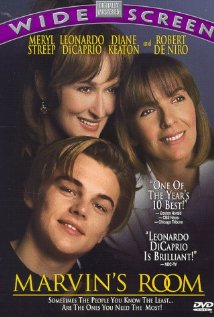
Marvin’s Room (1996), directed by Jerry Zaks

marvins-room-posterBoth of my parents died suddenly while they were still leading active lives. I never had to think about elder care or nursing homes. It was not until a friend of mine asked me to accompany him on a visit to some assisted-living and nursing home facilities that I began to understand the dilemma that families experience when they are facing the reality of caring for a loved one who cannot take care of himself. Children want to do the right thing, but decisions are often made not by considering what’s best but by what is affordable.

There is a scene in Marvin’s Room, a serious drama with lots of comic relief, which captures this dilemma. Two daughters, opposite in temperament, are visiting a senior care facility for their father who has been “dying for the past twenty years,” and who now needs full-time attention. One sister, Bessie, has been caring for Marvin, her father, for the past 17 years, even since he had his first stroke. The other sister, Lee, has been absent all those years, and even now does not want to make a personal sacrifice for her ailing father. She fears that her future will be compromised and states unequivocally: “In a few months, I’ll have my cosmetology degree. My life is just coming together; I’m not going to give it all up, now!”

What brings the sisters together after so many years in the sad news that Bessie has leukemia and may not be able to care for her father any longer. Bessie contacts Lee, who has two boys, and asks her to come with her kids so that they all can be tested as potential bone marrow donors. They may be able to save her life; and as a consequence, Bessie can continue to care for their father. If Bessie passes, the responsibility will fall to Lee. That possible scenario is the catalyst for their visit to the elder care facility.

Complicating factors is Lee’s oldest son, Hank, who has been in a mental institution after deliberately burning down their house in a act of rebellion against his mother whom he hates and who he feels was the cause of the split between his parents. Hank idealizes an absentee and abusive father who he barely knew and his mother feels the brunt of this anger. Family dysfunction abounds.

Marvin’s Room gives us a window into the world of families faced with awesome decisions. It exposes the raw nerves of a family, both challenged and confused by an inevitable future. The film depicts two points of view, one very dark and one optimistic, suggesting that confronting the mortality of a loved one can be a stimulus for reinventing one’s life and reordering life’s priorities. In fact, Lee and Hank finally undergo an epiphany in which they understand that living fully means giving to others, not just being concerned about one’s own needs.

The Talmud tells us that it is better to visit the house of mourning than the house of feasting because the lessons learned there are so profound and so meaningful for purposeful living. Moreover, the Bible exalts the commandment of honoring parents, which is defined in books of Jewish law as providing for the needs of parents, especially when they get older and cannot take care of themselves. This includes feeding them, clothing them, escorting them, and respecting them. Marvin’s Room provides a textbook case of varied responses to a life problem facing many, and in its own idiosyncratic way recommends that love trumps all. Family endures when children and parents care for one another.

Purchase this movie from Amazon.com.

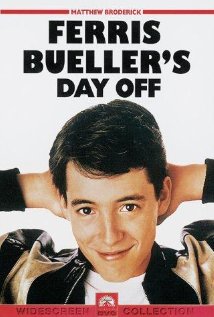
Ferris Beuller’s Day Off (1986), directed by John Hughes

I remember the meeting well. A teacher discovered a student who had plagiarized a paper and gave him a failing grade. The father of the student demanded a meeting with me, the teacher, and his son. He opened the meeting with a line I will never forget: “My son never lies.” The teacher, a woman with a sterling reputation for excellent teaching, exemplary character, and an abiding concern for the welfare of her pupils, was stunned by the implicit assertion that she either had lied in making the accusation or made a terrible mistake in evaluating the student’s work.

Having worked with students for many decades, I, like most teachers, always assume the best of students. But when confronted with incontrovertible evidence of cheating, I accept the reality that students, even good ones, occasionally may do dishonest things. The teacher in question broke down in tears from the baseless accusation. I, of course, defended and supported her. Several months later, the father apologetically confided in me that his relationship with his son was very rocky, and he felt a need at our meeting to be publically supportive of his son even if he had doubts about the veracity of his statements.

This kind of misguided, naïve parenting is at the heart of Ferris Beuller’s Day Off, a comic but true perspective on teenage life in the 80s that still resonates today. The plot, such as there is one, revolves around high school senior Ferris, who decides to cut school on a beautiful spring day and enjoy the day in downtown Chicago. He enlists his girlfriend Sloane and his buddy Cameron to join him on his self-declared vacation day.

The day begins with a lie as Ferris fakes an illness to his fawning and naïve parents, who believe everything he says. It is clear that they are preoccupied with their own lives; parenting to them is a diversion, not a mission. Cameron’s dad is never seen in the film. We only see his polished Ferrari, glistening in the family’s hillside garage. It is an emblem of parental neglect and a reminder of his parents’ total preoccupation with material things. In fact, almost all the adults in the movie are out of touch with children. Whether it be parents, teachers, administrators, all are self-absorbed and only peripherally aware of the children with whom they interact.

Two insights emerge from Ferris. First, parents need to be present in the lives of their children. They need to spend quality time with them and not be so preoccupied with business that they are clueless about what makes their child tick. Second, Ferris’s visit with his friends to the Chicago Art Museum suggests that kids need more than mastery of rote knowledge to succeed as human beings. Ferris, Sloane, and Cameron engage the modern art they view with creativity and wonder. The classroom is boring, but the museum, which houses a major collection of abstract art, unleashes a creativity that speaks to their curious and active teenage minds.

Proverbs tells us “to educate a child according to his personality.” This means that it is the job of parents to know their children well and to provide opportunities for them to develop their own unique talents. The patriarch Isaac, according to some Biblical commentators, erred in educating his children Jacob and Esau with the same parenting tool box. He failed to recognize that each one required a different parenting approach, one that recognized their different personalities and intellectual and spiritual inclinations. It may be easy to do more of the same when it comes to parenting, but it may be wiser to do something different that takes into account the way each child learns.

Purchase this movie from Amazon.com.

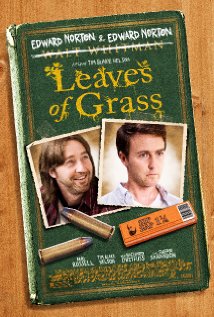
Leaves of Grass (2010), directed by Tim Blake Nelson

There was a time when “college dropout” was a pejorative term, but no more. Think Bill Gates or Steve Jobs. But as a teenager in the 50s, conventional wisdom was that getting a college degree was a prerequisite for success in life. Now many years later, I have a different perspective. While there is much to say about the positives of college, there are also negatives. I understand that it is a potentially corrupting environment, that it is filled with its own intellectual biases, and that the possession of a college degree does not guarantee success in life.

All this floated through my mind as I watched Leaves of Grass, the story of two twin brothers, one a Classics professor at Brown University, the other the grower of high grade marijuana in an elaborate and sophisticated hydroponics warehouse. Two bright children, same parents, yet radically different approaches to life. Consider Jacob and Esau in broad brushstrokes.

In the opening scene, Bill Kincaid is lecturing about the perfect world of the Greek philosophers, but he concludes by noting that, in spite of their desire for perfection, they and we still live in an imperfect world. All the brains in the world do not necessarily create a happy or moral universe. The Talmud echoes this when it states that the good deed is superior to the study of holy text. Good actions supersede intellectual accomplishments.

The plot thickens when Brady Kincaid tricks his twin brother into returning to their hometown. His motive: to use him as his double to create an airtight alibi for his own nefarious plans. Complications ensue, and the unpredictability of life asserts itself in a series of surprising, improbable, and violent  events, which on a deeper level reflect the dissonance between the academic world of theory and the real world in which we live.

To underscore this tension between theory and reality, Brady describes his view of God to his friend Bolger. He explains that man and God operate on two parallel lines, always following one another but never intersecting. In the end, man’s quest for God is neither linear nor necessarily satisfying.

This conflict is highlighted when Bill meets Janet, a poet and high school English teacher. Enamored with her, he shares his approach to life, which is grounded in the academic virtues of study, order, and reason. She confides to Bill that she entertained the possibility of teaching college students but found them too close-minded, just the opposite of what our own conventional wisdom would say, and contrary to Bill’s perception of college students. For Bill, this is a cathartic insight as he tries to navigate both his and Brady’s world.

These philosophical understandings are mirrored in the Ethics of the Fathers, a revered piece of Jewish wisdom literature, which says that it is not in the power of man to understand the inscrutable universe, to explain, for example, the peace of the wicked or the suffering of the righteous. Finite man cannot comprehend the infinite God. All he can do is to follow the parallel line of God, as it were, and do one’s best in an imperfect universe.

This philosophical reconciliation with man’s imperfection is signaled by the closing image of Bill and Janet, relaxing on beach chairs and holding hands in the rain. Rain which frightened him as a child now is both calming and restorative. Bill now experientially knows that life does not always provide answers, and that our human task is to persevere in the face of ambiguity.

Purchase this movie from Amazon.com.

Men in Black (1997), directed by Barry Sonnenfeld

It took me 12 years to get my doctorate in English at Georgia State University. Usually, it’s a five-year gig including the dissertation. For me it took longer because I was married with kids, had a full-time job, and could not devote all my time to this important professional goal. I owe a great debt of gratitude to Dr. William Sessions, my academic advisor, who believed in me and encouraged me to persevere even when I had doubts. Dr. Sessions recognized that family came first, and he knew that I could finish the degree if I had more time to complete the program.

My friend Charlie pursued a different career path. He wanted to become a university professor, and he postponed getting married until after he finished his PhD. He then postponed marriage again because he wanted to be financially secure and employed on a tenure track. He was then in his 30s. I spoke to him off and on during this time, reminding him of the Talmudic statement that at the end of 120 years, God will ask him whether he married and tried to have kids. I also reminded him that life in one’s advanced years can be very lonely without a wife. Furthermore, he will never be called Abba/Dad, which to me is my most important title. In spite of my comments, Charlie continued his exciting academic life, publishing book after book and occasionally getting into the media as well. He never did marry.

I thought of Charlie as I watched the crazy and wild Men in Black, a comedy about two men, Kay and Jay, working for a secret government agency who track alien life forms living on earth, and who embark on a mission to save the world from being destroyed by aliens. Their life is extraordinary and exciting. Every day is unpredictable. They meet creatures from other planets, they drive cars that are fast and fitted with the latest technological innovations, they have powerful weapons, and they can control the memories of others. In fact, they even periodically use the memory “neutralizer” to erase their own memories so that early frightening memories will not hinder them in their present assignments.

The catch is that their work requires them to give up their identity and their connections with friends and family. This is hard, for there are moments when one thinks of a wife, a time when one yearns for the human connection. From the aspect of eternity, family does come first. There is a touching moment when Kay reflects about the wife he left behind as he views her image on a monitor. When Jay comments that she is pretty, Kay clears the screen, but the image of his wife lingers in his mind.

After successfully avoiding the destruction of earth, Kay wants to transfer the mantle of leadership to Jay. Kay profoundly misses his wife and desires to go home. The pull of love is stronger than the adrenaline rush for action. He is older now and can appreciate the wisdom of Solomon who tells us “there is neither doing or reckoning nor knowledge or wisdom in the grave where you are going (Ecclesiastes 9:10).” The value of life is not measured in professional accomplishments alone, but rather in the human relationships that are nurtured over the years.

It is wise for us to treasure family over our job. At the end of our lives, we will not feel bad because we didn’t spend more time at the office. We will feel sad if we did not maximize our time with wife and children.

Purchase this move from Amazon.com.

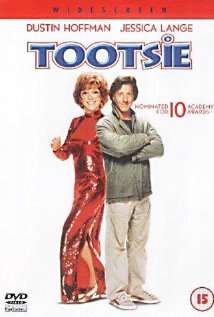
Tootsie (1982), directed by Sydney Pollack

I grew up in a home where my father had a great deal of respect for my mother. I never heard them argue although I am sure they had disagreements from time to time. My father appreciated the fact that my mother worked and helped out financially, but he always saw himself as the primary wage earner and never pushed my mother to enter the workplace. He not only loved her; he revered her. Furthermore, a hallmark of my home was the total absence of crude language. There was a certain sense of propriety that governed family behavior. All these things contributed towards my own attitude towards women as I grew up. I always took women seriously; and even when I was in ninth grade, I dated a girl thinking that she would be my wife one day. I never thought of women in a casual or demeaning way and didn’t fully realize that others did until many years later.

A cavalier attitude towards women is the subtext of Tootsie, a hilarious look at what happens when an out-of-work actor, Michael Dorsey played by Dustin Hoffman, assumes the role of a woman on a daytime soap opera. Callous towards women himself, Michael, for the first time in his life, observes how women are often treated in the workplace. The director calls him Tootsie instead of Dorothy and treats him as a cipher with no intellect, always presuming to know what’s best for her and the show. Moreover, the director treats other female cast members as familiar sex objects, not as independent people with brains and sensitivities. This discovery begins to affect Michael so much that his fictional counterpart, Dorothy Michaels, becomes a champion of women’s rights on the show. She is an assertive hospital administrator who will take no offense from any man. Dorothy veers from the script to be true to herself as a woman and the public idolizes her for it. She appears on magazine covers and becomes the talk of New York. In true comedic fashion, complications ensue when Dorothy’s contract is extended and when Dorothy/Michael falls in love with one of the actresses on the show.

Eventually, there is a day of reckoning and Michael’s hoax is revealed. In the last scene of the film, he confesses to Julie, his love, that he has become a better man by being a woman. Seeing things from the other side of the table has made him a more sensitive human being, better able to empathize and understand the perspective of a woman on love and life. This sensibility is hinted at in the Hebrew term for intimacy which is Yadah, to know. The Bible says that Adam knew Eve. He knew her intimately, say the Bible commentators, not only in a sexual sense but in an emotional sense. He understood her as a person and therefore the intimacy expressed a profound knowledge and understanding of the other. Sex was not exploitative but rather an expression of two souls comprehending one another in the deepest way possible.

Tootsie reaffirms the notion that for there to be true love, there must first be respect for the other. Romeo and Juliet are not the Jewish paradigms of love. Rather the paradigms are the patriarchs and matriarchs: Abraham and Sarah, Isaac and Rebecca, Jacob and Leah and Rachel. In all of these matches, what counts is character, not appearances. Proverbs tells us that outward beauty is false; what really counts is inner beauty, beauty of character and beauty of soul. It is this that enables relationships to blossom and endure, and this finally is what enables love to take root in Tootsie.

Purchase this movie from Amazon.com.