Category Archives: Documentary

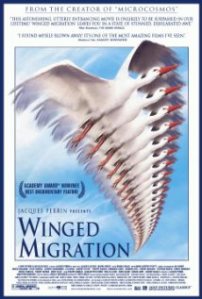
Winged Migration (2001), directed by Jacques Perrin, Jacques Cluzaud, and Michel Debats

winged-migration-posterThere was a time when my vacation trips would be spent traveling to historical points of interest, exploring museums and art galleries, and learning everything I could about the place I was visiting. In recent years, my downtime is spent differently. I no longer feel motivated to learn facts about specific tourist sites. I just want to travel to new locales and observe. I want to see natural landscapes and soak up the ambiance of the place. I do not want information. I want to feel connected to the universe. I want to see and hear the quiet energy that lies beneath the surface of everyday life. It is a different kind of experience and that is why I enjoyed Winged Migration, an unusual documentary about the yearly migration of birds.

This film tracks a number of species of migratory birds over a span of four years. Some travel over a thousand miles to find food each year; and then when food runs out at their destination, they return the same distance to their point of origin to find nourishment. They miraculously always fly the same route using the stars and familiar landmarks on land, in the sea, and in the sky to locate food sources and to get back home. Familiarity helps them to survive just as it helps us navigate difficult moments in life. In moments of crisis, we can return to our old routines and derive some stability in a stressful environment or situation.

Using in-flight cameras, the bulk of footage in the film consists of birds flying in the air. You can hear the air move under their wings and you have the sensation that you are flying alongside the birds. You are with them in the cold snow of the Arctic regions, you are with them when they escape a powerful avalanche, and you are with them in the bloom of summer with trees and flowers all around. The terrain, seen from the perspective of the birds, is breathtaking. The film truly is a visual work of art.

There is almost no narration in the film. There are just scenes of different species of birds traveling thousands of miles, crossing continents and oceans in search of food. There is no conventional plot. Instead, there are extraordinary images of birds desperately flapping their wings flying from one country to another. The key theme unifying all these migrations is survival. The birds cannot survive if they stay where they are. Movement is critical for survival.

The dominant visual in Winged Migration is a bird desperately flapping its wings to stay airborne on its long journey. For me, it was a metaphor of the human journey through life. All of us want to survive and thrive in life in spite of the adversities and challenges we all face. Like the bird, we have to keep moving and not allow challenges and occasional failures to cripple us.

The Biblical metaphor which captures this Jewish approach to confronting life’s challenges is the ramp upon which the priest walks when he approaches the altar to offer sacrifices. The priest does not climb steps. Rather he traverses a ramp, which has no natural place to stop or rest. The message to the priest, and for all men since the priest represents all of us, is to constantly strive, not to give up in the face of adversity. The Sages of the Talmud suggest that a successful life requires constant forward progress, constant movement and activity. The birds in Winged Migration teach us this valuable lesson.
Purchase this movie from Amazon.com.

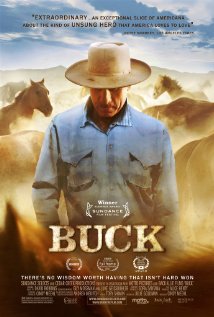
Buck (2011), directed by Cindy Meehl

When I was about ten years old, my father surprised me by taking me to a veterinarian’s office to pick up a dog. It was a “mutt,” a mixed breed, part collie and part something else. The visit was one of my “wow” moments growing up. I named the dog Shep, and we became fast friends. He would sleep at the foot of my bed, chew at the bedpost, and wake me up every morning with a happy look. My father taught the dog to go the newsstand a block away and to bring home the paper in its mouth. I thought that was really cool. When my day did not go well, Shep was always there to cheer me up. He was my dependable friend. But, like many kids, I was not diligent about walking the dog and taking care of all the stuff that goes with caring for a pet. Eventually my mother gave the dog away, and I spent that fateful day crying over my lost Shep.

The whole experience, in retrospect, gave me an appreciation for the value of pets in people’s lives. The presence of a pet, in a sense, is therapeutic for the owner. He is a reliable friend, never critical of you, lacking artifice, and always anxious to please.

These human qualities of animals form the subtext for Buck, an arresting documentary about Buck Brannaman, a horse whisperer with an uncanny ability to understand and train, not “break,” wild horses. As we watch him work with horses, he reveals how close his work is to child-rearing. The same principles are operative. Be gentle, be kind, be a good listener, show tough love when you have to, and don’t scare them. Interestingly, he describes the act of placing a saddle on a horse as a potentially frightening experience for the horse, which may see it as a lion attack. Therefore, the issue of trust between horse and rider is critical for training progress to be made. The same holds true in parenting children. The more trust between parent and child, the more communication and the more effective is the parental guidance.

It is noteworthy that the most prestigious Biblical figures who serve as role models for posterity began their careers as shepherds, people who care for animals. Their job of caring for sheep made them more adept at caring for human beings. Moses, Abraham, Jacob, King David—all had shepherd on their resumes. Similarly, Rebecca, one of the matriarchs of the Jewish people was selected as a wife for Isaac because of her kindness to animals. When Abraham’s servant asked for water, Rebecca brought water not only for him but for his camels as well. This was the litmus test of her character and Rebecca passed with flying colors.

In the Bible, God tells the Jewish people not to muzzle the ox when it is doing work in the field. Moreover, if we see an animal laboring under a heavy load, we are required to relieve the animal of its burden; and when we finish our day’s work, we should first feed our animal before we sit down to eat. Furthermore, if we come across a mother bird and want to take its eggs, we must first chase away the mother bird so that it does not suffer any psychological distress. All these sensitivities apply to the human realm as well. We permit workers to eat from the crops they are harvesting. We assist people who are struggling to support a heavy load, and we avoid causing psychological pain.

Buck reminds us of the many life lessons we can learn by being attuned to the needs of animals. Understanding their needs and their fears can make us more sensitive human beings.

Purchase this movie from Amazon.com.

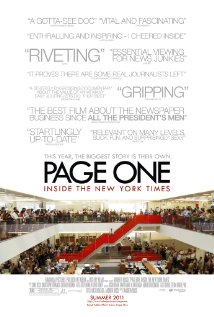
Page One: Inside the New York Times (2011), directed by Andrew Rossi

Two friends of mine do not use email. One is a synagogue rabbi and one is a school principal. Both are in the twilight of their careers and they see no need to update their familiarity with new modes of communication. If people want to contact them, there is always the telephone. To be sure, they are not philosophically opposed to progress; they just don’t feel at ease with the computer or the Blackberry and are reluctant to make the leap into today’s world of technology. I never had that aversion to technology. My late wife was a math teacher at my school and she introduced computer literacy into the curriculum many years ago. She and my kids kept me abreast of the latest technological advances and I was able to use them throughout my career, enabling me to communicate with people efficiently and quickly. The more techie stuff I used, the more productive I became. Years ago, I had a secretary who wrote drafts of my letters; now, without a secretary, I could do my own correspondence with Microsoft Word and respond to my constituency faster than ever before.

This perspective gave me an appreciation for Page One: Inside the New York Times, an engaging documentary giving an insider’s view of the state of print journalism today. The key factoid is that the advertising revenue that was central to a newspaper’s success is no longer present. Newspaper classifieds have given way to Monster.com and CraigsList and a myriad of internet alternatives to get out the word about a business, a job, or any new initiative. This leaves the paper in crisis mode, trying to survive in the face of decreasing revenues. There are scenes of layoffs, of columnists trying to learn new skills, and of media people justifying the uniqueness of what the New York Times does on the total informational landscape.

What emerges are intimate portraits of talented, mostly older, people coming to grips with radical change in their industry. It is a cliché that change is the only constant in life, and that is clearly what happens in Page One. The question is how we deal with unavoidable change. Does it crush us or does it create new opportunities for us?

A passage in the Talmud is instructive: “Who is a wise man? He who sees a future development.” Similarly, Ecclesiastes writes “the wise man has eyes in his head.” The Sages say that this means that at the beginning of something, the wise man foresees what will be in the end. This approach does not relate only to one’s career but to life itself. For successful living, we must be open to change and look beyond the immediate consequences of our actions.

David Carr, a New York Times journalist, is the film’s main character. His own history dramatically illustrates the ability to change. At a critical point in his life, he realizes that to see a different ending to his life, there must be a new beginning. Although the film does not deal with his past, Carr mentions that he was a single parent and former crack addict who left his wasteful life behind and reinvented himself as a reporter. No longer afraid of new challenges, he possesses the sobriety and wisdom to deal with failure. He understands that he has to change in order to survive and prosper. Indeed, the film shows him learning to navigate the latest social media craze “Twitter” with the goal of becoming adept at gleaning news and information from this public forum.

Watching Page One may help us get to page two of our own lives.

Purchase this movie from Amazon.com.

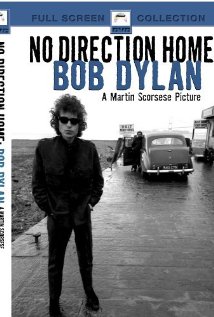
No Direction Home: Bob Dylan (2005), directed by Martin Scorsese

A few years ago, I was visiting my daughter in Lakewood, New Jersey, home of the renowned Lakewood Yeshiva, when I noticed a peculiar item in the local newspaper. Bob Dylan, scheduled to appear at a baseball stadium in Lakewood as part of a tour with Willie Nelson and John Mellencamp, was accosted by a 24-year old policeman who arrested him for vagrancy. It seems that a resident had called the police and stated that a man was wandering around a low-income neighborhood looking at houses. When asked for his identification, he said “Bob Dylan,” but the police officer at the scene did not recognize the name. Dylan was apparently walking around looking at houses passing away the time before that evening’s show. The officers then asked Dylan, 68, to return with them to the hotel where the performers were staying, and there the tour staff vouched for him.

As a teenager, I grew up in the shadow of the great Elvis Presley, so Bob Dylan was never one of my musical icons. But as I grew older and my musical tastes became more eclectic, I began to pay attention to his music, especially his early material, which is why I was drawn to No Direction Home: Bob Dylan, a fascinating documentary about Dylan’s genesis as a musical icon in America. As I watched the narrative develop with early footage of his career interspersed with a present-day interview, I made several observations. Dylan was a very curious and bright young man, totally disconnected from his home town mid-western environment. It was when he came to New York City that he flowered musically, for here he met other poetic and musical originals who shared his quest for artistic growth. He was awed by their talent and integrity. Over time, however, he truly saw himself as a “one-of-a-kind” artist, who didn’t need to answer to anyone. Other people’s opinions did not matter to him. What was important was to be honest with himself. He confesses that his early lyrics made him a hero to the civil rights and anti-war movement, but these political movements did not drive his art. His art was driven by his musical instincts. In fact, the movie includes footage of him being booed by the audience for performing electric rather than acoustic material. But he didn’t care what the audience thought. He listened to the sound of his own drummer. Moreover, he finds it absurd that celebrities are even asked their political opinions since they know nothing about such matters. For him, silence makes more sense than dangling political conversations that go nowhere.

Which brings me to a Torah perspective that is embedded in this movie. Our Sages tell us that one of the pillars upon which the world is based is emet, truth or honesty. Whether one agrees with Dylan or not, one certainly will admit that this film portrays him as an honest person in an industry full of pomposity and posturing. Moreover, his story reminds us that fame is illusive the more one pursues it. Dylan did not pursue fame in a conscious way; he pursued music and its varied expressions and fame came to him. This is what our Sages clearly tell us in the Ethics of the Fathers: “he who seeks fame loses it (Avot 1:13).The implicit message is to focus on being the best you can be and rewards will eventually come.

As I reflected on the movie, I began to appreciate more and more Dylan’s musical genius and his uncompromising integrity. At the end of the day, I understand why the police officer probably did not recognize him. The policeman was born many years after Dylan dominated the musical landscape and Dylan himself did nothing to promote his artistry other than write and sing songs. He did not rely on a publicist; rather it was his music that spoke for him.  In this sense, we can learn from this musical master. Perhaps if we are true to ourselves and do not look for recognition, we can make our best contribution to the world and notoriety will come to us. Furthermore, by rejoicing in our own uniqueness, we can celebrate the special gifts of others who collectively enrich the artistic environment.


Purchase this movie from Amazon.com.