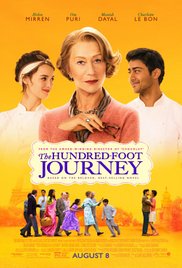
 Some people are passionate about food; others eat simply to be nourished, lacking interest in food preparation and presentation. I remember watching one of my Torah teachers eating a piece of gefilte fish almost every day for lunch in the Yeshiva. He ate at his desk in the study hall and did not want to waste a moment in walking to a nearby restaurant.
I also vividly recall spending a Friday night meal with the two heads of the Yeshiva I attended in ninth grade. I accompanied them on a fund-raising outing to the Five Towns where they attempted to storm local pulpits and appeal for money to sustain the Yeshiva in difficult financial times. On Friday night, our main course consisted of hard-boiled eggs, but that did not dampen the rabbis’ enthusiasm for the holy Sabbath. They sang sacred melodies until the wee hours of the morning. In contrast, in The Hundred-Foot Journey, money does not limit the ability of people to eat fine food, and all the characters are students and worshippers at the shrine of good cuisine.
Because of political turmoil and danger to life in Mumbai, India, Hassan Kadam and his family move to France where they hope to open a restaurant similar to one they owned in Mumbai. When their van breaks down, they are forced to rely on the kindness of strangers and one kind stranger does appear. She is Marguerite, a young woman who volunteers to take them to a local car mechanic and who also serves them platters of scrumptious and attractive food. The Kadam family is impressed both with her generosity and with her cooking.
While waiting for the repair, Papa Kadam wanders around the town and discovers an abandoned restaurant for sale. He sees the purchase of the restaurant as somehow divinely ordained, a message from his deceased wife that his car did not break down in this village for no reason, but rather to enable him to find a suitable location for his restaurant. Against family objections, he buys the property and the family works diligently to transform the decrepit property into Maison Mumbai, a food emporium specializing in Indian cuisine.
All is not fine, however, when Madame Malory, the owner of a award-winning restaurant across the street, about 100 feet away, sees Maison Mumbai as a serious competitor encroaching on her business. Meanwhile, Hassan, a gifted chef, strikes up a friendship with Marguerite who he discovers is the sous chef at the competing restaurant. She shares with him her passion and love for cooking food.
War breaks out between Papa Kadam and Madame Malory when Madame Malory asks to see the menu of Maison Mumbai, and then proceeds to go the market and purchase all the ingredients that Papa needs to cook his food. Papa retaliates by doing the same thing to Madame Malory, and so the hostilities continue.
Tempers boil until someone torches Maison Mumbai. Then Madame Malory, feeling guilty for encouraging a negative attitude towards her competitor, tries to expiate her sin by helping to fix the damaged restaurant. Papa and Madame become friends and Hassan becomes the bridge of their reconciliation.
Clearly recognizing Hassan’s amazing talents as a chef, they both encourage him to go to Paris where he will fine tune and broaden his cooking repertoire in the world-class restaurants of the city. Hassan, however, is conflicted during his sojourn in Paris. Does he truly want to be in the rarefied ambiance of one of the great culinary cities of the world, or does he want to be with Marguerite in his adopted hometown in rural France? Wherein lies his destiny?
Food preparation and presentation is at the heart of The Hundred-Foot Journey, but the film suggests that there are more important things that motivate people. It is good to appreciate passionately the sundry varieties of food that God has given us, but it is more important to passionately value our human connections, which endure beyond mealtime.
For the Jew, the Sabbath is the day that celebrates the enjoyment of food. The Sabbath table is supposed to be beautiful and enjoyable because it marks the Sabbath as a day different from the rest of the week. During the week, the emphasis is on the nourishment value of food. The Jerusalem Talmud states: “The world can live without wine, but it cannot live without water; the world can live without peppers, but it cannot live without salt.” The comment is a reminder of the value of simple fare that enables us to live. We should eat to live and not live to eat.
 There is a brief scene in Beyond the Sea, a biopic of singer Bobby Darin, which resonates with me personally. Bobby unbuttons his shirt and reveals his scar from open-heart surgery. It looks like a long zipper on his chest. I, too, have had open-heart surgery and remember other patients telling me I am now a member of the “zipper club,” all of whose members brandish an extended scar on their chest.
 My review of The Godfather trilogy requires some preliminary discussion. Why have I chosen to consider all three films in one review and why is it a “kosher” movie in spite of the fact that there is much violence and profanity in the film?
 As I write this review, the country is in a fierce debate as to whether the United States should accept Syrian refugees from that war-ravaged country. Coming after a devastating attack on innocent civilians by Islamic extremists in Paris, many in this country are wary of accepting Muslims without serious background checks. I witnessed similar anti-Muslim sentiment after 9/11, when Islamic extremists brought down the World Trade Center towers. I have no opinions about this matter other than to accept the reality that the resolution to this problem is complicated and probably will involve a balance of kindness and caution. We want to help people in dire straits; but we also have to be prudent and not put our own citizens at risk.
 One of my favorite poems is “The Convergence of the Twain” by Thomas Hardy. The poem describes two events occurring at the same time but at different locations. At some future time, the events converge. One is the building of the ship, the Titanic; the other is the forming of the iceberg with which the ship will collide. Hardy writes: “Alien they seemed to be/ No mortal eye could see/ The intimate welding of their later history/ Till the Spinner of the Years/ Said ‘Now!’/And each one hears/ And consummations comes, and jars two hemispheres.”
 My parents were people of modest means. Moreover, they always considered the needs of their children before their own. I never felt deprived as a child even though I lived in a low-income neighborhood and did not go on fancy vacations to Disneyworld. Life was joyous because my parents, by example, found joy in the everyday, in spending time with their children, in working as volunteers on behalf of the local synagogue, and in regularly visiting our extended family and friends. I do not recall ever envying other kids because I was satisfied with my lot in life. I remember that my favorite Bar Mitzvah gift was a simple basketball given to me by my friends Kenny and Marilyn Beeman.
 In the late 1970s, I taught a class on the Holocaust to teenagers at Yeshiva High School of Atlanta. A high point of the course was an interview with a survivor of the camps. There were many living in Atlanta, but it was not easy to find people willing to talk about their terrible experiences in the concentration camps. For them it was too painful to resurrect those memories.
 When I was in high school, I had a part-time job at a local pharmacy, working the evening shift from 4 PM until 11:30 and all day Sunday. It was the only store open on Sunday during the late 1950s, before the days of 24/7, or 24/6 in Israel.
 When I was a freshman at Yeshiva University, I thought I would try out for the basketball and wrestling teams. In high school I had never played on a school team, but I enjoyed the competition of organized sports. A freshman who befriended me was Bobby Podhurst, the tallest fellow I had ever known and I went with him to a practice one evening to see if my skill level in B-ball was up to college standards.
 In the Bible and Talmud, there are descriptions of people who respond admirably to adversity. In spite of whatever happens, they do not give up; rather they find a way to continue to be optimistic and productive, no matter what the obstacle.
 Kosher Movies