Category Archives: Drama

Chef (2014), directed by Jon Favreau

chef posterFor the past several years, I have been trying to secure an agent to publish a book of mine. One of the critical questions that agents ask me is what is my social media platform. In other words, agents justifiably want to know the chances of your book making money. The larger the social network, the larger your presence in social media, the greater chance exists that more books can be sold. The question prompted me to join Facebook, LinkedIn, and other Internet social media sites. I even thought about Twitter, but could not wrap my head around how it worked and what its benefits were. Watching Chef made me more acutely aware of the power and pitfalls of social media in the marketplace.

Carl Casper is head chef of a posh restaurant in Los Angeles. One night, the famous restaurant blogger, Ramsey Michael, is planning to visit his restaurant. Carl intends to boggle the mind and palette of the food critic with an innovative menu, but Carl’s boss Riva insists that Carl follow the traditional menu. Carl acquiesces, but the review is cruel and insulting personally to Carl. In anger, Carl challenges Ramsey to visit the restaurant again, using Twitter to send his message. Not realizing that his remarks are public, he creates huge publicity, which mostly works negatively for him. Compounding the problem is Carl’s public meltdown, which is captured on video and goes viral, in which he openly berates Ramsey for his impersonal attitude towards all people who work hard for a living. Professionally, Carl loses all credibility and is fired from his job.

Without a new job in sight, he decides to obtain an old food truck at his ex-wife Inez’s suggestion, and journeys to Miami where he becomes enthralled with Cuban cuisine. His son, Percy, who longs for his father’s attention, asks his father if he can help him restore the truck to its previous shiny condition and Carl accepts his help. The experience unites father and son, providing a catalyst for a new and meaningful relationship between parent and child. Percy, who is savvy about social media, becomes the linchpin for driving Carl’s business to financial success because of his ability to use Twitter to generate new customers.

Proverbs tells us that death and life are in the power of the tongue. It is a statement that also can apply to expressing oneself on the Internet or through emails. Electronic messages become an extended form of your speech, and what you utter in those forms has a ripple effect many miles away.

I remember once when I forwarded a friend’s email to another person to save some time rather than transfer the information to a new email, the sender of the original email criticized me for sending it without realizing that the email contained a long series of prior emails that discussed a highly sensitive issue. It should have remained a private matter, but because of my thoughtlessness, the information was now in the public domain.

Chef is a movie with valuable lessons about the consequences of carelessly using social media. On the one hand, it is a useful tool to connect with others, especially in business. It is inexpensive, fast, direct, and personal. Carl’s food truck business soars when the word spreads quickly about how good his food tastes. On the other hand, spreading gossip or slandering another person through social media sites makes one violate the laws of evil speech in an exponential way. The damage, once done, is irreparable because so many people are involved. It is impossible to limit its negative effects. Chef reminds us to think before pressing the send key.

Purchase this movie from Amazon.com.

Splendor in the Grass (1961), directed by Elia Kazan

Splendor in the Grass posterI saw Splendor in the Grass in 1961 when I was 19 years old. I was in college taking a course in English Literature and we had just read Wordsworth’s “Ode to Intimations of Immortality” focusing on the classic lines which make up the title of the movie: “Though nothing can bring back the hour of splendor in the grass, glory in the flower, we will grieve not; rather find strength in what remains behind.” The lines penetrated my psyche, and I had one of those “aha” moments as I connected the words to my own experience. I was not in love with anybody at the time, but I still had memories of my ninth grade infatuation that ended badly when I was rejected by my then girlfriend for another boy. It was devastating and it took me a long time to recover my psychological equilibrium. I too had come to the realization that I could not recapture the past; all I could do was “to find strength in what remains behind,” and reconstruct myself emotionally.

Splendor in the Grass is a sad but very wise movie. Although it ends with a piece of senior wisdom, a lot of teenage angst is portrayed along the way in all its raw emotion. Bud Stamper, the high school jock, cannot have an honest conversation with his father who wants to make Bud in his image rather than allow Bud to discover who he is on his own. Deanie Loomis, his girlfriend whom he loves dearly, cannot have a conversation with her mother without her mother depositing a truckload of guilt behind. “What we’ve got here is a failure to communicate” is the famous tagline from the popular film Cool Hand Luke, but it fittingly describes the relationship between Bud Stamper and his father and Deanie Loomis and her mother. Parents talk at their children but do not see beyond their own perspective and interests.

The story begins in 1928 in Kansas. Deanie and Bud are in love, and as a teenager in love once myself, their love seems real, not deep but definitely real. Bud’s dad does not want Bud to marry right after high school. He wants him to attend Yale and then embark upon a career. He even encourages Bud to be promiscuous, naively thinking that Bud’s desire for love can be assuaged with a coarse physical relationship. Dad, in truth, has little understanding of true love as can be seen from his loveless relationship with his own wife.

Bud and Deanie feel a strong physical attraction, but Deanie wants to remain virginal, and Bud thinks of Deanie as a “good girl;” inwardly he does not want her to be like others who might compromise their innocence. All this leaves them passionately connected to one another but under enormous emotional stress. Eventually, they break up with catastrophic consequences.

Years later they meet. Both have moved on with their lives, but they recognize the specialness of what they once had. They know that their strong affinity for one another cannot be resurrected, but that does not diminish the possibility of each one having a happy life with someone else.

In Jewish matchmaking, there is the notion of one’s bashert, one’s destined one or soul mate. I have wondered what happens when you meet your destined one, but do not recognize her or you do recognize her but lack the will to move forward. Time passes and your destined one marries another. What are you left with? Many Sages think that the notion of bashert is not part and parcel of Jewish law and should be applied only metaphorically. Rabbi Josh Yuter, in a masterful article explaining the concept, opines that bashert applies to how you view your spouse after marriage. In other words, when married couples go through rough spots, they should view their spouse as their destined mates and resolve to solve their problems rather than escape from them. Alternatively, one can say that the bottom line is that you have to seek out someone who fits with you emotionally and intellectually as well as physically.

One cannot be fatalistic in Judaism and just wait for the right one to appear. Rather we should find the missing part of ourselves that Adam lost in Eden and build our lives using the best information we can obtain at the time. Splendor in the Grass reminds us to do our best at whatever stage of life we are. Let us find glory in the flower even in the autumn of our lives.

Purchase this movie from Amazon.com.

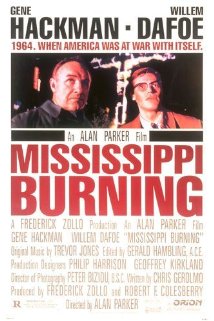
Mississippi Burning (1988), directed by Alan Parker

mississippi burning posterA recent newspaper reported that a prominent publisher of maps deleted Israel from maps sold to schools in some middle-eastern countries. Indirectly, schools who use the maps teach that Israel does not exist, and that Jews are usurpers of the land with no legitimate claims. It was another reminder that children can be educated to hate. Sadly, if you want to demonize Jews, there are unlimited ways to do this; the textbooks in many Arab schools and the Arab media promote a vision of the Jew that is easy to detest. I thought of this as I watched a scene in Mississippi Burning, a powerful film about racial tensions in the South, which focuses on the killing of three civil rights workers in the 1960s. In one scene, a Ku Klux Klan leader brands Negroes, Jews, and Catholics as un-American and as minorities who are destroying the fabric of American life and its morality as well. The camera pans on faces of adults and children who are listening attentively to his speech. They are innocent faces, but they are being taught to hate.

The story opens in 1964, when three civil rights workers are killed. At first it is a missing persons case, but the FBI sends two agents, Rupert Anderson, played by Gene Hackman, and Alan Ward, played by Willem Dafoe, to Jessup County, Mississippi, to investigate the details of their disappearance. The townspeople are reluctant to talk to them and getting the truth becomes difficult. A culture of hate is ingrained in the community. Moreover, the more the FBI invests its manpower and time to solve the mystery, the more dangerous life becomes for the community’s black residents.

Finally, the agents get information that leads them to the location of the bodies, and Anderson, using unorthodox methods, is able to ferret out who murdered them. The tense dynamic between Anderson, who is willing to break the law to get necessary information, and Ward, who wants to do things by the book, reveals the difficulty of ascertaining truth in a world where tradition trumps objective truth.

Judaism teaches that all men are created in God’s image and possess infinite value. Therefore, everyone deserves respect regardless of color or creed. It is noteworthy that in the Bible Jews are instructed not to hate the Egyptians, even though it was the Egyptians who enslaved them. The commentators point out that the Egyptians initially provided a place of refuge for the Jews during a time of severe famine. Moreover, it was the daughter of Pharaoh who saved Moses. The commandment not to hate the Egyptian essentially tells us not to carry past animosity with us. To be a free man, you have to let go of hate and not allow it to dominate who you are today.

It is instructive to note that when Miriam, Moses’s sister, criticized Moses for marrying a Cushite woman, a woman with dark skin, she was punished with leprosy. Furthermore, the Song of Songs, written by King Solomon, states “ I am black but beautiful.” A different color does not connote inferiority.

Mississippi Burning on one level is a superb crime thriller, in which we follow the dogged pursuit of the law towards apprehending the murderers of three innocent young men, whose only crime was to work for the civil rights and liberties of all Americans. On another level, it is a cautionary tale about what happens when people blindly accept narratives of hate about others and make them the operative principles for managing relationships with those who are different from them.

Purchase this movie from Amazon.com.

Begin Again (2013), directed by John Carney

begin again posterAt our Friday night dinners, we enjoy having guests. I am very busy during the week, and I rarely have time to engage people in conversation other than to give a quick hello and how are you. The Sabbath, however, is a day that moves slower than the rest. I disengage from my mundane activities and can think about life, about relationships, about getting to know people better.

On one recent Friday night when we invited a number of people I did not know well, I learned that one of our guests seriously considered becoming an actress. But she realized early on that such a career would be challenging for one who wanted to observe the Sabbath. Being an actress would raise other lifestyle issues as well. So many in the entertainment industry lead lives outside of conventional morality and the whole scene would be problematic for a person of serious religious faith. Therefore, she decided to stay away from a career in which her values might be compromised.

I thought of this as I watched Begin Again, the entertaining story of Gretta, a young singer/songwriter, who has a chance at stardom, but who, through the crucible of life experience, ultimately foresees the pitfalls of fame.

The story opens as Dan, a music producer who has fallen on hard times, discovers Gretta in a Greenwich Village bar singing one of her iconic songs. Dan is taken by her music and offers to sign her with his former record label. Though at first reluctant to work with him, Gretta decides to give it shot and see what happens. At first, nothing does happen, but then Dan gets the idea of recording Gretta’s album on the streets of New York. Dan, recruiting a number of talented musicians who are between jobs, is able to produce an album that might possibly be a huge success.

The entire experience of working together to produce the album bonds Dan with Gretta artistically and emotionally. Gretta takes an interest in Dan’s personal life, encouraging him to reconstruct his own life, which is in shambles. Divorced from his wife and disrespected by his teenage daughter, Violet, Dan is emotionally fragile and his friendship with Gretta gives him a new sense of purpose in life.

Gretta’s recent breakup with her unfaithful boyfriend Dave, also a singer/songwriter, has left her emotionally scarred. Gretta appreciates the honesty of Dan, who shares her love for music that is authentic and not crafted just to be commercial. To her and Dan, making music is not just about making money; it also about stirring the soul. In contrast, Dave is animated by the business of music. He puts great stock in the opinion of others and is quick to leave his principles behind. Gretta comes to understand this when she sees Dave performing before a packed house of female admirers who Gretta knows will satisfy Dave’s desire for fame and adulation.

Gretta wisely decides to assert her autonomy and chart her own course to success. For Gretta, music is her muse. Success means being able to share your creativity with the world. She will not compromise her principles, and so she allies herself with Dan who makes no demands on her and understands her need to preserve her artistic independence.

The Talmud instructs man to stay far away from a bad neighbor, someone who potentially can influence you to do bad things. The advice relates to choice of friends both on a personal level and in the marketplace. Gretta in Begin Again chooses to stay away from negative influences, from those people who value compromise over personal integrity.

Purchase this movie from Amazon.com.

On a Clear Day (2005), directed by Gaby Dellal

on a clear day posterAs a rabbi and as a father, the saddest funerals at which I have officiated or attended are those for a child. The loss of a child goes against expectation. Kids are supposed to survive parents and when a child dies, hope for the future dies as well. It is a profound loss and recovery is hard. I sense that when I talk to parents who have lost a child, they are still grieving inwardly. Life has gone on, but the pain lingers.

The loss of a child haunts Frank Redmond, the central character in On a Clear Day, an emotionally moving narrative of loss, acceptance, and reconciliation. When he loses his job as a veteran Glasgow shipbuilder after many years, he is adrift professionally and mentally. Freed from work that has occupied him for many years, his mind often wanders to the fateful day when his son drowned. Rob, his surviving son, does not fully grasp his father’s grief and disappointment and interprets his father’s withdrawal as an indication that his father in some way holds him accountable for his brother’s death. In truth, Frank holds himself responsible for the tragedy that took place while they all were swimming in the ocean. In spite of possessing a loving wife, a devoted son, and sweet grandchildren, dysfunction rules on the home front. His life is empty and devoid of meaning, leaving Frank depressed and inwardly angry at the world and at himself.

A casual conversation with friends gives Frank an idea that piques his curiosity and focuses his attention and energy; namely to swim across the English Channel. Already a serious recreational swimmer, he sees this swim as a goal that will give his life some purpose and boost his self-confidence, especially after being released from his shipbuilding job.

Enlisting the aid of friends, he trains arduously to prepare himself for the crossing. Without revealing his plans to his wife or son, he rents a boat and tests the waters literally and figuratively. Over the course of his secret training, he strains his relationship with his wife and falls into intense arguments with his son.

Frank, indeed, has problems: loss of job, loss of a child, loss of self-esteem. None of this is easy, but the approach of Jewish tradition to such challenges can be helpful. Lori Palatnik, a noted Jewish educator and self-help guru, wisely observes that her belief that God is in charge of the world gets her through almost anything. She writes: “It means that God is sending me this so that I can grow. It prevents me from blaming others, including myself. It frames a situation not as something overwhelming that is impossible to solve, but as a puzzle that can be worked out, and the process of working it out is where real growth takes place. Words are powerful; as soon as you reframe from ‘problem’ to ‘opportunity,’ you pull down the covers, get out of bed, pull up your boot straps and rise to the occasion. No one wants problems, but who doesn’t want opportunities?”

One of my Torah teachers once told me to see adversity in life as the back of a tapestry. The travails that we encounter are represented by the knots and clumps on the back of the tapestry. On the front, however, is a work of art, which is what is visible from the aspect of eternity. In God’s eyes, it all makes sense, but from our human perspective it is incomprehensible.

Frank, like all men, has no ultimate understanding of the tragedy in his life, but through supportive friends, he becomes more accepting of life’s twists and turns, and moves forward towards a family who has been yearning for his love and acceptance. On a Clear Day beckons us to accept the rain and focus on the clear day ahead.

Purchase this movie from Amazon.com.

Aliens (1986), directed by James Cameron

aliens posterWhen I was in ninth grade, I went to a Jewish day high school on the outskirts of Harlem. One evening, my friend Max and I went to a jazz concert featuring the celebrated xylophonist Terry Gibbs. Returning to the dorm late at night, we were accosted by a group of unsavory teenagers, one of whom was on roller skates. They wanted our money. One, in particular, threatened me with a brass ring that he provocatively thrust in my face. I was petrified, but my friend Max was not. Apparently he had been in similar situations before, and he suddenly grabbed hold of the fellow on roller skates and threw him to the ground. Then Max shouted, “run,” and we ran close to a four-minute mile back to our dorm. Max knew how to confront fear; I did not.

Aliens is all about confronting fear. Ripley, the only survivor of a space mission that discovered a hostile alien species, is serendipitously found after drifting in space in a hypersleep for 57 years. Because of her experience with the aliens, she is recruited to be an advisor on an expedition to find out why the colony that settled on the space station where the aliens were discovered has ceased transmitting to earth. At first, she refuses the request, but her continuous nightmares motivate her to join the mission with the goal of destroying the aliens. In this way, she hopes to find inner peace.

Her cohorts on the mission are a group of tough but arrogant Marines. They are so full of themselves and their weaponry that they do not pay much attention to Ripley’s warnings. Soon, however, they come in direct contact with the hostile aliens and a life and death battle with them rages. After a number of Marines, including the commanding officer, are killed or wounded, Ripley has to take charge of the spaceship and the mission. The situation continues to deteriorate as the Marines are confronted by an enemy vastly superior to them in strength and number. Furthermore, in the midst of all the fireworks, their transport back to the mother ship is damaged, leaving them with a limited supply of weapons and ammunition.

The situation is desperate and calls for innovative thinking. Some team members want to give up, but Ripley insists upon trying to survive in spite of the superior strength of the hostiles. She is fearful but she does not allow fear to paralyze her.

Judaism acknowledges the reality of fear in our lives. When the Jews were about to enter the holy land, they decided to send spies to check out the feasibility of conquering the land. Ten of the twelve spies saw not the good of the land, but rather the imposing giants who lived there. In comparison, they saw themselves as grasshoppers, ill-equipped to vanquish them. Attempting to battle them would only bring loss of life and disaster to the people as a whole.

However, two spies saw the same things but came to opposite conclusions. They also feared the giants living there, but they were imbued with a deep faith.

Judaism’s approach to life-threatening situations is not to ignore the reality of a danger, but rather to do one’s best to overcome the threat and to trust that God will be with you to carry you to victory. Facing the challenge, seeing it as an opportunity for growth, can transform fear into courage. Thus, the impending disaster can be changed into a divinely-ordained victory.

Aliens reminds us that in the midst of crisis are the harbingers of redemption and safety. Ripley, when confronted with almost certain death, overcomes her fear and finds a way to assert life over death to insure the survival of subsequent generations.

Purchase this movie from Amazon.com.

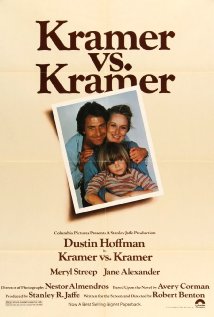
Kramer vs. Kramer (1979), directed by Robert Benton

kramer vs kramer posterOn occasion, as head of a community Jewish private school, I have been asked to sit in on the school’s scholarship committee meetings. Children of divorced parents often present complicated scenarios for the committee to ponder. For example, one parent may value Jewish day school education and the other may not. Moreover, a divorced mother may want her son enrolled in a Jewish day school not because of the education offered there, but because she wants her son to have role models. A father may think that the education at the day school is too parochial, not affording his child a wide range of course offerings. Such opposite points of view are not lost on the child, who may want to please both parents but feels inwardly conflicted.

Then there is the question of day school tuition. Who is responsible? Mom or Dad? And what if the mother has custody, but limited financial resources, and what if the father has little interest in Jewish education, but has the economic wherewithal to pay tuition?

While sensitive to the financial challenges the committee faces, my rabbinic training invariably compels me to see things from the child’s perspective. What is in his best interest? Divorce creates dysfunction within the family at many levels, and the child is riding an emotional roller coaster. Most important to me is focusing on creating a stable, predictable environment so that the child can grow academically and emotionally. As I watched Kramer vs. Kramer, a thoughtful film chronicling the disintegration of the marriage of Ted and Joanna Kramer, I recognized the epiphany to which the Kramers ultimately arrive.

Ted Kramer is a high-powered advertising executive who spends little time at home with his wife and child. So neglected is she that she decides to leave him and their son Billy as well. Suddenly, Ted is a Mr. Mom with full responsibility for Billy. This puts enormous strain on Ted who is in the middle of closing a major business deal.

Billy is a little boy that requires attention and, at first, father and son do not have an easy rapport, each one resenting the other. Ted, for the first time, has to learn to think about others, and not just be concerned about his clients. Over several months, they begin to relate positively with one another and love grows as they both begin to enjoy the other’s presence.

Fifteen months later, Joanna returns to New York to claim Billy in a custody hearing. What emerges from the proceedings are character assassinations of both parents, no longer in love, but who love Billy and want to do the best for him.

There is a story about King Solomon that is instructive. Two mothers come to him. They both had given birth but only one son survived. Each mother claimed the son was hers, so Solomon commanded that the baby be cut in two and each mother would receive half. One mother said this was fair; the other said let the other mother have the child rather than kill it. Solomon awarded custody of the child to the mother who did not want the child split fifty-fifty. What trumped everything was what was in the best interests of the child. Personal desires, personal egos, have to be left at the door lest the child be emotionally chopped to pieces.

Ted and Joanna Kramer start their custody battle as adversaries, but gradually understand that Billy needs the love and presence of both parents. The love for parents for one another may be conditional, but love for their children is not.

Purchase this movie from Amazon.com.

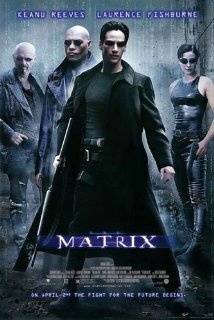
The Matrix (1999), directed by Andy and Lana Wachowski

MV5BMTkxNDYxOTA4M15BMl5BanBnXkFtZTgwNTk0NzQxMTE@._V1_SX214_AL_When I was an undergraduate student taking an introductory Philosophy course, I had an “aha” moment when I read Plato’s myth of the cave which describes a man living in a cave, thinking it is the real world until light streams in from above, at which time he realizes that what he has been experiencing is not the real world but an illusion. The real world is, in truth, somewhere else. It is this kind of subliminal narrative that forms the emotional and intellectual core of The Matrix, a thought-provoking, action-packed thriller about a human rebellion against a world controlled by machines.

Thomas Anderson, a computer programming guru, is also known as “Neo,” a computer hacker with an unsavory clientele for which he provides all sorts of illegal substances. One evening he is contacted by Trinity, another computer whiz, who apprises him of Morpheus, a mysterious man who can tell Neo the meaning of “the Matrix,” an entity that Neo frequently encounters online. Neo is interested in meeting him, but three robot-like men are determined not to have the meeting take place.

In spite of obstacles, and there are many, Neo and Morpheus meet, after which Neo’s life is forever changed. Offered a red pill by Morpheus, Neo takes it, and the pill enables him to see the world in a totally unconventional way. He embarks on a psychic journey, which convinces him to join Morpheus in his quest to overthrow the mechanical forces of conformity and rigidity that are presently controlling the world.

Morpheus tells Neo that in the 21st century, there was a war between human beings and the intelligent machines they created. Eventually the machines won and trapped the humans in an artificial world, the Matrix, in which humans exist in a simulated environment. This keeps them compliant slaves to materiality, without the freedom to question and to think on their own. Morpheus seeks to rebel against this universe of conformity by hacking into the Matrix and recruiting enslaved humans to rebel against the machines.

The rebels’ profound understanding of the artificial reality of the Matrix allows them the bend the laws of the physical world, giving them superhuman powers that are choreographed with visceral energy on the screen. We learn that Neo is recruited specifically because Morpheus sees him as “the One” to save the world from the corrupt machines, and he is trained to do battle with their human-like representations. The movie’s dense plot almost requires a second viewing in order to comprehend the complexity of the conflict between the men and the machines.

The essential question that the film poses is what is the nature of reality. Plato’s cave metaphor suggests we are living in a world of illusion and we have to exit the cave if we are to live a full and honest life. The matrix represents this world of illusion, and the rebels want to live a real, not artificial, life.

Jewish tradition encourages us to dream, to have illusions, but we must have our feet firmly planted in the real world. The patriarch Jacob dreamt of a ladder reaching to the heavens, but the ladder was rooted in the earth. Moreover, our Sages encourage us to contemplate other planes of existence, such as the heavenly World-to Come, which gives us spiritual pleasure. Nonetheless, they remind us that it is in this world, the nitty-gritty everyday world, the world that the rebels want to revive, that we express our humanity through the crucible of real life experiences. It is here that we truly accomplish our life’s mission and fulfill our personal destinies.

Free choice makes us human and reflects the divinity within us. The Matrix suggests that for humans to fulfill their potential as human beings, they must be able to freely choose life over death, light over darkness.

Purchase this movie from Amazon.com.

A Simple Life (2011), directed by Ann Hui

MV5BMTQ1NDI2OTU5N15BMl5BanBnXkFtZTcwOTAyNzcwOQ@@._V1_SY317_CR2,0,214,317_AL_Almost twenty years ago, a friend of mine who had just gone through a painful divorce visited me in Atlanta. We spent the Sabbath together, during which he shared many of his intimate feelings with me. I did not speak much, but allowed him to express long-repressed emotions. After the Sabbath was over, I decided to introduce him to a widow that I knew. I thought to myself that we can never know what G-d has in store for us, so perhaps he came to Atlanta so I could introduce him to this sweet lady and that would be the beginning of his new life.

Nothing ever came of the date that I arranged; but a few weeks ago, I received a call from my friend whom I had not spoken to for many years. His son was getting married in Israel and he wanted to share with me this happy moment in his life. I visited him and his new wife, to whom he had been married for eight years and he told me how much he appreciated my giving him good advice so many years ago. He felt that I encouraged him to be strong in the face of adversity and to put his emotional life back together again. I had no recollection of what I said so long ago, but he remembered the kindness vividly. For him, it was a kindness that spanned generations and for which he was eternally grateful.

Acknowledging the good that people do for you is one of the cardinal principles of Judaism. So ingrained is it in the Jewish psyche that it evens extends to recognizing the good that inanimate objects do for you. Our oral tradition tells us that Moses did not strike the Nile during the Ten Plagues to turn it into a river of blood because he owed a debt of gratitude to the river that saved him as a child. All the more so should we be grateful to human beings who do kindnesses for us. This is the implicit lesson of A Simple Life, a story of Ah Tao, a maid living in Hong Kong that has been in the employ of the same family for over four generations. After suffering a stroke, she announces to the family that she no longer wants to work; rather she wants to move into an old age home. The film details the challenges she faces as her health declines over time, and the efforts of the family to care for her in recognition of the service she has given the family for almost 60 years.

The key family member that is charged with taking care of Ah Tao is Roger, a 30-something bachelor, who works in the movie industry. In the midst of a stressful business and conversations about money, he does not forget Ah Tao, but rather remains solicitous and concerned about her welfare. Being involved with her adjustment at the nursing home, he becomes more aware of Ah Tao’s contribution to the happiness of his family over the years. For her part, Ah Tao wants to be as independent as possible and so she makes no demands upon the family. She even refuses financial help from them.

In many ways, Ah Tao served as Roger’s surrogate mother, sharing special moments with him when he was a child. Roger remembers this and treats her with the respect due to a mother. He escorts her to a movie premiere where he introduces her as his aunt. He arranges for visits to physicians. He even tries to find her an apartment in which to reside as her end draws near. He wants her to feel that she in a home, not an institution.

A Simple Life moves at a slow pace. Its rhythm is the rhythm of life, and the film requires patience. Its portrayal of the day to day interactions of people who are getting older and the caregivers who observe them getting older gives the viewer a visceral understanding of how important it is to treasure the moments and the memories of people who have been kind to us. We should not forget them. A Simple Life reminds to be grateful to those who have assisted us on our life’s journey.

Purchase this movie from Amazon.com.

Heaven Can Wait (1978), directed by Warren Beatty and Buck Henry

heaven can wait posterWhat kind of legacy will you leave the world? When will I complete my mission on earth? Can I explain why is it that some people die in the prime of youth and others live until old age? The Talmud tells us that these questions are unanswerable by men, but can only be answered by God from the aspect of eternity. Heaven Can Wait, a romantic fantasy, raises these questions without definitively answering them. What the movie does do is suggest some possible approaches to how we understand tragedy.

Joe Pendleton, backup quarterback for the LA Rams, is given an opportunity to start. On that fateful day, he is struck by a car as he is bicycling through a tunnel. The next scene reveals that Joe is now in some way station in the clouds about to depart for the afterlife. Escorted by two men, Joe discovers that his death is a divine mistake carried out by a first-time escort who, before Joe died, plucked him away from life. The escort tries to remedy the situation, but is too late. Joe has been cremated and there is no body in which to place him.

Mr. Jordan, one of the escorts, presents Joe with several possible choices, and Joe selects the body of millionaire Leo Farnsworth. His choice is motivated by a desire to develop a relationship with Betty Logan, a teacher who is an advocate for a small town that is about to be taken over by one of Mr. Farnsworth’s business empires.

Joe begins to live the life of Farnsworth, but is bothered by Farnsworth’s ethics and lifestyle. He expresses his feelings at a board meeting, which unnerves all the board members. They do not understand how a tough-minded CEO with ruthless financial goals can change into a liberal, sensitive executive with genuine compassion for the little man affected by board decisions taken many miles away.

Moreover, Joe still misses football. He decides to contact his old trainer Max, asking him to train him for a return to the Rams. To solidify his chances to play, he buys the team and sets up a scrimmage in which he is the quarterback. After some initial setbacks, he convinces the team that, indeed, he can play at a professional level. However, all his plans fall apart when his escort reappears to inform him that he can no longer use Farnsworth’s body.

How this dilemma is resolved is the stuff of fantasy. What sticks in my mind, however, are two ideas that are embedded in the film. Firstly, how long we live is not in our control. We have free will, but it is limited. We can influence our future but we cannot determine it. Secondly, how do we measure our life, by the years we live or by the way we live our years?

Heaven Can Wait suggests that each of us has a mission. Sometimes that mission is accomplished over the span of many years and sometimes it is completed in a very short time. We all know people who live long lives but who accomplish very little. There are others who live brief lives, but lives packed with meaning and accomplishment. In truth, we do not know why bad things happen. Such matters are left to God who sees the continuum of past, present, and future. Mere mortals can only see the present. Perhaps when we hear about or experience the premature passing of a loved one, it is useful to contemplate that, from the aspect of eternity, a life well lived, even for a brief time, is part of a larger divine plan that guarantees meaning to every life.

Purchase this movie from Amazon.com.