Category Archives: Family friendly

Back to the Future (1985), directed by Robert Zemeckis

back to the future poster Time is relentless. Rational people understand that you cannot turn back the clock. Sometimes, however, there are moments in your youth when you summon up the strength or courage to do things that actually help you better navigate the future. Which is why I look back fondly at my foot race with John King in the sixth grade.

My neighborhood had changed because low income housing was built nearby and now my school’s population changed. Instead of attending a school with affluent, college-bound kids, I attended a school with many low achievers and discipline problems. Like many kids, I rose to the level of expectation of my teachers, who now viewed me as mediocre, instead of the academic star I was in my mother’s eyes. My self-esteem plummeted, even in gym class where I was overshadowed by some genuinely gifted athletes.

So it was a special day for me when I was pitted against John King, one of the tough and cool kids who smoked cigarettes in junior high school, in a 220 yard dash in my PE class. I was nervous, but on that day I was very fast and won the race. Winning did remarkable things for my self-esteem. I was who I was, but now I felt I could seriously compete against anyone in my school. I might not win every race, but I thought of myself as a potential winner and it did marvelous things for my ego.

That kind of personality transformation is at the heart of Back to the Future, an escapist fantasy of time travel, in which Marty McFly travels 30 years into the past and orchestrates the encounter in which his parents, George, a shy, bookish teenager, and Lorraine, meet and fall in love. Marty discovers that if his father becomes more assertive, Marty can alter his destiny and that of his parents as well.

The film opens in the home-laboratory of Dr. Emmett Brown, an eccentric scientist who prides himself on creating inventions, one of which is a time machine whose exterior is a DeLorean automobile. Through a series of improbable events, Marty jumps in the car to flee Libyan assassins and accidently is catapulted back to 1955, and that is when the adventure begins.

Marty meets his parents before they got married and realizes that unless he intervenes in their lives, they will not marry and he never will be born. The problem is that George McFly, Marty’s dad, is extremely introverted and devoid of self-esteem. He simply lacks the courage to ask Lorraine, Marty’s future mother, out on a date. Moreover, he is subject to the constant bullying of Biff Tannen, who often threatens him with violence. To complicate things, Marty’s mother as a teenager is infatuated with Marty rather than her destined husband, George. How everything is sorted out and how George and Lorraine finally meet and fall in love is the narrative arc of the film. In the end, we see that decisions and actions made as a youth can have profound implications for the rest of one’s life, especially in the life of George McFly.

Time is an eternal value in Jewish tradition, encapsulated in the maxim of The Ethics of the Fathers: “if not now, then when?” Everyday should be filled with achievement and spiritual growth, not procrastination. Furthermore, the Sages say that one should think that each day is potentially one’s last day. Therefore, one should think about how to conduct oneself every day of one’s life. Back to the Future reminds us that how we act today can influence our tomorrows. Therefore, let us be wise and make the decisions today that will enable us to have a successful future.

Purchase this movie from Amazon.com.

Young Sherlock Holmes (1985), directed by Barry Levinson

young sherlock holmes posterWhen I was a graduate student on Hunter College in New York, I took a course in Modern American Literature with a group of very bright students, but Jonathan surpassed them all. Strangely, he rarely came to class; but whenever he did come, he shared insights that truly mesmerized me. I learned more from him than from the instructor. He taught me the value of thinking outside of the box when interpreting and understanding the great classics of literature.

On the eve of the final, Jonathan called me and asked if he could come over and borrow my notes. He knew my notes were complete and accurate and he wanted to review them before the test. Happily, I gave them to him. Inwardly, I felt it was his choice to attend class or not, and if he felt attending class was a waste of his time, so be it. It was my choice as a friend to share my notes with him.

Friendship is at the core of Young Sherlock Holmes, an imaginative recreation of how Sherlock Holmes and John Watson became friends. Their personalities are diametrically opposed. Holmes is independent and daring, and Watson is a “play it by the book” medical student, staunchly averse to risk, always worried about jeopardizing his academic future. However, he admires Holmes’s adventurous spirit. Despite their differences, their affection for one another grows and is celebrated in the many detective novels of Sir Arthur Conan Doyle.

The film begins in Victorian England on a dark night when we see a hooded assassin use a blowpipe to shoot a dart into an unsuspecting man. The dart causes the man to hallucinate and commit suicide. Two more people die under similar circumstances; and Holmes, a friend of one of the victims, tries to piece together clues to find the murderer. This leads to all sorts of escapades in which he and Watson put themselves in danger as they discover an Egyptian cult bent on taking revenge for a wrong committed many years earlier.

At the end of their adventure, Holmes and Watson take leave of one another, and Watson realizes he forgot to thank him. Watson reflects: “He had taken a weak, frightened boy and made him into a courageous, strong man. My heart soared.” The friendship has transformed Watson and for that he is eternally grateful.

The Ethics of the Fathers, a classic of Jewish wisdom literature, reminds us not to take friends for granted and to appreciate what they do for us. Specifically, we are bidden to “acquire for yourself a friend.” Surely it does not refer to buying friends with money. One of the Sages interprets the aphorism by telling us that to acquire a friend, we cannot be rigid in our own opinions. We have to be open to the voice of others who see things differently. When we are sensitive to the needs of others and are tolerant of diverse opinions, then friendship grows. Friendship cannot thrive in an environment where friends are not free to express their opinions without fear of ridicule.  Moreover, the Sages point out that we should give honor to anyone who teaches us even one piece of wisdom.

These aphorisms resonated as I watched Young Sherlock Holmes. The story, narrated by Watson, reveals that he grew as a person because he recognized that Holmes, although different from him, was a person of great insight from whom he could learn. Watson did not let his own personal bias interfere with nurturing a new friendship. Indeed, friendship ultimately flowers in a garden of tolerance.

Purchase this movie from Amazon.com.

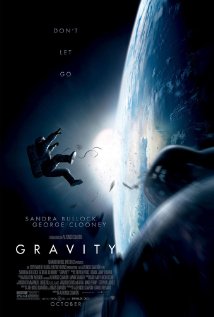
Gravity (2013), directed by Alfonso Cuaron

Gravity posterOver the course of my rabbinic career, I have seen people face enormous challenges physically and emotionally. Some are overwhelmed and life stops for them. Others are resilient and somehow find the strength to continue and even rebuild a shattered life. I remember many years ago when I received a call telling me that the son of a new synagogue member had tragically died in a farming accident as he was riding a tractor. The boy’s father was a Holocaust survivor and I stood in awe of him and his wife who kept their faith in the face of incomprehensible tragedy. Several years later, another major misfortune befell the family and I could not understand how the father weathered the storm of tragedy that assaulted him.

How we cope with an avalanche of ill fortune is the subject of Gravity, a tense and engrossing film about an accident that occurs in outer space, how the astronauts’ bad luck multiplies, and how they psychologically deal with the reality of their impending mortality.

Dr. Ryan Stone, Mission Specialist, is on her maiden space shuttle voyage with veteran astronaut Matt Kowalski, who is in charge of the expedition. During a spacewalk procedure, they receive news that space debris is headed their way and they must abort their mission. Abruptly, they lose communication with Mission Control, but they continue to transmit information in the hope of someone hearing them. Suddenly space debris hits them, causing Stone to tumble through space. Happily, Kowalski recovers her, after which they both try to return to the space shuttle, only to discover it unusable. This sets the stage for a survivalist drama as more and more problems occur, making it more difficult for them to return safely to earth.

In the course of their ordeal, they discuss Stone’s life on earth and the accidental death of her daughter. As their situation becomes more desperate, questions about the meaning of life surface. Faced with her possible death within hours, Ryan laments that no one will mourn for her and no one will pray for her soul. Her articulation of her emotional isolation illuminates the sadness of her life since losing her beloved daughter. She may have gotten over the heavy sadness of losing a child by keeping busy with her scientific work; but deep within her psyche, the pain remains for she has not emotionally come to terms with her tragic loss.

Whether she and Kowalski survive their ordeal makes for a tension-filled narrative that touches on themes of faith and resilience in the face of catastrophe. The outer-space setting makes these quandaries all the more stark and unsettling, for no one is present to view their frightening ordeal.

Judaism has much to say about how we should deal with tragedy in our lives. When we hear tragic news such as the death of a loved one, the Jew responds with a blessing: “Blessed are You, God, King of the Universe, Arbiter of Truth.” Death, of course, is not a happy event, but the true believer knows that God in His infinite wisdom always does what is good. While we may not rejoice in the face of tragedy, we do not succumb to despair for we know that, from the aspect of eternity, everything makes sense. Moreover, when the Jew says Kaddish, the Mourner’s Prayer during the year after the death of a close relative, the words he recites are words of praise to an all-powerful God. They are not words of anger or reproach because the Jew inwardly comprehends that even tragedy is part of the Divine plan. To fight it is impossible; therefore, the proper response to tragedy is to feel the initial pain and then to move forward knowing that our own life’s mission is not over even when we can no longer share it with a loved one.

Gravity reminds us of the uncertainty and danger inherent in living, but it also reminds us that crisis can be the catalyst of new understandings about ourselves and the world around us.

Purchase this movie from Amazon.com.

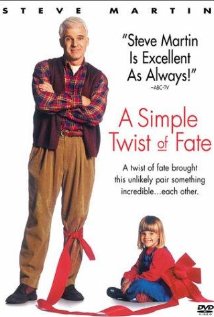
A Simple Twist of Fate (1994) directed by Gillies MacKinnon

simple twist of fateA friend of mine many years ago confided in me that he did not want to have children. He saw them as an inconvenience and simply preferred to own pets which would never make demands on him, argue with him, or keep him up at night. He would also not be required to pay exorbitant tuitions for Jewish day school education. When I countered that the Bible commands us to try to have children and that one of the first questions we are asked in the heavenly court is whether we truly attempted to have children, he dismissed my arguments. When I shared the practical reality that children take care of us emotionally and physically when we are older, and that they are a living extension of the legacy we create during our lifetime, he again rejected my thinking. To him, present creature comforts trumped everything.

A Simple Twist of Fate, based on George Eliot’s Victorian novel, Silas Marner, reminds us that to parent a child is a blessing that can make our own lives more meaningful. When we learn to care for child, we are leaving our own egocentric desires at the door and becoming better human beings by giving to another who cannot take care of himself. This is what happens to Michael McCann, a high school music teacher, when he adopts a small child who serendipitously finds her way into Michael’s home on a stormy winter night after her mother dies in the snow.

Until that transformational moment, Michael has led a reclusive life as a carpenter crafting elegant furniture and amassing a collection of gold coins which he counts every evening and jealously guards. On one fateful night, his coins are stolen, and Michael is shaken to the core. Depressed and irritable, his mood changes when he discovers Mathilda, the foundling, and rears her as her father. Life becomes meaningful for him as he learns to parent her. Love deepens as he guides her and watches her mature into an intelligent, precocious, and happy youngster.

Complications ensue when Mathilda’s real father attempts to adopt her many years later, citing Michael’s inability to pay for her education at the finest schools and his eccentric life style. Michael, after all, is only a carpenter who earns very little, and his social life is limited. Following in broad brush strokes the outline of Silas Marner, the film depicts the slings and arrows of outrageous fortune that beset Michael as he tries to retain custody of Mathilda. For him, parenting is a calling and he does not want to surrender that privilege.

Jewish tradition places great value on having children and on raising them to be images of the Divine. Being fruitful and multiplying is the first commandment in the Bible. God wants the world to be populated, and having children accomplishes this Divine goal. Moreover, Judaism emphasizes the chain of tradition and passing down values to the next generation. This is expressed in the Passover Seder, where children ask questions of parents, who supply answers to inquiring minds. Furthermore, every Friday night in many Jewish homes parents bless their children, poetically comparing them to the great patriarchs and matriarchs of the past, who carried the message of Jewish living to subsequent generations of Jews. Having children allows one to be a messenger of God in this cosmic plan.

As a parent, I have told my children that my most important title is not rabbi or doctor; rather it is Abba/Father. What my own parents left me was a host of positive memories which played a role in my own self-actualization as an adult. Their values are embedded in me, and that is their legacy, which I try to pass on to my own children.

A Simple Twist of Fate suggests that the best thing a parent can leave a child is a legacy of love and strong family values. These will endure beyond any material gift.

Purchase this movie from Amazon.com.

Hugo (2011), directed by Martin Scorsese

Hugo posterI recently had a conversation with a friend who moved to Israel ten years ago. I asked him why he made the move at the age of 50 when he was gainfully employed in a senior technology position with a well-established company. He told me that, in spite of the outward perception of his success, he saw the handwriting on the wall in terms of his professional life in America. Younger people were rising in the company who were more adept and knowledgeable, and he knew it was simply a matter of time before he was let go. That reality motivated him to move to Israel and reinvent himself here where he started a “quickie-lube” automobile service center, which is now thriving.

I thought about my friend as I watched Hugo, an engrossing, imaginative story of an innovative businessman, Georges Melies, who is left behind as the world changes and technology advances. Unlike my friend, he is unable to reconcile his creative past life with a future that is changing every day, and so he becomes depressed and sad over a fate of which he has no control.

The agent of his emotional redemption is Hugo Cabret, a 12-year-old boy orphaned when his widowed father dies in a museum fire. A bond between father and son is the movies. In particular, the imaginative films of Georges Melius, whom Hugo’s father adored, is the favorite of father and son.

After his father’s death, Hugo is taken in by his alcoholic uncle who maintains the clocks in the railroad station, and Hugo learns how to maintain and repair them. While managing all the timepieces, he tries to fix a broken automaton, a mechanical man, which his father bought many years ago. It is this project which animates Hugo, who senses that his father has left him a message which only the automaton can reveal. Desperate to keep his father’s memory alive, Hugo steals mechanical parts to repair the automaton, but he is eventually caught by a toy store owner named Georges Melius who makes and fixes toys. Their relationship is at first tense, but when Hugo discovers that the toy store owner is the same Georges Melius, the moviemaker and creative genius who was beloved by his father, he wants to repair not just the automaton but Georges Melius as well.

We learn that Georges was a master filmmaker, who introduced clever and original special effects into his silent movies. Unfortunately, the advent of World War I changed the entertainment landscape in France where the story takes place, and Georges is forced to sell his movies in order to survive financially. Hugo discovers that Georges actually created the automaton, which was the only surviving remnant of his creativity. Hugo, of course, possesses it and wants to return it to its creator. How he does that is the stuff of a magical movie, with exquisite art direction and cinematography which makes Hugo a contemporary masterpiece.

King Solomon tells us in Proverbs that “the righteous fall seven times and rise again.” The message to all men is never to despair after setbacks or tragedy. God is orchestrating things behind the scenes, and one can find meaning even in the most dire of circumstances. The proper response to adversity is to learn from it, not to give in to it. When Georges Melius finally has his emotional awakening, he acknowledges his debt to a brave young man “who saw a broken machine and, against all odds, fixed it. It was the kindest magical trick that ever I have seen.” The reference is both to fixing the automaton and to Hugo’s rekindling of Georges’s creative fire, enabling him to join the larger community of artists from which he had been detached for so many years.

Hugo reminds us to help those broken souls who need human connection, and to “fail forward” and learn from adversity rather than wallow in despair.

Purchase this movie from Amazon.com.

Cinderella Man (2005), directed by Ron Howard

Cinderella Man posterA few years ago, a friend of mine wanted to borrow some money from me. Ordinarily, I would have been happy to give it to him. But there was one problem. I lent him a substantial amount of money a year before and he never paid me back. I told my friend that I could only lend him a small amount this time because of what happened in the past.

Everybody understands that people go through hard times and they may need help to survive a financial crisis. However, lenders lose patience with people who do not make a good faith attempt to pay back their debts. I shared with my friend my experience serving on school scholarship committees. Committee members all want to help, tolerating low payments as long as they are made regularly. But when the debtor does not pay even a small amount, the mood changes. Committee members get angry when people stop paying altogether. Our Sages reinforce this approach to borrowers when they tell us that a person who borrows and does not pay back his debts is a bad person.

Cinderella Man, the fact-based narrative of boxer James Braddock, is about a man who pays his debts. After a successful beginning in his boxing career, Braddock loses everything in the Great Depression. He is so desperate that he begs for money from old friends in order to pay a heating bill to keep his children warm in the dead of winter. He dilutes milk with water so that his kids can have some nourishment in difficult times. Reluctantly, he asks for government relief money when he confronts extreme poverty. All this he does to provide for his family. However, when he achieves a modicum of success after a number of years, he returns the welfare money even though he is not required to do so. When a reporter asks him why he did this, he says: “I believe we live in a great country, a country that’s great enough to help a man financially when he’s in trouble. But lately, I’ve had some good fortune, and I’m back in the black. And I just thought I should return it.”

Jewish tradition says that one must do everything one can to avoid becoming a burden on the community. James Braddock lived by this creed. In fact, the Talmud states that a man should flay a carcass in the street, never feeling that work is demeaning no matter how great a scholar he may be. The Talmud actually mentions many great sages who did manual labor in order not to become a burden on society.

We can also admire Braddock as a parent. When times are tough and his son steals salami from a local vendor, he takes him to the butcher to confess his sin and to return the stolen meat. What he says to his son is instructive: “We don’t steal, no matter what happens. There are people who are worse off than we are.” Braddock recognizes the value of a teachable moment.

In a coda at the end of the film, we are told that Braddock “served honorably in World War II, later owned and operated heavy equipment on the same docks where he labored during the Great Depression, bought a house in New Jersey with the winnings from his celebrated come-from-behind victory over Max Baer, raised his children in that house and lived there with his wife Mae for the rest of his life.” Success never went to his head. He remained a modest man, content to live quietly and productively for the rest of his life. Our Sages tell us that we can learn from every man. James Braddock was such a man.

Purchase this movie from Amazon.com.

Lincoln (2012), directed by Steven Spielberg

Lincoln posterOver the course of my career, I have participated in many forums debating funding for Jewish day school education. Most of the time, I was principal of a Jewish day high school arguing for more funding for my school. Across the table often were representatives of Federation, the community funding agency charged with distributing money to a variety of constituent agencies.

In the early days, Federation was the enemy, the force that would potentially deny a Jewish education to needy families. As time passed, I took a different view of Federation. In truth, they were not the enemy. They were decent, intelligent people who wanted to do the best in their stewardship and management of community funds. Theirs was not an easy job: to determine with the wisdom of Solomon how much money went to each agency, all of whom were competing for allocations.

A friend of mine, Geoff Frisch, of blessed memory, with whom I studied Torah weekly, gave me an important piece of wisdom. Geoff, a master salesman, introduced me to the tapes and writings of Zig Ziglar, a motivational guru, who espoused seeing things “from the other side of table,” seeing things from the vantage point of the opposition and recognizing that they have a legitimate point of view, even though you disagree with them. Zig would say: “always look for the win-win situation and you will be successful.” Geoff practiced that approach and imparted it to me as well, and for that I am eternally grateful to him.

I thought of that negotiating approach as I watched Lincoln, a thoughtful and engrossing take on the presidency of Abraham Lincoln. The film deals only with a small piece of Lincoln’s presidency, but it reveals Lincoln’s nuanced tactics to get his legislative agenda passed by Congress.

In January of 1865, the Civil War is almost over, but Lincoln is troubled by the fact that even though the slaves have been emancipated, there is still no constitutional amendment making slavery illegal. Only a constitutional amendment will bring closure to slavery in America. The Thirteenth Amendment, passed in the Senate, still needs House ratification. Moreover, within Lincoln’s own cabinet and party, there is division. Some want to end the war first; others feel that if the war ends first, there will be little incentive to pass the amendment, and so Lincoln initiates a strategy to secure enough votes to pass this critical piece of legislation before war’s end.

The strategy is complex and nuanced. Lobbyists are hired with the explicit goal of securing the votes of those who are not yet committed to vote yea or nay. The approach they use varies from person to person, and Lincoln himself sometimes steps in to apply political and social pressure, always seeing things from the other’s perspective. Ultimately, the amendment is passed and Lincoln feels he has forever ended slavery in America, a historic legacy for which he will be remembered.

It is a remarkable performance by Daniel Day-Lewis that separates this Lincoln from any other film about this illustrious president. We can see and hear the thoughts and words of a man focused on his mission in spite of much political opposition and in spite of stress on the home front where his wife Mary is still grieving of the loss of their son Willie three years before. In the face of these pressures, Lincoln keeps his cool and enables those around him to do so as well. Often he is able to diffuse a situation with an amusing story or the sheer power and logic of his argument.

Jewish tradition fosters argument for the sake of arriving at truth. The Talmud tells us the sages Hillel and Shammai often disagreed with one another, but their respective points of view have endured because of the purity of their motives. So it was with Lincoln and many of his opponents in Congress. Lincoln did not see them as the enemy but as friends who needed to be convinced of the correctness of his position. His nuanced management style is worthy of admiration as we negotiate our own life challenges.

Purchase this movie from Amazon.com.

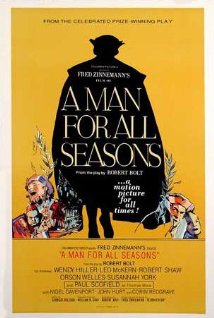
A Man for All Seasons (1966), directed by Fred Zinneman

man for all seasons posterWhen I assumed my first position as a synagogue rabbi, I was a man with many opinions. Fresh out of rabbinical school, I felt I had access to the whole truth and nothing but the truth. If someone wrote an article with which I disagreed, I wrote back a sharp response to indicate the intellectual weakness of the writer’s argument and the truth of mine. I could not resist not being silent. I knew the right answers and it was my mission to let everyone else know of the correctness of my position as well.

Very soon, thankfully, I became aware of the arrogance and silliness of my ways. I received an acidic letter from someone whose article I took issue with. He accused me of narrow-mindedness and insensitivity. As I reflected on his comments, I realized he was right. There was no reason for me to publically criticize someone else just to demonstrate the correctness of my position. I forgot the maxim of our Sages that silence is a fence to wisdom, and that my overall success in the rabbinate did not depend on my diminishing the reputation of others. There was no point to my diatribes. I should have remained quiet, and from then on, I did.

The issue of silence is critical in A Man for All Seasons, the story of Thomas More and his quarrel with Henry VIII, King of England, who wanted More, in his capacity as Lord Chancellor of England, to ask Pope Clement VII to annul his marriage to Catherine of Aragon, who did not bear him a male child. More resigned rather than take an Oath of Supremacy declaring the King as Supreme Head of the Church of England, an oath that would allow the King to dispense with the need to ask the Pope for the annulment.

More chooses silence as his response to the political pressures around him. He is cautious about his words and serves as a sterling example of the man who measures carefully each and every word he utters, knowing that the wrong word can ruin him in this world and possibly in the next.

However, he cannot escape the entreaties of the king, and ultimately More is branded a traitor for his unwillingness to take an oath supporting Henry’s new marriage to Anne Boelyn. More’s silence is construed as high treason against the king.

At his trial, the matter of silence is a key argument of Cromwell, the prosecutor, who explores the different interpretations of silence: “Gentlemen of the jury, there are many kinds of silence. Consider first the silence of a man who is dead. What does it betoken, this silence? Nothing; this is silence pure and simple. But let us take another case. Suppose I were to take a dagger from my sleeve and make to kill the prisoner with it; and my lordships there, instead of crying out for me to stop, maintained their silence. It would suggest a willingness that I should do it, and under the law, they will be guilty with me. So silence can, according to the circumstances, speak.” Cromwell then attacks More by suggesting that his silence is an clever denial of Henry’s authority as Supreme Head of the Church of England.

More responds that his silence should not necessarily be interpreted as denial, but rather as the silence of consent. In truth, he should be acquitted for he has never said a word against the King.

Jewish tradition has much to say about silence. The Ethics of the Fathers offers several pithy statements: “There is nothing better for a man than silence. Silence is a fence to wisdom. He who increases his words increases sin.” Clearly, the thrust of Jewish tradition is to weigh one’s words. Once uttered, they cannot be recalled. Therefore, it behooves us to carefully consider the value and purpose of our speech before opening our mouths to offer an opinion. I am thankful I learned this lesson early in my career.

Purchase this movie from Amazon.com.

The Impossible (2012), directed by J.A. Bayona

impossible posterA year ago, I landed in Ben Gurion Airport in Israel without a working cell phone. I had contracted with a car service to pick me up, but time was passing and the driver was nowhere in sight. I began to get panicky because of my inability to contact my driver, and decided to ask someone to borrow a cell phone. The first person I spoke to told me he could not lend me his cell since it was running low on power and he needed to conserve power to insure that he could contact his family. The second person I addressed happily lent me his phone and I was able to reach my driver.

I thought of this incident as I watched a scene in The Impossible, a gripping narrative of a family’s survival after being caught in the deadly 2004 tsunami in Thailand. Swept along in a flood, the Bennett family is separated. Husband Henry, mother Maria, and sons Lucas, Tomas, and Simon are tossed by powerful waves and wind up isolated from one another. Henry desperately wants to make a phone call to determine the safety of his family and at first is rebuffed by someone whose cell phone is low on power; but a second request is answered and Henry can finally make his call. It is a touching scene that reminds us how important is the kindness of strangers when one is in dire straits.

Maria and Lucas soon find one another and set about to locate a safe haven. However, Maria spots a small boy alone crying for his family. She insists that they rescue him in spite of Lucas’s protestations that this detour will place them more at risk. Maria reminds him that the child could have been their missing sibling and Lucas acquiesces.

Kindness in the face of adversity is a central theme of The Impossible. When Maria is finally found by locals and taken to the hospital, she encourages Lucas to help reunite families. Lucas collects names and tries to match them as he scours the crowded hospital corridors. When someone recognizes a name he has called, Lucas is overcome with joy, a joy that intensifies when he actually witnesses a father and son reunite. As his search to bring together family members continues, Lucas moves from focusing on self to focusing on others.

There is a compelling story in Genesis in which Abraham prays for Abimelech, king of Gerar, who, thinking that Abraham’s wife Sarah was his sister, took Sarah into his royal home. As a result, the Bible tells us, all the wombs of Abimelech’s household were closed and no one could bear children. Abraham prayed that they be healed and they were.

The next section in the Bible details the story of the birth of Isaac, who was born to Sarah at the age of ninety after many years of infertility. The great medieval commentator Rashi, quoting a passage in the Talmudic tractate of Baba Kamma, states that the juxtaposition of these two narratives teaches us that if someone prays for mercy on behalf of another when he himself needs that very same thing, he is answered first. This conceptually represents what happens to Lucas. When he shows compassion for others and is concerned for their welfare, he himself is rewarded with the survival of his own family.

The Impossible depicts the chaos that surrounds any rescue mission after a large natural disaster. Survivors search for loved ones, identities are confused in the ensuing hours and days, and medical help is hard to find. The narrative of the Bennett family reminds us of the enduring bond between all survivors of a catastrophe and of the need to be involved with the destiny of all, not the destiny of one.

Purchase this movie from Amazon.com.

Real Steel (2011), directed by Shawn Levy

Real Steel posterAs part of the matriculation requirement for Israeli high school students, they have to do a project upon which their oral examination is based. Since my students enjoy cinema, I gave them the topic of “Influential Movies of the 20th and 21st Centuries.” One student selected the film Real Steel, which describes a future time when human boxing is outlawed as too dangerous and robot fights are substituted. I asked the student why the film was influential, and he responded that it was influential for him because the story of a boy and his father that is the subtext of Real Steel gave him an insight into his own relationship with his father and how it might be improved.

Charlie, a former boxer and now manager of a robot boxer, is an absentee father when Max’s  mother dies. Instead of assuming responsibility for Max, he requests $100,000 in return for signing over custody to Max’s aunt. But there is a hitch. Max’s aunt and her husband have to go away for a month before they can take Max into their home, so they ask Charlie to take care of him until they return. The month turns into an unforgettable road trip for Max as he accompanies his father through the entrepreneurial world of robot boxing. Charlie buys used robots, repairs them, and then uses them in fights in order to win prize money. Sometimes his robots win, but most of the time they lose and eventually Charlie goes broke.

All seems lost until Max serendipitously finds a buried robot named Atom. They reboot Atom and set to work restoring its fighting functions. Although built as a machine to spar with other robots, Max and Charlie teach Atom how to take the offensive and fight against other mechanically superior machines.

Gradually Charlie and Max find unofficial fights for Atom. Max uses the winnings of matches to buy spare parts and fix Atom, and Charlie begins to pay off his old debts. Eventually, Atom’s prowess is recognized by professional promoters and he is offered prestigious matches in the Worldwide Robot Boxing Association. Soon the ultimate match is scheduled between Atom and Zeus, the undefeated champion of robot boxing. The bruising fight is the climax of the film, with the outcome unclear until the last moment.

The heart of Real Steel is not the robot gadgetry; rather it is the story of a dysfunctional relationship between a father and a son, and how that relationship is made whole again. Reconciliation begins when father and son stop finding fault with one another, when they begin to accept one another’s imperfections, and when they share a common goal. The shared goal of repairing Atom and preparing him for his fights unites father and son and rids them of old memory tapes of past indiscretions.

As a parent, it is natural to find fault with a child. I often want to correct my children, but I try to be guided by the Biblical model of how to give correction. I first ask myself if this is the right time and place?  Can I criticize the behavior and not my child? Is my child ready to listen to me, or do I first need to build more trust so that my words will be accepted more readily?

The Bible tells us that criticism is good. We grow when we are able to listen to reproof and make midcourse corrections in the way we live. However, we have to be very careful when we criticize. The language in the Bible for this commandment is “you shall surely reprove.” Our Sages inform us that the Hebrew phrase for reprove is repeated to emphasize that reproof should only be given when someone is ready to listen. Simply criticizing goes nowhere. Charlie and Max finally understand this, which allows them to focus on the future and enrich their relationship. Real Steel does not just refer to robots. It refers to the strong bond between father and son that endures despite the mistakes that we make as fathers and sons.

Purchase this movie from Amazon.com.