Category Archives: Movie review

Alien (1979), directed by Ridley Scott

In my career as a school principal, parents from time to time would ask me to break a school rule when their child was in trouble. In one case, the parent told me that enforcement of a particular rule would turn off his child from Judaism and I would be responsible for his son’s lack of faith. Such a comment weighed heavily on me. Moreover, in my early years, I wanted to be liked, and enforcement of the rule would make me unpopular with a few parents. Fortunately, a mentor of mine reminded me that my goal in my professional life should not be to be liked but to be respected. He impressed upon me that whenever I make an exception for one student, I have to make it for all students. There is no such thing as a private deal when it comes to maintaining the integrity of a school rule. Everybody has to follow the same Bible. Whatever expedient decision you make in the short term may bring you some satisfaction and peace momentarily, but it will eventually bring you havoc. It is just a matter of time.

The consequences of a decision to break a long-standing policy for a short-term benefit, however noble it may seem at the time, is the catalyst for all the mayhem that erupts in  Alien, a tense and disturbing science fiction thriller, which spells out in grim detail the horrific results of breaking one rule to ameliorate an immediate problem.

The Nostromo, a commercial towing vehicle traveling to Earth with over a million tons of mineral ore, intercepts a signal which the crew perceives as an SOS. When Kane, a crew member, leaves the ship with the captain and investigates the origin of the signal, he is attacked by a foreign life form which attaches itself to his head. Some crew members want to bring Kane back to the ship to see if they can save him; but Ripley, the commanding officer when the captain is not on the ship, refuses to bring Kane back on board, citing quarantine protocol and the real danger of putting more lives at risk. In spite of her ruling, one of the ship’s officers disobeys Ripley and opens the door of the spaceship allowing the contaminated Kane to enter. This marks the beginning of the end of most of the crew who do not realize that they have allowed the alien to enter the ship as well.

The Ethics of the Fathers tells us that the wise man is he who foresees the consequences of his actions, who does not put others at risk to satisfy his own immediate needs. One rash act can leave in its wake a plethora of tragedy.

It is a Jewish sensibility to do whatever we can to prevent danger and harm to others, to minimize risk to our friends and neighbors. The Torah lists numerous laws that are designed to protect people. When we build a house, we are enjoined to erect a guardrail on a roof. Furthermore, we are enjoined not to possess an unstable ladder, not to own a vicious dog, or do anything that may create a hazard for anyone who enters our home. Moreover, contemporary authorities in Jewish law argue that driving recklessly is a violation of Jewish law in that it puts the lives of others as risk. In truth, when a Jew drives with courtesy, it is a way of sanctifying the name of God.

Although Alien deals with a foreign universe, it reminds us of the importance of following the rules and not placing others at risk. We cannot predict the outcomes of our actions. Therefore, it becomes incumbent upon us to think wisely before making an exception to the rules.


Purchase this movie from Amazon.com.

The Killing Fields (1984), directed by Roland Joffe

My wife and I have been blessed with many new friends since coming on aliyah to Israel. But there is nothing like an old friend who has known you for many years. For example, my friend Harvey, who I have known since I was 12, gave me two important pieces of advice or insights that have proven to be invaluable to me. When I was struggling in my Torah learning in 1966, he suggested I come to Israel where I could develop my learning skills and be free of secular distractions. Later on when I was about to enter the rabbinate, he told me that the most important thing for me to do is to love people. If people sensed that I truly cared for them, I would be successful.

The nature of friendship is at the core of The Killing Fields, which takes place in Cambodia in the mid-70s. The country is in the midst of a civil war between the Cambodian national army and the communist Khymer Rouge as a result of the Vietnam War spilling over into its borders. The two central characters Sydney Schanberg, a New York Times reporter, and Dith Pran, a Cambodian interpreter, form a deep friendship as they document in stories and photos the tragic plight of the Cambodian people who are caught in the crossfire of a war on its periphery.

Because of the mounting instability in the country, Pran’s family is evacuated with other international diplomats, but Dith Pran stays with Schanberg in spite of the risk. Pran’s situation worsens when the Khymer Rouge demand that all Cambodian citizens in the French embassy be turned over. Forced to live under its totalitarian regime, he uses all of his resources to stay alive. Meanwhile, Sydney returns to New York and launches a campaign to find him. Years pass with no word from Dith Pram; but in 1979, he is located in a Red Cross facility in Thailand.  Sydney flies there to see him and immediately asks for his forgiveness for not encouraging him to leave safely when he had the chance. Dith Pram tells him that there is nothing to forgive. They embrace as John Lennon’s “Imagine” plays in the background and the Cambodian victims of war look on, mystified by the show of friendship between these two different men from different lands. The lyrics resonate as we watch Cambodian and American embrace: “You may say I’m a dreamer, but I’m not the only one. I hope someday, you’ll join us. The world will live as one.” Friendship means thinking of the other as part of you. It is the one of us.

I once enlisted the aid of a rabbi older and wiser than I to come to Atlanta to strengthen the Torah program of the Yeshiva of which I was principal. Surprisingly, the rabbi said he would come, but he told me something that sticks in my mind to this day. He was sensitive to the political undercurrents of my situation, and he said he would come only if I was sure it would be helpful to me. If at any moment I had second thoughts about my invitation, it was okay for me to change my mind. There was no self-interest on his part. This is what true friendship is all about.

The Ethics of the Fathers underscores this when it praises the love between the Biblical characters Jonathan and David. They loved one another and wanted to do what was in the other’s best interest. This is the kind of friendship we should all strive for, friendships where we ask ourselves what can I do for my friend, not what’s in it for me.

Purchase this movie from Amazon.com.

Moneyball (2011), directed by Bennett Miller

I like teachers and have great respect for them. This is why in my early years as a school principal, I always found it difficult to fire a teacher even when it was clear to me that it had to be done. One particular case still haunts me. The teacher was a wonderful person, but was boring. After much observation, I knew I would have to terminate him but I was conflicted. He had a large family and my firing him would have great consequences for his family. I agonized and finally called a mentor for advice. He was quick and to the point. He said: “You are not an employment agency. You must do what is in the best interest of the students.” It was one of those whiplash moments. Everything became clear. Students come first, and that conversation guided much of my subsequent decision-making in my professional career.

I was reminded of that conversation as I watched Moneyball, a smart, insightful movie about the business side of baseball. Billy Beane, general manager of the Oakland Athletics must release a player and he does it with intelligence and style. He knows that his goal is to win games, and he will do whatever is necessary to achieve his end. He never loses his focus. He calls the player in the office and with a smile informs him: “Jeremy, you’ve been traded to the Phillies. This is Ed Wade’s number. He’s a good guy, he’s the GM. He’s expecting your call. Buddy will help you with the plane flight. You’re a good ballplayer, Jeremy, and we wish you the best.” The parting is necessary, but it is humane and brief.

Beyond serving as a model of management, Billy Beane’s story also has other important life lessons. Billy determines that players are valued incorrectly and that even a team with limited financial resources can find undervalued players who can be melded into a winning team. His strategy: select players with the highest on base percentage. Don’t buy players; buy runs and you will win ballgames. The strategy is successful, setting a precedent for how players will be recruited in the future. The lesson: sometimes we have to shift our paradigms in order to be successful at solving problems.

I had to shift my paradigm when I first began teaching. At first, my primary concern was teaching the material. In a few years, I realized that to be successful, I needed to alter my perspective. The successful teacher focuses on students, not just information. That paradigm shift would make a dramatic difference in the way I taught and the way students learned. I was now teaching people, not facts, and the classroom dynamic changed.

Another life lesson: statistics alone cannot predict the future. Scouts saw Billy Beane as a first round pick and they offered him a huge contract with a major league team right out of high school. Billy then came to the proverbial fork in the road: should he go to Stamford on a full scholarship or sign with majors. He chose the latter, but never fulfilled the potential that scouts saw in him. Money and fame were the allure; but when he left professional baseball, he vowed never again to make a decision based upon money alone.

These lessons reflect Jewish sensibilities. The ability to see alternate points of view, to shift paradigms, is the essence of Talmudic learning. The great rabbis Hillel and Shammai looked at the same realities but possessed vastly different approaches to solving problems. Moreover, King Solomon reminds us at the end of his life that wealth does not bring happiness. The truly wise man is the one who is happy with what he has.

Purchase this movie from Amazon.com.

Proof of Life (2000), directed by Taylor Hackford

Over the years as a rabbi, I have done some marital counseling. One standard piece of advice I give to couples of all ages is never go to bed angry, never leave a problem hanging and allow it to fester overnight. The consequences can be far-reaching and potentially devastating. My wife and I do not agree on everything, and we probably never will. But we both understand that it is foolish not to resolve a divisive issue as soon as possible. We have learned that there are three very important phrases in any marriage: “I’m sorry, Forgive me, and I love you.”

Proof of Life is about a marriage under stress. On the surface, it is an action film about a kidnapping in a South American country, which introduced me to something that, thank God, I know little about; namely, how a hostage release is negotiated with a kidnapper. It is scary, but fascinating. Based on a true story that appeared in Vanity Fair magazine, it recounts the tense ordeal of Alice Bowman and her husband Peter, who is kidnapped by guerilla rebels and taken into the country’s mountains for a number of months.

What makes the kidnapping especially worrisome is the conversation that Alice and Peter had the night before. Peter’s company is in financial straits, and yet Peter wants to stay in the country. Alice, who suffered a miscarriage when they were stationed in Africa, is emotionally spent and wants to return to the States. Peter, angry at his lot in life, tells her to take a break and leave the country alone; he will stay here. It is an emotionally wrenching scene to watch as the fabric of a relationship between a loving couple, who were once devoted to one another, begins to unravel.

It is against this emotional background that the kidnapping takes place. What ups the ante is the fact that Peter’s company has no insurance coverage for kidnapping, placing his wife Alice in the unfortunate position of personally hiring a hostage negotiator to achieve her husband’s release, all the while knowing that Peter feels ambivalent about the marriage.  After a false start, she engages Terry Thorne, an expert in kidnapping and ransom cases, to help her.

The beginnings of rapprochement and reconciliation occur when Peter asks his captors if he can take a picture of his wife out of his wallet to bring with him on his trek into the wilderness. It is a photo that both comforts and inspires him throughout his ordeal. Alice, too, begins to sense that her husband still loves her when a fellow prisoner who has escaped tells her of Peter’s devotion to her, and how it enabled him to survive pain and humiliation.

Peace between husband and wife is the bedrock of a Jewish home. So precious is spousal harmony that the Bible speaks of a ritual in which God’s holy name is erased in order to promote marital harmony and save a marriage in peril. Moreover, the classic dictum of “loving your neighbor as yourself” refers specifically, says the Talmud, to the relationship between husband and wife who are not only lovers but the best of friends.

Proof of Life on one level refers to the proof that the hostage negotiator wants before transferring money to kidnappers. On another level, it refers to the deep love that asserts itself when marriages are being tested. Resolving disputes, daily expressing love in word and deed to one’s spouse, is an affirmation that, in spite of adversity, love will endure. Love itself is proof of life.

Purchase this movie from Amazon.com.

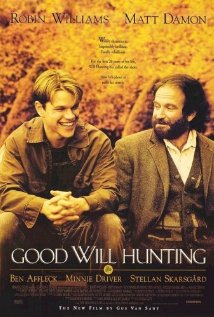
Good Will Hunting (1997), directed by Gus Van Sant

For a number of years as a synagogue rabbi, I officiated at funerals and gave thoughtful and comforting eulogies. But it wasn’t until my mother passed away that I really understood what loss meant. I had spoken to her on a Thursday night right after Passover in 1976; the next morning I received a call from my father who was crying, telling me at the same time that Mommy had died. I felt an emptiness within; and at the funeral service the following Sunday in Mt. Vernon, New York, I was speechless and could not sing her praises. I could only share with the officiating rabbi my strongest memories of my mother, and the rabbi in his eulogy gave voice to my thoughts.

After that seismic event in my life, my sensitivity towards mourners who had just suffered a loss was more heartfelt. Loss was not just a sermon topic; it was something that changed my perception of death, which made me more empathetic, and more understanding of what it means to be a loved one left behind.

There is a line in Good Will Hunting uttered by Will Hunting’s therapist, Sean, which expresses the difference between just learning or hearing about tragedy and experiencing it.  Sean tells Will, an arrogant, cocky, but brilliant, young man, that “You’re just a kid. You don’t have the faintest idea of what you are talking about.” Furthermore, he doesn’t know about art, about love, about war. All he possesses is book knowledge, not wisdom that emerges from the crucible of life experience. Sean has lost his beloved wife to cancer, and Will casually presumes to know everything about Sean because of a painting he saw in Sean’s office.  Sean responds to his facile remarks stridently: “You don’t know about real loss because it only occurs when you’ve loved someone more than yourself,” and clearly Will is self-absorbed. To sharpen his observation of Will, Sean, aware that Will is an orphan, declares honestly: “You think I know how hard your life has been because I read Oliver Twist?”

In the book of Exodus, we are told that Moses went out to see the suffering of his brethren. Until that time, he was isolated from them and did not comprehend their pain. Witnessing first-hand the beatings they were receiving at the hands of the Egyptians gave him a different perspective. He identified with them and so began his odyssey of redemption. Seeing things from the balcony may be academically satisfying, but it is only through the shared life experience that one learns to understand human tragedy and become more empathetic.

There is another challenge Will has to overcome:  low self-esteem. This is nurtured by a cohort of friends who spend all their free time drinking beer, carousing, and engaging in the language of the gutter. Will is unable to see beyond his lowly origins. Only through his friendship with Sean, who does not abandon him in a time of crisis, does Will begin to see his future differently.

The Ethics of the Fathers states that sitting among the gatherings of the ignorant remove a man from the world. Association with the philistines of society makes you one of them. It is only when you separate from them that you can begin to create your own independent identity and soar.

Good Will Hunting implicitly suggests to us that a life of meaning is based on shared human relationships. It also reminds us that sometimes we have to make a clean break with the past to have a bright future.

Purchase this movie from Amazon.com.

The River Wild (1994), directed by Curtis Hanson

Rafting brings to mind the rafting trip that Jim and Huck Finn take on the Mississippi. It is a metaphor for a journey from youth to adulthood, and defines the travelers as they experience adventures along the way. Another memory is a rafting trip I took many years ago with Jan Siegelman, an Atlanta friend and veteran whitewater guide, and my two oldest boys, Dani and Elie, on the Ocoee River in Tennessee.

We encountered serious rapids. My boys handled it well but I fell off the raft three times, once stuck underwater for a short while until Jan freed me from being trapped between the raft and a rock. For me, river rafting was no longer just an exciting wilderness adventure. It represented risk-taking and danger. The River Wild, a thriller about a family rafting trip, viscerally depicts the inherent danger in navigating the rapids, and also describes how a moment of crisis can serve as a defining moment in the life of a family.

Gail and Tom have a troubled marriage. Tom, obsessed with work, is emotionally distant from his wife and young son, Roarke. Gail, whose father is deaf and uses sign language to communicate, looks to her mother for guidance. When Gail tells her that things are hard, her mother responds: “You don’t know what hard is. That’s because you give yourself an out.” Her mother wisely counsels her that marriage is by nature a challenging relationship, requiring consistent effort to endure.

Gail percolates with this wisdom as she begins her rafting trip with her son and husband who, surprisingly, joins them at the last minute. The trip takes a sinister turn when they are joined by Wade and Terry, armed fugitives who pretend to be carefree vacationers on a rafting excursion. Gail and Tom try to find an exit strategy, but it doesn’t work. They are trapped by men who threaten harm to their family if she does not cooperate. Their goal is to compel Gail, an experienced whitewater guide, to take them to safety downriver, where they can escape the law. The problem, however, is that they will have to go through the gauntlet, a section of the river where a rafter has recently died and another was paralyzed. It is a formidable and dangerous task.

The River Wild says a lot about the ties that bind a family. It demonstrates that spouses need to spend time with each other and talk to one another. When there is no dialogue, relationships are hard to maintain. Men are from Mars and women are from Venus is not just a clever maxim. It is a reminder to married couples to spend time trying to understand each other, to appreciate the everyday interactions and kindnesses that form the bedrock of a strong marriage. Moreover, the story reminds parents to be present for their children, to engage them, and celebrate their special moments with them.

Beyond these lessons about family, the film reminds us of the Torah requirement to preserve life and to avoid danger. The Talmud, in fact, states that the rules protecting us from danger are more important than ritual prohibitions. Without life, there is no opportunity to do God’s will. There are even laws that prohibit walking near a crumbling wall or an unstable bridge.

In The River Wild, crisis brings the family together, and forever after defines them as a loving unit, committed to one another for the long haul. Roarke sums it up when he responds to the policeman who asks him what happened. Roarke, smiling broadly, says: “My mom got us down the river and my dad saved our lives.”

Purchase this movie from Amazon.com.

Jeremiah Johnson (1972), directed by Sydney Pollack

As a young father, vacations generally meant going to places like Disneyland or to resorts with a pool and kid-friendly activities. Once I became an empty nester, vacation destinations changed. National Parks were the place to visit. My first one was to Acadia National Park in Maine; and over a number of years, my wife and I visited many in the United States and Canada. Instead of going somewhere to be amused, we traveled far to contemplate and appreciate the beautiful world that God has given us. Spending time hiking, surveying breathtaking lookout points, and listening to the sounds of nature were rejuvenating. Which is why I greatly enjoyed a recent viewing of the Western classic, Jeremiah Johnson.

Jeremiah leaves civilization as he knows it and journeys to the mountains. He wants to become a mountain man, living away from the hustle-bustle and corruption of the busy city. He wants to be alone,  and to discover the beauties of nature first-hand. There is a parallel here to a famous story told about Rabbi Samson Raphael Hirsh, a 19th century leader of German Jewry and Bible commentator, who near the end of his life resolved to visit the French Alps. His students tried to convince him not to go because of the risk to his health, whereupon he told them:”When I come before God, I will have to answer for many things. But what will I tell Him when He asks me, ‘Have you seen My Alps?'”

This thirst to see all of God’s resplendent world is a Jewish sensibility. The Talmud (Yerushalmi Tractate Kiddushin) explains that in the future God will hold us responsible if we do not enjoy the beautiful things He created in this world. It is a good thing to go out and see the trees, the mountains, the rivers, lakes and oceans. Seeing them reinforces our belief and appreciation for God who created all of it.

However, there is a dark side to being a mountain man. “Do not separate from the community,” say our Sages. Jeremiah learns that a life of isolation can be dangerous and unforgiving, and that there is a price to pay for solitude. For example, he has no back-up when things go awry.

One incident, in particular, brings this lesson home. Having married an Indian woman and found a modicum of happiness in the wilderness, he is asked by the U.S. Calvary to lead a search party to bring food to a stranded wagon train. He is not anxious to leave his family, but he reluctantly agrees and leads them to the wagon train. Inwardly, however, he is agitated that the route takes him through a sacred Indian burial ground. The scene of traversing the burial ground is one that encapsulates both the allure and danger of nature. It is a grey day, snowing gently but relentlessly as the soldiers pass by skeletons of dead Indians, foreshadowing a tragedy that is to come.  It is an image of both beauty and dread.

Left alone in a vast wilderness with savages all around, Jeremiah is forced to defend himself on countless occasions in order to survive. The Hobbesian notion that life is nasty, brutish, and short finds expression in the harsh life of Jeremiah Johnson. But in spite of it all, he emerges not as a bitter or angry person, but as one content with his lot, understanding that life is filled with contradictions, with happiness and sadness, with beauty and ugliness. It is a mature sensibility, worthy of emulation.

There is much to admire in Jeremiah Johnson. He is a man of few words, of deep feelings, of personal integrity, who, through age and experience, appreciates and values the beautiful world before him.

Purchase this movie from Amazon.com.

A River Runs Through It (1992), directed by Robert Redford

None of our children are alike. Over the years, I have understood more and more the wisdom of King Solomon who instructs parents to “educate a child according to his way,” which implies that parenting is not a cookie-cutter skill. Rather, effective parenting involves understanding the uniqueness of each child and recognizing that success in life can be measured in many different ways. For one, it might be getting an advanced degree; for another, it might be being a very skilled plumber. All we can do is teach children how to navigate life, give them freedom to choose their own path, and pray for the best results.

But, life, like a river, is constantly moving and we can’t always see what is at the bottom. There is a mystery that we cannot penetrate and unpredictable things can happen after the best parenting efforts. You can do everything right, and your child may still make bad decisions. Your hopes and dreams for that child may never be realized. How do you relate to that child and how do you integrate that outcome into your own life?

A River Runs Through It offers suggestions. It is the autobiography of Norman and Paul, brothers who grow up in 1920s Missoula, Montana. Their father, a Presbyterian minister, does his best to parent them while at the same time recognizing their need to follow their own hearts. Fly fishing is the activity that bonds the generations, and is the film’s lyrical metaphor for achieving perfection in life.

Norman and his father have an affinity for poetry. When Norman discovers his dad reciting a Wordsworth poem, Norman chimes in and reads alternate verses; thus they achieve a perfect synchronicity of souls. They truly are on the same wave length.

While Norman achieves academic success, Paul achieves success as a newspaper reporter and fly fisherman, who demonstrates a level of artistic perfection as he catches fish in Blackfoot River. Catching a huge fish in the midst of being pulled by a powerful current is a special moment for Paul and his father, who is unaware of Paul’s addiction to gambling and carousing. We sense that this brief moment of perfection in the life of father and son will not last. As Norman narrates the story of his family as an old man, he observes that “life is not a work of art.” He recognizes that in spite of our best efforts, outcomes are beyond our control.

A classic phrase in Jewish prayer is “Our Father, Our King.” When we ask God for help, we appeal to two aspects of the Divine persona. He is our King, the one who makes the rules, and He is also our Father, always there with unconditional love in spite of our shortcomings. This is the Jewish paradigm for parenting.

Reverend Maclean, father of Norm and Paul, says it eloquently in a sermon: “Each one of you will at one time in your lives look upon a loved one who is in need and ask the question: we are willing to help, Lord, but what, if anything, is needed? For it is true we can seldom help those closest to us. Either we don’t know what part of ourselves to give or, more often than not, the part we have to give is not wanted. And so it is that those we live with and should know, they still elude us. But we can still love them; we can love completely without complete understanding.”

This is a Jewish sensibility, to be present always in the lives of those we love most, both when they make us proud and when they encounter uncertainty or failure.

Purchase this movie from Amazon.com.

Rain Man (1988), directed by Barry Levinson

My sister Carol had Down’s syndrome. As a little boy, I would fantasize about becoming a doctor and being able to transform Carol into a normal person; but as I grew older I understood that my hopes for Carol were only a dream. Over the years I tried to be a dutiful brother, especially after my parents passed away. When my own children were of age, I explained Carol’s situation to them and they were always warm and accepting of their aunt, who always had a sweet smile for them whenever she saw them. I often reminded my kids of how fortunate they were to possess a normal intellect, with the potential to learn so much knowledge. Why things happen is ultimately unknowable, and we need to reflect that there but for the grace of God go I.

Rain Man tells the story of two siblings, Charlie Babbitt who is normal, and Raymond Babbitt, an autistic “savant,” who has been institutionalized. Charlie is very self-absorbed, immersed in a world of money and materialism. When Charlie learns that his estranged father has died, he travels to Cincinnati for the funeral and to settle the estate. There he learns that all he will receive from the estate is a classic Buick Roadmaster, while an undisclosed beneficiary will inherit three million dollars. The beneficiary turns out to be the mental institution where his brother Raymond lives, a brother of whose existence Charlie was never aware. Charlie kidnaps Raymond from the institution in the hope of forcing the trustee of the funds to make a settlement with Charlie for half the inheritance. Thus begins their cross-country trip together.

In the course of their trip, Charlie observes Raymond’s fixation on ritual as a calming mechanism in the face of change. Raymond must watch certain TV programs, he must go to bed by 11 PM, and he must have pancakes for breakfast on specific days. At first Charlie thinks this is a massive charade and feels he can correct Raymond’s behavior. Over the course of their journey, however, he learns that Raymond’s autism is not subject to a quick fix. His routines provide stability, and any deviation potentially creates chaos for him and those around him. For example, Raymond refuses to fly on an airline unless it is Quantas, which has a zero crash record. The problem is that Quantas does not fly from Cincinnati to Los Angeles. This is the catalyst for the car trip across America, a shared experience that bonds the two brothers together, ultimately resulting in Charlie’s recognition that, in spite of his brotherly love, the people and the institution in which Raymond lives are best equipped to care for him.

As a young rabbi, I remember my own naïve arrogance when I thought that I could fix all problems. In retrospect, I realize the delusion of my youth. It was not until years later and encounters with people in the real world that I understood that there are occasions when I did not have all the answers and that I had to call a professional for guidance.

Perhaps one of the lessons we learn from people with disabilities of all types is to be appreciative and grateful for our own normality. In fact, I told my children that when we see people with a visible abnormal appearance, we recite a blessing: “Blessed are You, God of the Universe, who makes creatures different.” It could be that the Sages who formulated this blessing wanted to convey the message that all humans, no matter what their intellect or appearance, are creations of God imbued with an essential sanctity and infinite value. Rain Man reminds us of this truth.

Purchase this movie from Amazon.com.

Men in Black (1997), directed by Barry Sonnenfeld

It took me 12 years to get my doctorate in English at Georgia State University. Usually, it’s a five-year gig including the dissertation. For me it took longer because I was married with kids, had a full-time job, and could not devote all my time to this important professional goal. I owe a great debt of gratitude to Dr. William Sessions, my academic advisor, who believed in me and encouraged me to persevere even when I had doubts. Dr. Sessions recognized that family came first, and he knew that I could finish the degree if I had more time to complete the program.

My friend Charlie pursued a different career path. He wanted to become a university professor, and he postponed getting married until after he finished his PhD. He then postponed marriage again because he wanted to be financially secure and employed on a tenure track. He was then in his 30s. I spoke to him off and on during this time, reminding him of the Talmudic statement that at the end of 120 years, God will ask him whether he married and tried to have kids. I also reminded him that life in one’s advanced years can be very lonely without a wife. Furthermore, he will never be called Abba/Dad, which to me is my most important title. In spite of my comments, Charlie continued his exciting academic life, publishing book after book and occasionally getting into the media as well. He never did marry.

I thought of Charlie as I watched the crazy and wild Men in Black, a comedy about two men, Kay and Jay, working for a secret government agency who track alien life forms living on earth, and who embark on a mission to save the world from being destroyed by aliens. Their life is extraordinary and exciting. Every day is unpredictable. They meet creatures from other planets, they drive cars that are fast and fitted with the latest technological innovations, they have powerful weapons, and they can control the memories of others. In fact, they even periodically use the memory “neutralizer” to erase their own memories so that early frightening memories will not hinder them in their present assignments.

The catch is that their work requires them to give up their identity and their connections with friends and family. This is hard, for there are moments when one thinks of a wife, a time when one yearns for the human connection. From the aspect of eternity, family does come first. There is a touching moment when Kay reflects about the wife he left behind as he views her image on a monitor. When Jay comments that she is pretty, Kay clears the screen, but the image of his wife lingers in his mind.

After successfully avoiding the destruction of earth, Kay wants to transfer the mantle of leadership to Jay. Kay profoundly misses his wife and desires to go home. The pull of love is stronger than the adrenaline rush for action. He is older now and can appreciate the wisdom of Solomon who tells us “there is neither doing or reckoning nor knowledge or wisdom in the grave where you are going (Ecclesiastes 9:10).” The value of life is not measured in professional accomplishments alone, but rather in the human relationships that are nurtured over the years.

It is wise for us to treasure family over our job. At the end of our lives, we will not feel bad because we didn’t spend more time at the office. We will feel sad if we did not maximize our time with wife and children.

Purchase this move from Amazon.com.