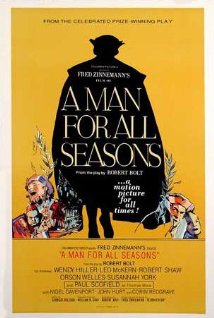
A Man for All Seasons (1966), directed by Fred Zinneman

man for all seasons posterWhen I assumed my first position as a synagogue rabbi, I was a man with many opinions. Fresh out of rabbinical school, I felt I had access to the whole truth and nothing but the truth. If someone wrote an article with which I disagreed, I wrote back a sharp response to indicate the intellectual weakness of the writer’s argument and the truth of mine. I could not resist not being silent. I knew the right answers and it was my mission to let everyone else know of the correctness of my position as well.

Very soon, thankfully, I became aware of the arrogance and silliness of my ways. I received an acidic letter from someone whose article I took issue with. He accused me of narrow-mindedness and insensitivity. As I reflected on his comments, I realized he was right. There was no reason for me to publically criticize someone else just to demonstrate the correctness of my position. I forgot the maxim of our Sages that silence is a fence to wisdom, and that my overall success in the rabbinate did not depend on my diminishing the reputation of others. There was no point to my diatribes. I should have remained quiet, and from then on, I did.

The issue of silence is critical in A Man for All Seasons, the story of Thomas More and his quarrel with Henry VIII, King of England, who wanted More, in his capacity as Lord Chancellor of England, to ask Pope Clement VII to annul his marriage to Catherine of Aragon, who did not bear him a male child. More resigned rather than take an Oath of Supremacy declaring the King as Supreme Head of the Church of England, an oath that would allow the King to dispense with the need to ask the Pope for the annulment.

More chooses silence as his response to the political pressures around him. He is cautious about his words and serves as a sterling example of the man who measures carefully each and every word he utters, knowing that the wrong word can ruin him in this world and possibly in the next.

However, he cannot escape the entreaties of the king, and ultimately More is branded a traitor for his unwillingness to take an oath supporting Henry’s new marriage to Anne Boelyn. More’s silence is construed as high treason against the king.

At his trial, the matter of silence is a key argument of Cromwell, the prosecutor, who explores the different interpretations of silence: “Gentlemen of the jury, there are many kinds of silence. Consider first the silence of a man who is dead. What does it betoken, this silence? Nothing; this is silence pure and simple. But let us take another case. Suppose I were to take a dagger from my sleeve and make to kill the prisoner with it; and my lordships there, instead of crying out for me to stop, maintained their silence. It would suggest a willingness that I should do it, and under the law, they will be guilty with me. So silence can, according to the circumstances, speak.” Cromwell then attacks More by suggesting that his silence is an clever denial of Henry’s authority as Supreme Head of the Church of England.

More responds that his silence should not necessarily be interpreted as denial, but rather as the silence of consent. In truth, he should be acquitted for he has never said a word against the King.

Jewish tradition has much to say about silence. The Ethics of the Fathers offers several pithy statements: “There is nothing better for a man than silence. Silence is a fence to wisdom. He who increases his words increases sin.” Clearly, the thrust of Jewish tradition is to weigh one’s words. Once uttered, they cannot be recalled. Therefore, it behooves us to carefully consider the value and purpose of our speech before opening our mouths to offer an opinion. I am thankful I learned this lesson early in my career.

Purchase this movie from Amazon.com.

Quiz Show (1994), directed by Robert Redford

quiz-show-posterAs a parent, I am heavily invested in my children. When my kids were younger, I could guide them in a very direct way. Now that they are older, I parent differently because my children live in faraway places. I offer counsel by phone or email to continue my involvement in their respective destinies.

In truth, parenting older children is much harder than parenting young kids. Life is much more complicated for an adult than for a child; and adult children have a mind of their own, which may not always coincide with a parent’s point of view. Regardless, I still love my kids whether we always agree or not. I identify with them and share their joys and missteps as well. When they achieve, I feel joy within; and when they stumble, I am still standing by their side, which is why I understood the father-son dynamic in Quiz Show, an expose of the rigged TV quiz shows in the 1950s.

Quiz Show introduces us to Herbert Stempel, the reigning champion on Twenty One, one of the ubiquitous television game shows where contestants win money based upon their ability to answer questions from a wide range of knowledge areas. Behind the scenes, the corporate gurus are worried about flat ratings, and they ask Stempel to take a dive so that a new intellectual hero can emerge. That new hero is Charles Van Doren, the son of the celebrated academic, Mark Van Doren, a venerated English professor at Columbia University. The producers of the show offer to give Van Doren the answers, appealing to his pocketbook and to his ego. At first he refuses, sensing that he will compromise his name and his family’s reputation; but at the end he succumbs to temptation. In the week’s that follow, Charles Van Doren, intoxicated by money and fame, becomes a celebrity.

Dick Goodwin, a Harvard law graduate, begins to investigate the show, and uncovers that the fix is in. Both Stempel and Van Doren received the answers beforehand. A Congressional Committee convenes to ferret out the truth and it becomes clear that Van Doren will be implicated. At that moment, he visits his father and confesses his dishonesty. His father, shocked by his son’s revelation, in a heated interchange reminds his son that “your name is mine.” Charles has besmirched the family name and it is a painful realization.

In spite of Charles’ moral lapse, Mark Van Doren and his wife accompany their son to the Congressional hearing. He is a father, not only a mentor, and it is in this role that he looms large. He does not abandon Charles because of his mistake. He is invested in his son, who, like his father, is a PhD professor at Columbia. They share the same contextual framework at the professional level; and even at family picnics, they can finish the other’s literary quotations. He is disappointed by his son’s betrayal of the public trust, but he still sticks with him even when Charles is publicly humiliated.

Two messages emerge from Quiz Show, both of which are found within Jewish tradition. The Talmud tells us that more than erudition, more than wealth, more than status, a good name is man’s crowning achievement, and is more precious than money or fame. Furthermore, we should never give up on our children, even when they make mistakes. Our role model is the patriarch Jacob, whose sons gave him much him much grief. Simon and Levi attacked Shechem without asking for their father’s approval, and their action was a public relations gaffe of the highest order, recounts the Bible. And when Jacob finds out that the brothers have sold Joseph, he is at first astonished at their behavior. However, at no time does Jacob walk away from his children, no matter how egregious the fault. Jacob can be critical of them but he cannot desert them.

Our children should be taught the value of their good name and how their actions affect the public perception of their name. Furthermore, we should understand that while mistakes by our children may be painful, our love for them is unconditional.

Purchase this movie from Amazon.com.

The Impossible (2012), directed by J.A. Bayona

impossible posterA year ago, I landed in Ben Gurion Airport in Israel without a working cell phone. I had contracted with a car service to pick me up, but time was passing and the driver was nowhere in sight. I began to get panicky because of my inability to contact my driver, and decided to ask someone to borrow a cell phone. The first person I spoke to told me he could not lend me his cell since it was running low on power and he needed to conserve power to insure that he could contact his family. The second person I addressed happily lent me his phone and I was able to reach my driver.

I thought of this incident as I watched a scene in The Impossible, a gripping narrative of a family’s survival after being caught in the deadly 2004 tsunami in Thailand. Swept along in a flood, the Bennett family is separated. Husband Henry, mother Maria, and sons Lucas, Tomas, and Simon are tossed by powerful waves and wind up isolated from one another. Henry desperately wants to make a phone call to determine the safety of his family and at first is rebuffed by someone whose cell phone is low on power; but a second request is answered and Henry can finally make his call. It is a touching scene that reminds us how important is the kindness of strangers when one is in dire straits.

Maria and Lucas soon find one another and set about to locate a safe haven. However, Maria spots a small boy alone crying for his family. She insists that they rescue him in spite of Lucas’s protestations that this detour will place them more at risk. Maria reminds him that the child could have been their missing sibling and Lucas acquiesces.

Kindness in the face of adversity is a central theme of The Impossible. When Maria is finally found by locals and taken to the hospital, she encourages Lucas to help reunite families. Lucas collects names and tries to match them as he scours the crowded hospital corridors. When someone recognizes a name he has called, Lucas is overcome with joy, a joy that intensifies when he actually witnesses a father and son reunite. As his search to bring together family members continues, Lucas moves from focusing on self to focusing on others.

There is a compelling story in Genesis in which Abraham prays for Abimelech, king of Gerar, who, thinking that Abraham’s wife Sarah was his sister, took Sarah into his royal home. As a result, the Bible tells us, all the wombs of Abimelech’s household were closed and no one could bear children. Abraham prayed that they be healed and they were.

The next section in the Bible details the story of the birth of Isaac, who was born to Sarah at the age of ninety after many years of infertility. The great medieval commentator Rashi, quoting a passage in the Talmudic tractate of Baba Kamma, states that the juxtaposition of these two narratives teaches us that if someone prays for mercy on behalf of another when he himself needs that very same thing, he is answered first. This conceptually represents what happens to Lucas. When he shows compassion for others and is concerned for their welfare, he himself is rewarded with the survival of his own family.

The Impossible depicts the chaos that surrounds any rescue mission after a large natural disaster. Survivors search for loved ones, identities are confused in the ensuing hours and days, and medical help is hard to find. The narrative of the Bennett family reminds us of the enduring bond between all survivors of a catastrophe and of the need to be involved with the destiny of all, not the destiny of one.

Purchase this movie from Amazon.com.

World War Z (2013) directed by Marc Foster

world war z posterAs a child, my mother took me to see the movie Phantom of the Opera starring Claude Rains. There is a scary scene when a bottle of acid is thrown disfiguring a man forever. For many months afterward, I had nightmares. From that time on, seeing horror movies of any kind did not appeal to me and I rarely saw one. So it was with some reluctance that I went to see World War Z, a thriller about a zombie apocalypse threatening to take over the world.

The film opens with images of a happy family about to spend time together renewing and strengthening family ties. As they drive through stalled downtown Philadelphia traffic, however, the unexpected happens. A former UN employee, Gerry Lane, and his family are attacked by hordes of zombies along with countless others. The Lanes escape to a deserted apartment, where they are extracted by a helicopter sent by Gerry’s former UN colleague. They are then taken to a US Naval ship, where militarily analysts and scientific personnel are trying to determine the scope of this worldwide plague.

Dr. Andrew Fassbach, a virologist, is sent to a military base in South Korea to investigate the source of the virus along with Gerry, a veteran UN investigator, who is charged with facilitating the work of Dr. Fassbach. But then tragedy strikes. Fassbach is killed when he accidently discharges his gun amidst a zombie attack, and the investigating team is left without a scientist who can analyze the remains of those who have been killed by the zombies. At this moment, all seems lost. How can the problem be solved if there is no one to define the problem?

The Ethics of the Fathers says that in a place where there is no man, we have to step up to the plate and be the man. This is what Gerry does. When Fassbach dies, Gerry does not abort the mission. He does not make excuses. He understands what is at stake and continues on his search to investigate the source of the plague.

His search takes him from Korea to Jerusalem where he picks up more evidence and some helpful wisdom. Gerry learns that the Israelis had an early indication of the zombie menace and were able to use a barrier wall against terrorists as a barricade against zombie penetration. A local guru tells him that the Israelis took the zombie threat seriously and did not dismiss it because of their “tenth man” theory. This theory, based upon the experience of having miscalculated the strength and strategy of the enemy in a number of military situations, says that whenever everyone is in agreement about a potential threat, we suppose that a “tenth man” sees things differently. Moreover, we presume that the alternate view is correct and we investigate it. Solving a problem becomes similar to an exercise in Talmudic logic in which all possibilities are explored.

Ultimately, Gerry finds a path towards recovery, but it is not a panacea. As he observes the positive signs of human initiatives to end the zombie invasion, he wisely says: “This isn’t the end, not even close.” However, his comment reveals a determined optimism in the face of what seemed to be total apocalypse. This ability to focus on the positive in a desperate situation is what carries him forward to another day.

The Ethics of the Fathers tells us that it is not our job to complete the task, but rather simply to begin. This is especially true if that task seems overwhelming. Rather, all we need to do is put forth our best effort since the final result is in God’s hands.

Gerry does not solve the zombie problem, but he initiates a path towards a solution. That is sometimes the best we can do in difficult situations. Begin the process and leave the outcome to God.

Purchase this movie from Amazon.com.

The Best Exotic Marigold Hotel (2012), directed by John Madden

best exotic marigold hotel posterWhen I turned sixty, I realized that in spite of the fact that I felt at the top of my game in terms of the skill set I brought to Jewish high school education,  I was no longer perceived as such by potential employers.  They wanted younger people to assume positions as school heads. I was part of the past, not the future. This is one of the reasons why living in Israel has been exciting for me. Here I can recreate myself as a Jewish educator, not as a head of school but as a valuable piece of a larger educational entity. Here I can redefine my mission.

This is the essential narrative arc of all the characters in The Best Exotic Marigold Hotel, who have an emotional epiphany as they stay at a hotel “for the elderly and beautiful.”  Marigold  captures the pain of growing old, its challenges, and its possible joys if one approaches this time with a positive attitude, and focuses on what one can do, not on what one cannot do.

Old age is a time of loss but also a time of freedom and redefinition. All of the principals come to this picturesque hotel because of an attractive brochure; but, in fact, the hotel is in a state of disrepair and neglect. In a sense, the hotel is a mirror of its new guests who also are “elderly and beautiful.”

Evelyn, recently widowed, is forced to sell her home to cover her late husband’s huge debt and her vacation is a reprieve from the pressures she faces on the home front. Graham, a retired judge, has come to India to find a long lost lover. Jean and Doug come because it is an affordable vacation after giving their daughter most of their savings to start a business. Muriel, a retired housekeeper, comes because she can obtain a hip replacement in India at a fraction of the cost in England. Madge is seeking a husband, and Norman is seeking sexual adventure and companionship.

The intertwining stories, however, share a common thread: how do we come to terms with old age, with declining physical strength, and the knowledge that our life is coming to close? How do we deal with feeling marginalized or ignored?

All the characters in the story have an emotional awakening. Most are able to redefine their life. Some sadly cannot and remained paralyzed by yesterday’s perceptions. They see, as one character says, neither light nor joy and are unable to seize life’s new opportunities. There is a remarkable piece of wisdom, articulated at several points in the film, which suggests the proper approach for senior living. Sonny, the hotel manager, a young man with senior insight, offers the following perspective when things are not going well and the worst is expected: “everything will be all right in the end. If it’s not all right, then it’s not yet the end.”

This is a point of view which is expressed in the Talmud when the Sages tell us that whatever God does for us is for the good. It may not be apparent immediately because we see only a part of the picture. If we were to see everything from beginning to end, we would understand that, in the final analysis, from the aspect of eternity everything is good. A conversation between Muriel and Evelyn encapsulates this philosophy in a humorous way. Evelyn observes: “Nothing here has worked out quite as I expected,” to which Muriel responds:  “Most things don’t. But sometimes what happens instead is the good stuff.”

The Best Exotic Marigold Hotel reminds us that retirement does not have to mean the end of life as we know it. It can be a time of self-evaluation, a time for redefinition, and a time for the assumption of new and worthwhile tasks. In truth, in the Bible there is no word for retirement. Abraham doesn’t retire.  He is productive until his last breath. Moses also does not retire. He is active until the final day of his life. They lead a life of purpose, in which every day has meaning. Their senior years are golden because they use them to clarify life’s goals and to implement a strategy for purposeful living.

Purchase this movie from Amazon.com.

War of the Worlds (2005), directed by Steven Spielberg

war of the worlds posterDuring the Cuban Missile Crisis of the 1960s, I was taking a philosophy course at Yeshiva University. Students felt that there was real possibility of a nuclear holocaust, and my malaise was deepened when my Philosophy professor ended his Thursday class by saying “See you on Monday if there will be a Monday.”  I remember asking one of my Judaic studies teachers what would happen to the Jewish people in such a doomsday scenario. He told me that the Jews might suffer as well as the rest of humanity; but that there would always be a remnant of the people left, for God’s covenant with the Jews was eternal and the Jews would never totally disappear from the world. The only appropriate action we could take now was to do good deeds and pray for peace.

These memories percolated in my mind as I watched War of the Worlds, a story of what might happen if a malevolent extra-terrestrial force were to target the earth for destruction. The film opens as Ray Ferrier, a divorced dad, picks up his children, Robbie and Rachel, from his ex-wife who is going on a weekend vacation with her husband.

Ray has a very small parenting tool box; and while he enjoys spending time with his kids, he has little idea of who they are and what makes them tick. His parenting skills are tested when calamity strikes. Soon after they arrive at his Bayonne, New Jersey home, unseasonably strong winds and lightning set the stage for a Martian invasion of the earth.  Martian tripod-killing machines emerge from the bowels of the earth and incinerate everything around them. Ray, in a panic, flees to Boston with his children in one of the only remaining working vehicles, hoping to find sanctuary in the home of his former in-laws where their mother is staying.

Scenes of death and destruction traumatize Rachel; and when they find temporary refuge in a deserted building, she asks her father to sing her a lullaby so she can sleep. Ray doesn’t remember any lullaby, but he manages to sing a song that calms her. Ray realizes that in times of crisis, family comes first. The safety of loved ones trumps all other considerations.

Jewish tradition fosters a similar mind set. It is the family that is the bedrock of stability that enables one to endure the storms of adversity. The Bible emphasizes that when the Jews went down into the iron furnace of Egyptian slavery, they went down as families; for it is within the family unit that people can find safe haven and it is within the family where lifelong values are nurtured.

There is a well established family custom that Jewish parents bless their children regularly. Some do it once a year on Yom Kippur, the holiest day of the year; others do it every Friday night. It was my own custom to do it once a year, but in recent years I wished I had done it weekly. To look into your child’s eyes once a week, to utter a blessing to your son and daughter, and then to hug and kiss them seems an exquisite pleasure for a parent. Why do it only once a year? Kids leave the home when they grow up, but the memory of an embrace, of a heart to heart moment of love, leaves a bank account of affection that that can draw interest for many years.

My children and I live in different communities now but my children often call me on Friday to ask for by blessing. I cannot hug them from Israel, but I can tell them I love them and that means a lot to me and them.

War of the Worlds reminds us that in times of crisis, family comes first. It is wise to nurture family ties with our young children so that we and they can enjoy the warmth and constancy of our mutual love as we and our children grow older together.

Purchase this movie from Amazon.com.

Catch Me If You Can (2002), directed by Steven Spielberg

 catch me if you can posterOver 25 years ago, one of my sons asked me a question of Jewish law. I meditated for a moment and gave him an answer that I thought was correct. About a year later, I discovered that what I told him was incorrect. I apologized for giving him the wrong answer and life went on. Still, however, my quick response of many years ago rankles in my mind. He came to me because he assumed that I was a source of wisdom upon whom he could rely, like money in the bank. My hasty answer wasn’t fully researched and turned out to be flat-out wrong. I realized then and now that, in spite of their sometimes challenging behavior, children intuitively respect and revere parents, and we always have to be conscious of our status as teachers and role models for them, and behave at our very best for them.

This father-son dynamic is tested in Catch Me If You Can, an entertaining and thoughtful drama based upon the true life story of Frank Abagnale, Jr., a clever young man who impersonated an airline pilot, a doctor, and a lawyer in order to bilk others out of millions of dollars on three continents, all done before he reached the age of twenty.

The narrative begins with a dinner honoring his father who has worked for his local civic organization for many years. Frank Jr. watches his father in admiration as he tells the story of two mice who were in peril of drowning in a vat of milk. One succumbs and the other keeps on scurrying about until the milk turns into butter and he is saved. The moral: hard work leads to ultimate success. It is a great lesson for a father to teach his son.

However, privately Frank’s father is not what he seems. He has money problems, which he denies, doing whatever he can to avoid responsibility. Frank Jr. follows his lead but is more creative than his father, charting an egregious course for himself that gets the attention of the FBI.

When, after many months of crime, he pays a surprise visit to his father, the meeting turns into a painful realization of his father’s failure to parent him in morality. Frank Sr. complains that the government is after him: “The IRS wants more. I gave them cake. They want the crumbs. I’ll make them chase me for the rest of their lives.” He also reveals that he knows his son has stolen millions of dollars from unsuspecting victims and is being investigated by the FBI. Frank Jr. pointedly asks him: “Why didn’t you ever ask me to stop?” His love for his father is still there, but he is angry and disappointed that his father never voiced objection to his life of crime.

The Talmud tells us that a father has an obligation to teach his son a trade; and if he doesn’t do this, it is tantamount to teaching his son to be a robber. A parent’s task clearly is not just to provide for a child’s material needs but to give him moral guidance, to teach him how to navigate an ethical life in a world in which morality is tested every day.

The concrete image of this parental role is what transpires on the Passover Seder night, where the father sits at the head of table and conducts an evening of moral instruction for his family. The evening is filled with life lessons, focusing on the interchanges between father and son. Metaphorically speaking, parents always sit at the head of the table, and it is from that vantage point that we should exercise our parental roles.

Purchase this movie from Amazon.com.

Brothers (2009), directed by Jim Sheridan

brothers posterMany times I have read in the newspapers about post-traumatic stress syndrome as it relates to soldiers coming home after serving in combat. I understand it intellectually, but it is something very far from my personal experience. In conversations with my son-in-law, one of the few Orthodox Jews who served in the Marines, he gave me some idea of what soldiers face in the battle. Although stationed in Kuwait and not in an active battle theater, he described the training he received for combat which focused on learning how to kill efficiently.

After watching Brothers, a powerful drama about the aftermath of military service, I have a better understanding of the daily stress of those who serve in battle and how service in the thick of combat can change lives for many years afterward.

Sam Cahill, a solid family man, is a Marine captain about to leave on his fourth tour of duty. Married to his high school sweetheart, Grace, and the father of two beautiful daughters, his parting is fraught with a quiet anxiety as family members take leave of one another.

Sam was a star high school athlete and student who never quit or backed away from a tough assignment. His brother, Tommy, in contrast, avoided responsibility at all costs. We first meet him as he leaves jail after serving time for armed robbery, and he arrives just in time to bid farewell to Sam as he embarks for Afghanistan in October of 2007.

News soon arrives that Sam’s helicopter has crashed, killing all of the Marines aboard. But in truth, Sam and his childhood friend, Joe Willis, have been taken captive in a remote mountain village. The film alternates scenes of Sam’s brutal incarceration with scenes of his family back home, who mourn for Sam and who at the same time try to reconstruct their lives without him. His brother Tommy becomes an anchor to Grace and the children who see in him a hint of their father and husband. Tommy and his friends even redecorate the family kitchen to give Grace an emotional lift.

A bond develops between Grace, her girls, and Tommy, in which they genuinely mourn for Sam while at the same time create isolated moments of happiness to make the present bearable. All this transpires as Sam and Joe are tortured brutally, both physically and mentally. Eventually, Sam does an unspeakable act which goes against his very nature, and the psychic residue of that act remains with him when he eventually is rescued and returns home. His adjustment to normality is complicated and involves his relationship with many family members who realize that something has changed within him. He is no longer the person he once was and may be unstable psychologically. The film approaches his adjustment in a complex way and we observe how a friend’s minor gesture can evoke major emotional reactions in Sam.

In the darkest of hours, Jewish tradition always tells us to focus on the light. Our Sages tell us the cycle of the moon reminds us that when all is dark, light will come. Bad times are not forever. The new moon will appear shortly, signaling that happiness and healing can begin. It is a message of hope that after tragedy will come joy and redemption. In Brothers, the response is not so clear, but it is evident that love between husband and wife can be the bedrock of a new beginning. Moreover, when Sam, in a moment of lucidity, says that in spite of what he has gone through, he should be so happy that he is alive, we realize that he is on a road to recovery. Appreciating the gifts we have in the present allows us to have a healthy future.

Purchase this movie from Amazon.com.

Mr. and Mrs. Smith (2005), directed by Doug Liman

mr and mrs smith posterIn my work as a volunteer matchmaker on an internet site, I often see self-descriptions of people that are totally bland and uninteresting. One girl writes: “I love to read, listen to music, and I enjoy following sports and spending time with friends.” I wrote a note to her advising her to share something about her goals in life, what moves her spiritually, what makes her different from someone else. I find that men do not want a shallow mate. They want to marry a person who thinks deeply and who will have something to say to them about important life issues.

I was reminded of this as I watched Mr. and Mrs. Smith, an action-saturated comedy about two assassins who marry one another and do not reveal their professions to each other. Over time, they have little to say to one another except bland platitudes, and the film opens as they are participating in a marriage counseling session to rejuvenate their union.

We learn that John and Jane Smith first met in Bogota, Columbia where they both were being pursued by the authorities. It was love at first sight and soon after they married. Working for different firms, they conceal their true vocations and lead a life in which duplicity is the norm, each lying to the other whenever they leave the house on a mission. Things come to a head when they both are assigned to eliminate the same target. Almost killing each other, they discover each other’s true profession. At first, their professional goals come first and they attempt to kill each other; but love asserts itself and in an epiphany of honest affection, they reunite as a couple and rediscover their original passion for each other.

John and Jane soon find out that their employers want them dead. Assassins who marry one another are a liability and the Smiths become a target for a veritable army of assassins. How they cleverly evade their pursuers and untangle the web of lies that they have woven over the five or six years of their marriage provides a humorous and fascinating narrative of marital therapy taken to extremes.

Judaism places a high value on preserving marriage and insuring good relations between husband and wife. So important is this that even the name of God can be erased from Scripture in order to sustain the marriage bond and to create a peaceful household. For example, when a woman is suspected of adultery, she is required to participate in a ritual that demands the erasure of holy text to restore her good name. The Sages all agree that for that lofty purpose, God’s name can be blotted out. The sanctity of the home is paramount.

Tensions inevitably arise in a marriage where two people are sharing every day together. One can always find something to complain about. But that is not what marriage is all about. On the contrary, marriage is about finding the good in another person, and not finding fault and constantly criticizing the other.  In truth, it is much easier to love someone from afar because that love is not tested daily as it is in marriage.

Mr. and Mrs. Smith reminds us that the bedrock of a successful marriage is a combination of unconditional love, honest communication, and a focus on the future instead of the past. In a moment of crisis when they are both facing possible annihilation, Jane tells John “There’s nowhere I’d rather be than here with you.” That’s a message that resonates with John, who knows that whatever the outcome, he and his wife possess a shared destiny.

Purchase this movie from Amazon.com.

Real Steel (2011), directed by Shawn Levy

Real Steel posterAs part of the matriculation requirement for Israeli high school students, they have to do a project upon which their oral examination is based. Since my students enjoy cinema, I gave them the topic of “Influential Movies of the 20th and 21st Centuries.” One student selected the film Real Steel, which describes a future time when human boxing is outlawed as too dangerous and robot fights are substituted. I asked the student why the film was influential, and he responded that it was influential for him because the story of a boy and his father that is the subtext of Real Steel gave him an insight into his own relationship with his father and how it might be improved.

Charlie, a former boxer and now manager of a robot boxer, is an absentee father when Max’s  mother dies. Instead of assuming responsibility for Max, he requests $100,000 in return for signing over custody to Max’s aunt. But there is a hitch. Max’s aunt and her husband have to go away for a month before they can take Max into their home, so they ask Charlie to take care of him until they return. The month turns into an unforgettable road trip for Max as he accompanies his father through the entrepreneurial world of robot boxing. Charlie buys used robots, repairs them, and then uses them in fights in order to win prize money. Sometimes his robots win, but most of the time they lose and eventually Charlie goes broke.

All seems lost until Max serendipitously finds a buried robot named Atom. They reboot Atom and set to work restoring its fighting functions. Although built as a machine to spar with other robots, Max and Charlie teach Atom how to take the offensive and fight against other mechanically superior machines.

Gradually Charlie and Max find unofficial fights for Atom. Max uses the winnings of matches to buy spare parts and fix Atom, and Charlie begins to pay off his old debts. Eventually, Atom’s prowess is recognized by professional promoters and he is offered prestigious matches in the Worldwide Robot Boxing Association. Soon the ultimate match is scheduled between Atom and Zeus, the undefeated champion of robot boxing. The bruising fight is the climax of the film, with the outcome unclear until the last moment.

The heart of Real Steel is not the robot gadgetry; rather it is the story of a dysfunctional relationship between a father and a son, and how that relationship is made whole again. Reconciliation begins when father and son stop finding fault with one another, when they begin to accept one another’s imperfections, and when they share a common goal. The shared goal of repairing Atom and preparing him for his fights unites father and son and rids them of old memory tapes of past indiscretions.

As a parent, it is natural to find fault with a child. I often want to correct my children, but I try to be guided by the Biblical model of how to give correction. I first ask myself if this is the right time and place?  Can I criticize the behavior and not my child? Is my child ready to listen to me, or do I first need to build more trust so that my words will be accepted more readily?

The Bible tells us that criticism is good. We grow when we are able to listen to reproof and make midcourse corrections in the way we live. However, we have to be very careful when we criticize. The language in the Bible for this commandment is “you shall surely reprove.” Our Sages inform us that the Hebrew phrase for reprove is repeated to emphasize that reproof should only be given when someone is ready to listen. Simply criticizing goes nowhere. Charlie and Max finally understand this, which allows them to focus on the future and enrich their relationship. Real Steel does not just refer to robots. It refers to the strong bond between father and son that endures despite the mistakes that we make as fathers and sons.

Purchase this movie from Amazon.com.