Category Archives: Comedy

The King of Comedy (1983), directed by Martin Scorsese

When I was 11 or 12 years old, I visited a Times Square Army recruiting booth at which Audie Murphy, a celebrated war hero who won the Congressional Medal of Honor and a movie star in Grade B westerns, spoke and gave out autographs. He was an early role model and I left the recruiting station elated that I had in my hands the autograph of an American hero. Many years later, I introduced my sons to a sports celebrity. I ran a 2-week camp for a synagogue in Atlanta, and arranged for admittance to an Atlanta Hawks practice session where we could watch the great Pete Maravich in action. He was very accommodating to the campers and signed their scraps of paper with his name. It was a heady moment for many of the kids to be in the presence of a basketball legend.

Flash forward to the year 2012, and our adulation of celebrities is no longer so innocent. Just ask any parent or educator. Celebrities, actors, politicians often grab our attention due to their nefarious activities, including dishonesty of all types, illicit sex, drugs, and the list goes on. The King of Comedy, appearing in 1983, gave us a prophetic hint about the craziness surrounding celebrity that was to come.

In a brilliant opening scene, Jerry Langford, a late night TV host, is bombarded with fans as he exits the studio. One obsessed fan tries to get close to him, but Rupert Pupkin, ostensibly trying to protect him, slams the door in her face, and we are left with a freeze frame of hands pressing against the window of the limousine. It is an image representing the intense longing of an obsessed fan for access to a celebrity. Life is nothing unless there is connection with fame. It is sad and it is frightening when the entire thrust of one’s life is to live through others.

Rupert Pupkin is determined to become a TV celebrity like Jerry and the movie chronicles his fantastical and obsessive quest for fame. Rupert keeps cardboard figures of Jerry in his basement and has imaginary conversations with him and Jerry’s guests. His friend Masha, a celebrity stalker, will stop at nothing to get close to Jerry, her idol. She ultimately helps Rupert break the law in order to compel the studio to grant him a guest appearance on Jerry’s show.

Rupert receives a prison sentence of six years for his crime, but is freed after serving less than three years. He goes on to write his memoirs and becomes a celebrity in his own right, which echoes what happens so often today. The criminal is released, writes a book, and becomes a fixture of talk shows as he rehabilitates his public image.

The Torah view of celebrity is clear. The Ethics of the Fathers instructs us that fame is elusive. The more one chases it, the more it eludes him. Gaining celebrity is not a Jewish goal. Moreover, the object of Torah adulation is not the actor or the athlete. Rather it is the scholar or the doer of good deeds. In the end, we cannot live vicariously through others. Each of us is an image of the Divine, totally unique with our own respective missions. No one else can live our life for us because we are accountable for our own destinies. God only wants us to be ourselves, not an imitation of someone else. At the end of 120 years, God will not ask me if I was as great as Moses or Abraham; instead He will ask me if I was the best “me” I could possibly be.

Purchase this movie from Amazon.com.

About a Boy (2002), directed by Paul Weitz and Chris Weitz

I do some work as a volunteer matchmaker for an international website. Primarily, I work with 40-year olds, and occasionally I encourage some of my bachelor friends to join the website. I am surprised at their reluctance to join considering the fact all of them tell me about their desire to settle down and have a family. One tells me he is too busy, another that he prefers to meet real people and not to meet people on an impersonal website. Another says that friends are setting him up and this is not a good time for him to put his profile on the website. Time marches on and I still hear the same refrains. As a rabbi and personal friend, I feel sad and troubled. I cannot say it with certainty, but it seems that these friends want no responsibility, even if the alternative is to be alone. They may not say it, but their actions speak louder than their words. They enjoy a life where they are accountable to no one, where there is no emotional investment in any significant other.

Such is the life portrayed by Will Lightman in About a Boy, a hilarious look at the self-indulgent life of the career bachelor. Will narrates his own story. He has no job and lives off the royalties of a popular holiday song that his father wrote in 1958. He goes to a single parents’ group to meet single mothers, fabricating a story about a two-year old son of his to gain their sympathy and trust. He spends his time shopping, watching television, and exercising, which to him means playing pool. To Will, he leads a full life. He exclaims: “A person’s life is like a TV show. I was the star of the Will Show, and the Will Show was not an ensemble drama. Guests came and went. It came down to me.”  Considering how “busy” he is, he wonders if he really would even have time for a job.

Will’s life begins to change when he meets Marcus, a young boy with a suicidal mother. Through a series of improbable events, he befriends Marcus and slowly starts to think of the welfare of others. Will buys Marcus sneakers and marvels that “I made a boy happy, and it was only 60 quid.” At a Christmas party, he begins to understand the importance of human connection. He leaves the party with a “warm, fuzzy feeling.” The stark realization that his present life is meaningless occurs when Will meets the love of his life and discovers he has nothing to say to her. He has no job. He is a blank slate.

Ultimately, Will concludes that Marcus is the only thing that means something to him and Will finally comes out of his self-centered self to help Marcus at a moment of crisis. Connection with Marcus leads to connection with others, and Will becomes a more rounded individual at the story’s end.

King David writes in Psalms that “those that sow in tears will reap in joy.” The commentators suggest that this means we should be mindful of the pain of others in order to feel true joy. Living an isolated life, without feeling the travail of others, is leading a life without meaning; for it is only in connection with others that our own life becomes meaningful. The Ethics of the Fathers states it differently: if I am only for myself, what am I?” About a Boy reminds us that leading a life of meaning requires one to think of others, not just of oneself.

Purchase this movie from Amazon.com.

The Terminal (2004), directed by Steven Spielberg

When I came to Israel a couple of years ago as a recent oleh (immigrant), I arrived with a rudimentary speaking knowledge of Hebrew and no Israeli cell phone. Yet I had arranged from America to meet old friends, now living in Israel, at the airport, who would take my wife and me to our home in Beit Shemesh. The challenge: how to make contact with him if I had no cell phone and no Israeli money to use a pay phone. Moreover, even if I had money for a pay phone, I was unaware that I had to dial city code prefixes before the actual phone number.

Fortunately, I found my friends and everything worked out, but I was reminded of my unsettling airport experience as I watched an early scene in The Terminal, in which Viktor Navorksi, a citizen of an Eastern European country in the midst of a violent coup, arrives in the United States and is unable to leave the airport. His passport is no longer valid and he cannot enter the USA until his situation is resolved. While stuck in the airport, airport security gives him food vouchers and a 15-minute phone card, but Viktor does not have the language skills to know how to use them. Viktor is confused and I understood his frustration.

As his temporary stay at the airport extends into weeks and months, Viktor, a building contractor, uses his skills at construction to get a job with a renovation crew at the terminal. This enables him to earn money to buy food, clothes, and other necessities. These crafting skills and his modest personality slowly ingratiate him with the airport staff, who admire his resourcefulness and his innate kindness towards others.

A turning point occurs when a foreign national wants to bring in medicine for his deathly ill father. He threatens airport personnel and Viktor, because of his language skills, is brought in to diffuse the situation. He successfully resolves the tension by calming the foreigner and creatively suggesting to him that he claim that the medicine he brought in from Canada is for goats and, therefore, needs no special clearance. Viktor, originally seen as a buffoon, now is perceived as a savvy negotiator, which brings him the admiration of many who work at the airport.

Our first impression of outsiders may be akin to seeing Viktor for the first time as simply a foreigner; but once we mentally engage another human being, we are peeling an onion, discovering new layers every time we speak with him. I have found that the more I get to know people, the more interesting they become.

When my wife and I have guests over for a Friday night Shabbat meal, I always ask the invitees to introduce themselves for a moment. I sometimes suggest that each guest tell us something we may not know about them. Surprisingly, I learned that one of our guests celebrated her 70th birthday by parachuting out of a plane. There is clearly more to people than what meets the eye. Viktor Novarski reminds me of the innate complexity of people, and that we should give people a second chance to make a first impression.

The Bible instructs us many times to remember our sojourn in Egypt when we were strangers in a strange land. I am no longer a recent immigrant but I remember how good it felt when I was greeted with a smile, when someone asked me what my name was and where I was from, when someone clarified a confusing moment. It is a good thing to be kind to the stranger. After all, one day the stranger may be you.


Purchase this movie from Amazon.com.

Zelig (1983), directed by Woody Allen

Going to grade school in Mt. Vernon, New York, I was a good student focusing on academics until my neighborhood changed almost overnight. Low income projects were built a block away and Jews fled the hood rapidly. We could not afford to move so we stayed and my education took a different turn. Surrounded by peers who wanted to be cool, I wanted to be cool too. As a result, I spent time combing my hair and listening to rock and roll instead of focusing on my studies. Over a period of several years in a junior high school of average achievers, I became average. No longer at the top of my class, I became one of the cool guys. I remember vividly going into the school restroom with Ernest, a buddy, and styling my hair just like Elvis, slicked back with a curl dangling in front. Hormones were raging and Ernest and I wanted to look good for the girls. It wasn’t until my high school years and my being “born-again” as an Orthodox Jew that I firmly realized that the most fulfilling way to lead a life is to be yourself, to think of larger issues than personal appearance, and not to construct a life determined by the expectations of peers. I finally understood that my goal in life should not only be to be liked, but to be holy, a goal of a totally different order.

I was reminded of this as I watched Zelig, the story of Leonard Zelig, a man whose only purpose in life is to be liked by others. It is an all-consuming goal, which even has physical consequences. If he is with Chinese people, he becomes Chinese and can even speak the language; if he is with people of color, the actual color of his skin changes; if he is with physicians, he becomes a doctor who can speak the medical lingo. He becomes whoever he is with. Through a protracted psychoanalysis with Dr. Eudora Fletcher, we learn that Zelig morphs into whoever he is in order to protect himself emotionally. When alone with himself, he has no identity.

The film traces Zelig’s journey towards personal self-actualization, which occurs because of the love of one person who deeply cares for him, who validates him, who thus enables him to change his life: Dr. Eudora Fletcher. This notion that a person who knows that he is loved feels valued is a Jewish sensibility. Parents understand this almost intuitively. Rabbi Akiva in the Talmud used to say that “Beloved is man, for he was created in God’s image. It shows even a greater love when God informed man that he was created in His image.” If we know God made us in His image and loves us, we feel special; and that is very good for us emotionally. Because we are all created in God’s image, all of us have infinite value. Moreover, God created the world, say our Sages, with only one man. This teaches us that one life is equivalent to the entire world. None of us is a mere number. Each one of us is an entire world.

Zelig reminds us that ultimately we achieve very little in life if all we do is imitate others. The key to emotional maturity and progress lies in our very individuality, in our ability to understand how we in our own special way can contribute to and enrich the world around us by being who we are, by celebrating our divinely-given uniqueness.

Purchase this movie from Amazon.com.

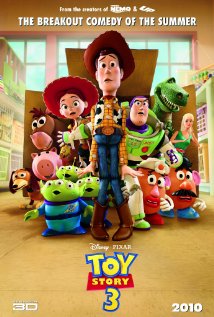
Toy Story 3 (2010), directed by Lee Unkrich

Many years ago, I hired what I thought was a star teacher. He gave an excellent model lesson, had good references, and even played the guitar. Yet I soon discovered a serious flaw. He never wanted to deal with parents. It seems that, once long ago, he was abused verbally and emotionally by an insensitive school parent. The repercussions of that event still lingered and colored his approach to all parents. He was still angry with them, for they were the enemy. Ultimately, I had to let him go because our school welcomed parent engagement and did not see parents as adversaries.

The experience reminded me that sometimes we can let a bad experience define how we behave in the future. In truth, it is a great tragedy if we cannot move beyond a hurtful experience, if we permit anger and ill will towards others to dominate our lives.

Toy Story 3, an animated film that is a parable of human relationships, provides one classic example of this in the character of Lotso, the chief toy in a day care center full of dysfunctional and malevolent toys that lord over the new recruits who come to Sunnyside Day Care. Lotso has allowed a bad experience in his youth to forever taint his relationships with anyone he meets. The back story reveals that Lotso also was once a treasured toy, but his owner abandoned him, or so Lotso thought. In truth, she lost him and did not deliberately abandon him. Lotso, however, lived on the false myth of his abandonment and made that bad experience the seminal one in his life. Anger was what drove him and defined him.

Into Lotso’s monstrous world enter a group of naïve toys, who fear obsolescence when their owner, now grown up, departs for college. They fear abandonment, but take heart in the possibility of finding a warm and friendly environment of a local day care center. From a distance it looks attractive. But a closer look reveals that the ownerless day care toys are not only used but abused. The kids at the day care do not feel any emotional connection to the toys. The children play with the toys and then toss them away. In contrast, the new recruits, accustomed to an owner who had invested in a relationship with them, want in some way to replicate that situation. They want to feel valued, emotionally connected, and respected. The toys are truly us.

Their first impression of Lotso is positive. He is soft spoken and huggable on the outside, but they do not realize he is an angry monster on the inside. His past anger has determined his future.

Jewish tradition tells us that anger is one of the worst traits to possess. In fact, the Talmud compares it to idol worship. When one is angry, it is a manifestation of a lack of belief in God’s providential supervision of the universe. After all, how can one be angry if God is in charge of things? It is a Jewish mode of sensibility to presume that from the aspect of eternity, everything ultimately will make sense because God is orchestrating events in a hidden way which our finite minds cannot comprehend at the moment.

Lotso, whose life is defined by anger, reminds us not to allow negative memory tapes of the past to determine our present or future. It is a bad thing when anger lives rent-free in our brains and influences our present relationships.

Purchase this movie from Amazon.com.

Stranger than Fiction (2006), directed by Marc Forster

Stranger Than Fiction posterAs a rabbinical student, I would often have discussions with classmates and teachers about theological questions that, in the final analysis, have no definitive answers. One classic question relates to the notion of free will. Simply put, if God is in charge and knows all, how can man have free will to choose? One response that a teacher gave to me made some sense and I share it with you.

We are finite creatures and can only live in the present. In this life, we are watching a video which opens with the caution: formatted to fit your screen. In contrast, God sees past, present, and future and his view is the wide-screen version. God is infinite and exists in all three time periods: past, present, and future. This is why He knows all and we cannot. Yet in spite of God’s knowledge of our future, traditional Judaism believes that God, in his infinite kindness, limited Himself and gave man the freedom to act. This problem of free will versus destiny is the crux of Stranger than Fiction, which depicts the ordinary and extraordinary life of Harold Crick.

Harold is an IRS agent whose life is defined by numbers. He also is a lonely man with few friends. The film opens with the viewer observing Harold’s robotic lifestyle, where everything is calculated down to the last second. Then the camera switches to brief scenes of a little boy receiving the gift of a bicycle from his parents and a woman looking for a job. These two characters appear at various points in the movie, and one wonders why since they seemingly have no connection to the plot.

Harold begins to hear a writer’s voice narrating what is happening to him at that moment. He is aware of the voice, but cannot fathom how it can describe his every action as he experiences it. The conceit of the film is that an author, Karen Eiffel, is actually writing his life, leaving him with little free will to exercise. It is frightening when Harold realizes that he no longer is in control of his destiny, especially when Karen writes that he will die “imminently.” The circuitous plot of the film describes Harold’s attempt to come to terms with his seeming inability to affect his future.

This realization that life will end soon moves Harold to be more proactive in the time he has left. He begins a romantic relationship and even learns to play the guitar.  Jewish tradition tells us that we do not know the day of our death; it could be any day. For example, the rabbis teach us to “repent one day before your death.” The commentators explain this to mean that since no man knows the day of his death, he should repent every day. In other words, make every day a special day and fill it with meaning. We should value time and value the people with whom we come into contact.

Harold understands this life lesson. One of his mentors in the film poetically observes that only we can determine if our life will be a comedy or a tragedy. Will our lives affirm the continuity of life or the inevitability of death? The spiritually sensitive person lives with this constant dialectic as he makes decisions each and every day of his life.

The lives of the boy on the bike, the woman looking for job who is now working as a bus driver, and Harold finally converge in the last segment of the film. Harold is at a bus stop and the boy on the bicycle rides in front of the bus. Harold reaches out to save the boy and is hit by the bus. Does he die as the author writes or does he live and exercise free will? The film raises the question of how much free will does man have. Jewish tradition tells us that God is in charge of the world, but God gives man a limited area to exercise free will. As it is written in the Ethics of the Fathers, “everything is foreseen, yet freedom of choice is given….everything depends on the abundance of good deeds.”

Man’s destiny is not totally pre-determined. Man cannot change some things, but there are some things he can do, and that is what Stranger than Fiction affirms. In the face of an all- knowing God, man can still influence his destiny, especially through the performance of a good deed, which is what Harold does when he saves the boy who rides in front of the bus.

Moreover, the film presents a morally sensitive character in the author, Karen Eiffel. She decides to change the tragic ending of her novel. She changes it from a literary perspective; she moves it from a masterpiece to just an average work of fiction in order to protect and save someone. What is paramount to her in the final analysis is not fame but doing the right thing. Morality trumps personal ego.

The movie concludes with Eiffel reminding the viewer that we need to thank God for the small pleasures of life that we often take for granted in our busy daily lives, for the “accessories of life” that are here to serve nobler causes and save our lives emotionally and spiritually. She speaks of the importance of the loving gesture, the subtle encouragement, the warm embrace. It is these little things that make life precious. Harold Crick appreciates this truth when he finds life after almost losing it.

Purchase Stranger than Fiction on DVD from Amazon.