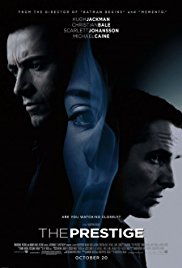
 When I was a kid playing basketball at the local Jewish Community Center, I would often hear adults mentioning famed football coach Vince Lombardi’s comments about winning. Here are some of those quotable quotes: “Success demands singleness of purpose.” “Winning isn’t everything, it’s the only thing.” “Second place is meaningless. You can’t always be first, but you have to believe that you should have been – that you were never beaten – that time just ran out on you.” These statements fit the profiles of the two central characters in The Prestige, a mind-bending tale of two adversarial magicians who spend their lives trying to best the other professionally.
Their initial friendship turns into bitter rivalry when the wife of Robert Angier, known as the “Great Danton,” dies in a magic trick because of a knot tied around her hands by Alfred Borden, a competing magician who is assisting Angier in his show. It is unclear whether Borden disregarded a warning not to use this particular kind of knot and deliberately placed Angier’s wife at risk by making the knot more difficult to untie, or whether he assumed that Angier’s wife could easily free herself from the knot. In any event, after the death of Angier’s wife, the two men go their separate ways, admiring the other’s illusions, but also attempting to damage the other’s professional reputation.
The competition between them intensifies with both men trying to outwit the other and learn the secrets behind the other’s magic tricks. Tragedy strikes Angier again during a trick called the “transported man” when he falls into a hidden giant tank of water from which he cannot escape. Borden watches Angier suffocate and is ultimately accused of murdering him.
The film is full of twists and turns, revealing information about how their magic is performed, and then suggesting that what we see is not really what is happening. One must pay close attention to the machinations of both Angier and Borden to discover the truth.
What is clear is that neither Angier nor Borden play by conventional rules. They both want to be the best magician, and everything in their life is subservient to satisfying the desires of their respective egos. Jewish ethicist Rabbi Dr. Asher Meir in an essay entitled “Ethics and Sportsmanship” writes: “In business, like in sports, keeping score is a legitimate and valuable way of motivating people and inducing them to give their best. But just as sportsmanship in games reminds us that winning is not what’s ultimately important, business ethics reminds us that we don’t win the game of life by accumulating the most ‘monopoly money,’ but rather by doing the most good with our God-given talents.”
In The Prestige, we have two men driven not by doing the best with their God-given talents, but by their personal desire to gain notoriety by creating the best illusion. They have no interest in benefiting society with their skills. All they want to do is provide an “aha” moment to the audience so that their tricks are memorable. For them, family responsibilities are secondary to winning accolades as the best illusionist.
The fates of Angier and Borden remind us that obsessive concern with fame ultimately does not bring us happiness in life. It may for the moment be satisfying, but it does not foster meaningful human connections. The Ethics of the Fathers, a classic of Jewish wisdom literature, reminds us: “He who pursues a name will lose his name.” Yaakov Astor, a veteran Jewish educator, writes: ”Fame is an empty goal; it’s nothing unto itself. The person who gears his every thought and action toward the pursuit of fame cannot grow. Growth is an internal quantity; fame is external, a shell. The person whose entire focus is the external shell is not alive and growing on the inside.” Angier and Borden do not understand this basic truth.
 I remember hearing about the incident. I learned that two young boys were playing around with each other and one of them had a stick with a nail on the end of it. In the course of their “playing around,” the boy with the stick hit the other child in the eye. Blood gushed out and the boy was in great pain.
 A number of years ago, I engaged a contractor to build an addition onto my home. Over the course of several months, he would ask me for an advance on his fee because he needed to buy supplies and pay his workers. I had no experience dealing with contractors and assumed everyone was honest, so whenever he asked for money I gave it to him.
 My son-in-law is a special education educator focusing on autistic students. He helps kids and their families cope with a disability that manifests itself in different ways depending upon many idiosyncratic factors such as age and family background. Therapies that work in one situation may not work in another.
 In the course of my career, I have occasionally met people who are morally inconsistent. One example comes to mind. He was a synagogue attendee and very charitable towards the institutions I represented, but he gained his wealth by selling drugs, a fact I only learned some time after my friend was incarcerated. Jewish law is very clear: you cannot accomplish a good deed by committing an immoral action. However, in the woof and warp of daily life, many people make ethical compromises to justify an affluent lifestyle and the good deeds that one performs through charitable giving.
 As a child, I often read Classic Comics, which presented classic novels in cartoons. I remember reading one of the Sherlock Holmes novels in this format and being fascinated by Holmes’s ability to focus on the details of a case and ignoring extraneous details.
 A family member recently bought a foreclosure home in Florida. A foreclosure is a home owned by the bank because of the failure of the owner to pay his mortgage. From a distance, it looks great for the new purchaser who can acquire a home at a very favorable price; but, up close, a foreclosure has a dark side and can signify a very human tragedy. This is depicted in 99 Homes, an unsettling look at the consequences of foreclosure on decent people who, for a variety of reasons, can’t make ends meet.
 When I taught Hamlet some years ago to a high school class in Atlanta, a student voiced surprise that Ophelia, a woman deeply in love with Hamlet, committed suicide. It prompted a class discussion about how friends experience great pain when they see a loved one suffering.
 Terrorism is very much a part of the world’s landscape at this point in history. Terrorist attacks occur not only in Israel, but in the United States, France, and Belgium among other countries. The world is a scary place, and many are trying to figure out what is the intellectual and emotional appeal of this aberrant behavior, which destabilizes the world. The Dancer Upstairs is a quiet, thoughtful, and tense film that gives us some understanding of the philosophical and practical motives that drive terrorists in the modern world.
 I began my doctoral studies in English in Atlanta in 1972. It was intended to be a 5-year program, but it took much longer because I was busy with earning a living and rearing a young family. I finally received my PhD in 1984, twelve years after I started.
 Kosher Movies