Category Archives: Movie review

127 Hours (2010), directed by Danny Boyle

127-hours-posterMy wife and I enjoy visiting America’s national parks and going for short hikes. I am a bit impulsive on the trails and am ready to start walking at almost any trailhead. My wife is more methodical. She wants to know if the trail is a loop, how long the hike will take, and whether we have enough water to sustain us for the duration of the hike. As I get older, I realize the wisdom in her words, and now I plan carefully for such adventures to insure that I do not put myself at risk.  I thought of my own hiking experiences in the Canyonlands in Utah as I watched 127 Hours, the true story of Aron Ralston, an extreme sportsman who finds himself trapped in an isolated canyon in Utah after a boulder falls on his arm.

The story begins on Friday, April 25, 2003, when Aron is preparing for a day of hiking in Utah’s Canyonlands National Park. Excited about his upcoming adventure, he is careless about his preparation. A clever camera shot of his hand trying to find stuff in a closet reveals that he forgets to take his trusty Swiss knife with him, a fact that will have consequences later on.

Once into his hike, Aron climbs over and through narrow stone passageways, and then tragedy strikes. He dislodges a large boulder, which crushes his right arm against the canyon wall. He calls for help, but no one can hear him. He is in a remote section of the park with no one nearby. Moreover, he has told no one where he was going that day, and his situation soon turns desperate. Realizing that his fate is in his hands only, he begins a video diary with his portable camera and starts to ration his water and food.

As his strength ebbs away, he understands that the sole way to survive is to amputate his arm, a near impossible task with a dull-bladed knife on a multi-tool device. With each passing hour, Aron gets groggier, and thinks about his friends, his family and his uncertain future. Finally, he accepts the reality of his situation and methodically plans to amputate his arm with the crude devices he has available. It is both wrenching and riveting to watch his ordeal.

The ordeal changes Aron. Instead of being the independent adventurer responsible only for himself, he now understands that he needs others. His tortured cry for help at the end of his trial is a recognition that living for oneself is ultimately a lonely existence.

On another level, Aron’s ordeal reminds us of the importance of properly preparing for a dangerous trip, letting people know of your whereabouts, and evaluating the inherent risk before attempting a perilous task. Furthermore, it reminds us to think about the definition of an acceptable risk when it comes to engaging in problematic behavior which may lead to loss of life.

Jewish law is prescriptive regarding the notion of acceptable risk. The Bible says “you shall guard your souls,” which means that we should not do anything that jeopardizes our health and safety. The Talmud even instructs us not to walk next to an unstable or shaky wall. Furthermore, if we build a house, we have to insure that it is safe. If it has a roof that people can traverse, the roof must have a fence. If we own a dog that bites people, we have to make sure that the dogs are in a secure location so that guests to our home are free of danger. Recent codes of Jewish law forbid smoking under the same guideline. Smoking is hazardous to your health and, therefore, is considered an unacceptable risk.

127 Hours is a gripping narrative of survival. Embedded within the story are many life lessons. It encourages us to celebrate and enjoy life, to value the presence of significant others in our lives, and not to be careless and place ourselves in unnecessary danger.
Purchase this movie from Amazon.com.

Marvin’s Room (1996), directed by Jerry Zaks

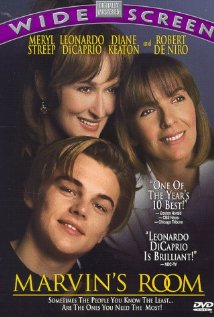
marvins-room-posterBoth of my parents died suddenly while they were still leading active lives. I never had to think about elder care or nursing homes. It was not until a friend of mine asked me to accompany him on a visit to some assisted-living and nursing home facilities that I began to understand the dilemma that families experience when they are facing the reality of caring for a loved one who cannot take care of himself. Children want to do the right thing, but decisions are often made not by considering what’s best but by what is affordable.

There is a scene in Marvin’s Room, a serious drama with lots of comic relief, which captures this dilemma. Two daughters, opposite in temperament, are visiting a senior care facility for their father who has been “dying for the past twenty years,” and who now needs full-time attention. One sister, Bessie, has been caring for Marvin, her father, for the past 17 years, even since he had his first stroke. The other sister, Lee, has been absent all those years, and even now does not want to make a personal sacrifice for her ailing father. She fears that her future will be compromised and states unequivocally: “In a few months, I’ll have my cosmetology degree. My life is just coming together; I’m not going to give it all up, now!”

What brings the sisters together after so many years in the sad news that Bessie has leukemia and may not be able to care for her father any longer. Bessie contacts Lee, who has two boys, and asks her to come with her kids so that they all can be tested as potential bone marrow donors. They may be able to save her life; and as a consequence, Bessie can continue to care for their father. If Bessie passes, the responsibility will fall to Lee. That possible scenario is the catalyst for their visit to the elder care facility.

Complicating factors is Lee’s oldest son, Hank, who has been in a mental institution after deliberately burning down their house in a act of rebellion against his mother whom he hates and who he feels was the cause of the split between his parents. Hank idealizes an absentee and abusive father who he barely knew and his mother feels the brunt of this anger. Family dysfunction abounds.

Marvin’s Room gives us a window into the world of families faced with awesome decisions. It exposes the raw nerves of a family, both challenged and confused by an inevitable future. The film depicts two points of view, one very dark and one optimistic, suggesting that confronting the mortality of a loved one can be a stimulus for reinventing one’s life and reordering life’s priorities. In fact, Lee and Hank finally undergo an epiphany in which they understand that living fully means giving to others, not just being concerned about one’s own needs.

The Talmud tells us that it is better to visit the house of mourning than the house of feasting because the lessons learned there are so profound and so meaningful for purposeful living. Moreover, the Bible exalts the commandment of honoring parents, which is defined in books of Jewish law as providing for the needs of parents, especially when they get older and cannot take care of themselves. This includes feeding them, clothing them, escorting them, and respecting them. Marvin’s Room provides a textbook case of varied responses to a life problem facing many, and in its own idiosyncratic way recommends that love trumps all. Family endures when children and parents care for one another.

Purchase this movie from Amazon.com.

Live Free or Die Hard (2007), directed by Len Wiseman

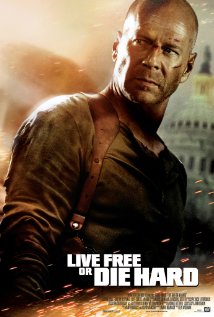
mv5bndqxmde1otg4nv5bml5banbnxkftztcwmtmzotqzmw-_v1_sy317_cr00214317_The computer teacher, the techie, is often the most powerful member of the teaching staff in a high school. He controls the keys to the kingdom of the Internet. He can enable teachers and students to enter the portals of Google, Wikipedia, and a variety of social networks. He can expand their worlds.

As a school principal for many years, I observed the transformation of the school office via computer applications. Instead of two or three secretaries, we eventually needed only one. Instead of dictating speeches and correspondence through a Dictaphone machine, we now wrote and corrected our own material using Microsoft Word. Furthermore, we mostly used the more convenient and speedy electronic mail rather than snail mail, which was slower and used so much paper. Currently, when I have to inform my parents and students in Israel of school news and changes in class schedules and syllabi, we use email and social media outlets, not letters or phone calls.

The computer guru, in truth, can be a beacon of light bringing wisdom and enlightenment to the world, but he can also be a sinister force for evil if he uses the computer to lord over others and take advantage of them. In truth, the computer can be a powerful means to control and shape politics and economics in a destructive way. Such is the premise of Live Free or Die Hard, part of the Die Hard series of movies starring Bruce Willis. In it, a computer genius, Thomas Gabriel, designs a plan to create worldwide chaos so that he can profit from the ensuing panic and destruction. Can he be stopped in time is the classic question in this formulaic but exceptional action-packed thriller. Gabriel begins by sabotaging the nation’s infrastructure. Traffic signals malfunction, trains and planes come to a halt, the stock market closes, and the financial systems of the nation are breached. He then launches a plan to take out the nation’s power grid. Gabriel is able to do this because, as a former national security director responsible for building the security systems, he knows the systems inside and out, including all its vulnerabilities.

Why is he so hell-bent on causing so much human damage through computer manipulations?  The back story informs us that many years earlier he attempted to interrupt a Joint Chief of Staffs meeting to share his professional expertise and to point out weaknesses in the nation’s security system using only his laptop. At the time, he was rebuked and publically humiliated. As a result, he now wants to show all those who mocked him that he truly does have the power to control events and they do not. He wants money and he wants revenge.

Watching this film reminded me of the many people I have observed in positions of power. The best of such people work selflessly for the community with no personal agenda. The worst see the possession of power as an opportunity for payback, to control, and to intimidate. It can be very scary for one who falls within their orbit.

The Talmud tells us in many places that the possession of power brings with it responsibilities. The classic example is King David. He does not seek kingship. Rather it is thrust upon him, and he struggles to leave a positive legacy. He is not perfect, but he tries to be loyal to God and beneficent to his subjects. All he wants is for his people to actualize their spiritual potential, to be all they can be. David understands that power may corrupt, and that it is wise to temper power with an abiding sense of community responsibility. Power is neutral. It is our job to harness it for good.

Purchase this movie from Amazon.com.

Chronicle (2012), directed by Josh Trank

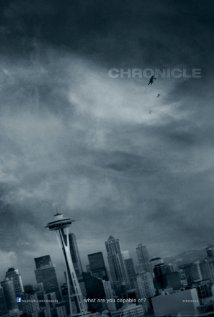
Chronicle posterThe unexpected violence at Newtown, Connecticut, sparked much controversy about legislating tougher gun control laws. Moreover, there has been much discussion about mental illness and the role it plays in these nightmare scenarios where children are murdered by a depressed or belligerent teenager. How can we identify the loner, the mentally unbalanced person, before he acts out his violent fantasies?

Chronicle does not answer any questions, but as a former high school principal for many years, I can tell you that the alienation and loneliness of Seattle high-school teenager Andrew Detmer depicted in this dark, disturbing, and profanity-laden film ring true. I recall vividly a student in my school who always was absorbed in her own world, who had very little meaningful connection to her peers, and who generally seemed depressed. About five years after she graduated, I read in the newspaper that she had been murdered. I never learned the details, but her tragic end was not surprising to me. She was the victim, not the perpetrator, but her social isolation set the stage for a turbulent future.

In Chronicle, we can actually trace the evolution of a high school loner into a full-fledged murderer. To those who interact with him in a pleasant way, Andrew is a decent guy; but under the quiet façade is an angry young man poised to do terrible things.

To combat loneliness, Andrew buys an expensive camera and takes it everywhere to record his life. He is obsessed with filming his day to day existence, which is very unhappy. His mother is dying of cancer, his father yells at him and beats him, and the kids at school bully him. Using the video camera enables him to distance himself from the sordid life he is actually living and allows him to create his own reality.

The crux of the film details the encounter of Andrew and his friends Matt and Steve with a strange substance that gives all of them telekinetic powers. At first, the use of these special gifts is a game, but they soon realize that it is a gift that can be used for good or bad, to create or destroy, to help or to harm.

Over time, Andrew becomes more isolated from everyone and hostile to those who make fun of him. Away from friends and family, he begins to see himself as an “apex predator,” someone who feels no guilt for using his power to inflict pain on those who hurt him. His isolation grows and he ultimately decides to steal and physically to hurt other people to accomplish his personal goals, which to him are reasonable and just. As Andrew’s power grows, he uses it more to advance his own personal agenda, and people feel his wrath.

The Talmud instructs us not to separate from the community. The community is the anchor to normality and connects us to concerns other than our own. Moreover, the community elevates us and enables us to achieve higher levels of spiritual transcendence and holiness. That’s why Jews pray preferably pray in a quorum of ten because ten in Jewish tradition represents the community. Separation from it creates risks for all. Andrew’s aberrant behavior reminds us of this.

Linkage to community perhaps is the antidote to the loneliness that fosters disconnectedness and, in a worst case scenario, destructive behavior. The violence at Newtown should make us think about the idea and reality of community. Do we do enough to welcome the stranger, to make the loner feel accepted as part of a larger community? Do we bring the loner into the family of man or do we let him struggle as he defines himself as an outsider? Jewish tradition tells us that there is more that binds us than divides us. We are all created in God’s image, and there is no fixed image of a godly person. In truth, it is the divinity within every man that connects us all, regardless of how we look or present ourselves to others. If we understand this, then we can make the outsider an insider.


Purchase this movie from Amazon.com.

Winged Migration (2001), directed by Jacques Perrin, Jacques Cluzaud, and Michel Debats

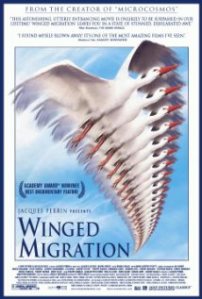
winged-migration-posterThere was a time when my vacation trips would be spent traveling to historical points of interest, exploring museums and art galleries, and learning everything I could about the place I was visiting. In recent years, my downtime is spent differently. I no longer feel motivated to learn facts about specific tourist sites. I just want to travel to new locales and observe. I want to see natural landscapes and soak up the ambiance of the place. I do not want information. I want to feel connected to the universe. I want to see and hear the quiet energy that lies beneath the surface of everyday life. It is a different kind of experience and that is why I enjoyed Winged Migration, an unusual documentary about the yearly migration of birds.

This film tracks a number of species of migratory birds over a span of four years. Some travel over a thousand miles to find food each year; and then when food runs out at their destination, they return the same distance to their point of origin to find nourishment. They miraculously always fly the same route using the stars and familiar landmarks on land, in the sea, and in the sky to locate food sources and to get back home. Familiarity helps them to survive just as it helps us navigate difficult moments in life. In moments of crisis, we can return to our old routines and derive some stability in a stressful environment or situation.

Using in-flight cameras, the bulk of footage in the film consists of birds flying in the air. You can hear the air move under their wings and you have the sensation that you are flying alongside the birds. You are with them in the cold snow of the Arctic regions, you are with them when they escape a powerful avalanche, and you are with them in the bloom of summer with trees and flowers all around. The terrain, seen from the perspective of the birds, is breathtaking. The film truly is a visual work of art.

There is almost no narration in the film. There are just scenes of different species of birds traveling thousands of miles, crossing continents and oceans in search of food. There is no conventional plot. Instead, there are extraordinary images of birds desperately flapping their wings flying from one country to another. The key theme unifying all these migrations is survival. The birds cannot survive if they stay where they are. Movement is critical for survival.

The dominant visual in Winged Migration is a bird desperately flapping its wings to stay airborne on its long journey. For me, it was a metaphor of the human journey through life. All of us want to survive and thrive in life in spite of the adversities and challenges we all face. Like the bird, we have to keep moving and not allow challenges and occasional failures to cripple us.

The Biblical metaphor which captures this Jewish approach to confronting life’s challenges is the ramp upon which the priest walks when he approaches the altar to offer sacrifices. The priest does not climb steps. Rather he traverses a ramp, which has no natural place to stop or rest. The message to the priest, and for all men since the priest represents all of us, is to constantly strive, not to give up in the face of adversity. The Sages of the Talmud suggest that a successful life requires constant forward progress, constant movement and activity. The birds in Winged Migration teach us this valuable lesson.

Purchase this movie from Amazon.com.

The Rainmaker (1997), directed by Francis Ford Coppola

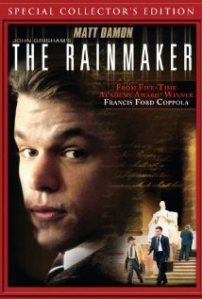
rainmaker-posterA friend of mine has been studying for the actuarial examinations for the past several years, but without success in passing them. He has hired private tutors to help him, taken online courses, and devotes an hour daily to working on practice tests; but the examination still eludes him. He is a very intelligent young man, a National Merit Scholar in Math, but his paycheck is small without the credential of Enrolled Actuary. Presently, he works for a pension fund company which hired him with the hope that he will soon pass the test that will qualify him for more responsibility in the office and a bigger salary. In the interim, his keen analysis of data and company files has enabled his company to save millions of dollars because of discoveries he has made in the accounting processes of his firm, even though he lacks an official actuarial credential.

There is a character in Francis Ford Coppola’s exceptional legal drama, The Rainmaker, who mimics what happened to my friend. Deck Shifflet is a paralegal who has failed the bar exam six times, but he is a master at locating critical information about insurance companies and their economically driven claims policies. His resourcefulness enables him to get hired by law firms who take advantage of his knowledge at a fraction of the cost of a full-fledged attorney.

The Rainmaker revolves around the case of a middle-aged couple, Dot and Buddy Black, who file suit against an insurance company, Great Benefit, which denied insurance coverage for a bone marrow transplant for their 22-year old son Donny Ray, dying of leukemia. In spite of religiously paying their premiums for many years, they are victimized by small print in the insurance contract which precludes the company paying for aggressive procedures to cure their son. Moreover, Great Benefit has a corporate policy of denying all claims when they are first presented. It is only the customers who press on despite initial rejection of their claim who receive any compensation at all.

Rudy Baylor, a young attorney representing the Blacks against the high-powered lawyers for Great Benefit, has just passed the Tennessee bar exam; but he has never before argued a case in front of a judge and jury. It is a daunting task for a rookie attorney, but he has a secret weapon in Deck Shifflet. When all seems lost, it is Deck who repeatedly comes up with an innovative strategy that potentially can win the case, or locate a crucial witness who has long since dropped out of sight.

The Ethics of the Fathers tells us that the wise person learns from every man. Deck in professional terms is a loser, but he possesses the street smarts needed to be successful in the sinister world of insurance fraud. Deck reminds us that the possession of a credential, a degree or a license, does not guarantee wisdom, insight, or financial success.

Rudy recognizes Deck’s value and partners with him in his law practice. It is a partnership founded on genuine friendship, mutual trust, and respect. Each one relies on the other for expertise in the area where they are weak. Rudy’s sincerity and humility impress the jury, but it is Deck’s resourceful research and knowledge of human nature that buttress Rudy’s legal arguments before the jury.

Our Sages teach us that we should never belittle any man for every man has his hour of glory, his moment in the sun. The synergy of Rudy and Deck remind us that every person has something to contribute to the greater good regardless of pedigree, regardless of intellectual or social background. No one should be considered insignificant.

Purchase this movie from Amazon.com.

3:10 to Yuma (2007), directed by James Mangold

Three ten to Yuma posterI recently taught a poem entitled “Those Winter Sundays” by Robert Hayden to my eleventh grade English class. The poem is about the relationship between fathers and sons, how a son finally understands how much his father did for him as he raised him from boy to man. He remembers how hard his father worked to maintain his household and “no one ever thanked him.” He acknowledges that he was unaware of his father’s love for him, which was expressed in taking care of the daily needs of his family: “ What did I know, what did I know of love’s austere and lonely offices?”

These lines resonate in many films that show the complex relationship between fathers and sons, many of which reveal the son not appreciating his father until the father has passed away.

3:10 to Yuma is the story of Dan Evans, a poor rancher and veteran of the Civil War, who is struggling to keep his land in the face of people who want to take it away from him and sell it to the railroad at exorbitant profit. When two men set his barn on fire, he resolves to make things right; but his son, William, has little hope that his father can do this. When Dan tells his son that he will understand when he walks in his shoes, his son bitterly responds, “I ain’t never walking in your shoes.” He sees his father as weak and incapable of fixing anything. He does not see inner courage, only outer trembling.

Dan is pained by his son’s low estimation of him and will do anything to be a hero in his eyes, even escort Ben Wade, a notorious bank robber and murderer, to federal court in Yuma where he will probably be hanged. For a payment of $200 from the railroad company, a huge sum in those days, he puts his life on the line to save his farm and to redeem himself and his family. He wants his son to know that he was the one who brought Ben Wade to Yuma for trial when nobody else would, a feat that would impress and draw the admiration of his son. Against near impossible odds, he gets Ben Wade to the train to Yuma but with tragic consequences.

The Bible tells us that the commandment of honoring parents is rewarded with long life. A parent of a student I teach recently complained to me about his teenage son who almost never speaks to him. My friend said:  “I wish he was an adult already. Then we could talk to one another normally.” He also told me that even though he often told his son that he loved him, his son never told him “I love you, Dad.” He had no doubt that his son loved him but he wanted his son to have long life; it weighed on his mind that his son didn’t seem to understand how meaningful it would be if he would be more forthcoming with expressions of parental appreciation and affection.  To the father, expressing love verbally was a way to honor parents and for his son to receive the reward of long life. He was perplexed that his son was not taking advantage of this spiritual opportunity. Moreover, my friend was fearful that he would no longer be living in this world when his son finally wanted to verbally express his love.

3:10 to Yuma has a lot to say about father-son relationships. It reminds us of how much a father wants to be a good role model for his son, and how satisfying it can be to a parent when children express appreciation and love. A parent-child dynamic may be rooted in love, but the roots have to be watered for that love to flourish.

Purchase this movie from Amazon.com.

The African Queen (1951), directed by John Huston

African Queen posterI serve as a volunteer matchmaker on an international internet site, and as a volunteer I can choose which age group on which to focus. Although I try to be helpful to people of all ages, I especially like to work with the over-40 crowd. This is a challenging group since I find that the over-40 group is perceived very negatively as consisting of people who are confused, commitment-phobic, who have unrealistic expectations about a marriage partner, and who possess a streak of selfishness. While there may be a grain of truth in such a stereotype, I have found that, in most cases, these people have simply not found their destined one yet. And so I research the site and try to find a suitable match, and sometimes I happily succeed.

The idea that love begins after 40 is given cinematic reality in the classic film, The African Queen, starring a mature Humphrey Bogart, who plays Charlie Allnut, and Katherine Hepburn, who plays Rose, a Christian missionary. Charlie Allnut delivers mail and supplies to a remote African village while World War I rages in Europe.  When a contingent of German soldiers arrives at the village and sets it afire, Rose’s brother, also a missionary, becomes despondent and commits suicide. Charlie volunteers to take Rose, his surviving sister, to safety, and so begins their dangerous journey on Charlie’s boat The African Queen.

Charlie and Rose come from different worlds, but destiny has thrown them together. What begins as an adversarial relationship eventually morphs into love as they share perilous adventures together. Surviving treacherous rapids and the gunfire of German troops, they bond through shared adversity.

What emerges from their mutual trials is the revelation that Charlie and Rose share a common humanity, an innate honesty, and a positive attitude towards life. They are vastly different from their public personas. Charlie is not the proverbial drunken sailor; nor is Rose the conventional missionary.

Also noteworthy is their honest self-appraisal. Rose and Charlie have no illusions about one another. They do not long for a younger love. They live in the moment and want every minute to count. This approach to life is captured exquisitely in the final scene of the film in which Charlie asks a German ship captain to marry Rose and him when they are about to be hung for spying. The captain concludes the ceremony and declares: “By the authority vested in me by Kaiser William II, I pronounce you man and wife. Proceed with the execution.” What happens next defies description. Suffice it to say, the loving couple lives happily ever after.

What makes for a match in Jewish tradition? The Talmud tells us that making a match is like splitting the Red Sea, a miracle of major proportions. As a matchmaker, I can never predict why two people ultimately will connect emotionally. I just make a calculated guess and leave the rest up to God. The African Queen provides several examples of Providence taking over to produce positive results. Rain comes to free a boat entangled in a swamp. Makeshift torpedoes hit a target without being launched by a human being. All demonstrate that we can only do our best; but to be successful, God has to intervene.

Finally, what underpins my volunteer work is the belief that what binds a couple together is not just physical attraction. There has to be an intellectual connection as well. Moreover, there has to be a feeling of a shared spiritual destiny. Therefore, on the client’s profile page, I pay close attention to self-descriptions more than to dimensions of height and weight. Proverbs teaches us that “beauty is vain.” It passes and then we are left with who we really are.

Purchase this movie from Amazon.com.

Equilibrium (2002), directed by Kurt Wimmer

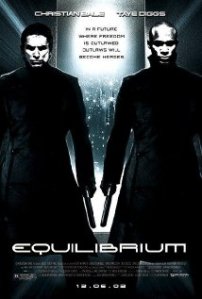
Equilibrium posterWhen I was in college in the 1960s, it was acceptable and fashionable to be a liberal arts major. I had friends who majored in philosophy, history, music, art, and English. Studying the liberal arts was cool because it meant you were a Renaissance man prepared for everything life had to offer. Liberal arts majors understood the past and were better able to navigate the future because of their well-rounded education. I remember hearing a lecture by Rabbi Joseph Soloveitchik, a master of philosophy as well as Torah, in which he said that some of the most important decisions that one makes in life are not based on calculations, but on emotional leaps of faith. He cited the decision to get married to a particular person as one example.  All this ran through my mind as I watched Equilibrium, a violent science fiction thriller which posits that human emotion is the root cause of war and that the way to guarantee a peaceful future is to suppress all emotions.

 Equilibrium (2002) takes place after a Third World War, when a totalitarian state emerges from the ashes with a philosophy that human feelings are the primary cause of conflict in society. Therefore, the way to prevent war in the future is to ban all emotion, to make sensitivity a crime punishable by death. In this society, “sense offenders” are persecuted and all emotionally stimulating material, most of which is under the rubric of the liberal arts, is forbidden. To control people, everyone is required to take daily doses of Prozium, which suppress all emotion.

John Preston, a high-ranking officer and enforcer in this new government, notices that his partner has taken a book of poems from a sense offender rather than incinerate it. For the offense, Preston kills him. Before dying, his partner confesses that the feelings he experienced through reading the poetry were worth the cost of dying for it. When Preston accidently breaks his daily vial of Prozium, he too begins to feel and is remorseful over executing his partner. As time goes on, he deliberately skips his daily dose and becomes a more sensitive, more emotional man.

A crisis occurs when Preston arrests Mary O’Brien for sense offense. In a searing conversation, she asks him why is he alive, to which he responds: “to safeguard the continuity of this great society.” She reminds him of the circular nature of his response: “You exist to continue your existence. What’s the point?” Stymied, Preston asks: “What’s the point of your existence,” to which she answers” “To feel….it’s a vital as breath. And without it, without love, without anger, without sorrow, breath is just a clock ticking.” Preston’s epiphany is now complete and he allies himself with the Underground Resistance forces to overthrow the government. The man of cold intellect is now the man of feeling.

When I first started learning Talmud, I was impressed with the braininess of the Sages who debated and analyzed the intricate text. It seemed to me that the Jewish people had created an aristocracy of intellect where the wise man’s opinion was the one that counted. As I matured in my studies, however, I realized that the Sages were not robots who simply knew all the answers. Rather, they were masters of human psychology, who comprehended not only text but understood in a deep way the thoughts and emotions of man. This is perhaps why one of my instructors told me that he would ask his teachers for advice not only because they were knowledgeable men, but because they understood him as a person as well. They understood his heart as well as his head, and that makes for true wisdom.

Purchase this movie from Amazon.com.


Hachi: a dog’s tale (2009), directed by Lasse Hallstrom

Hachi posterA friend of mine has two dogs. Whenever he and his wife go on vacation, they place the dogs in what is essentially a dog hotel where they will be fed, walked, and cared for while they enjoy their time off from work. Several months ago, one of the dogs died and my friend went through a genuine grieving experience. He was depressed, very mellow instead of his usual upbeat self, and generally quiet as he processed his loss. When I spoke to him, I felt that the dog was not just a dog to him, but functioned like a human friend, always there with him in times of trouble to comfort him and provide a beacon of light in dark times. The dog was a real companion that made his life more happy, more positive, and more fulfilling.

My friend’s attitude towards dogs resonated as I watched Hachi, the story of a remarkable dog who feels a special bond with its owner. Sent as a gift in a cage from Japan, the cage falls off a baggage cart leaving the dog alone and in danger. Professor Parker Wilson finds him and tries to locate its owner but to no avail. Soon he forms an attachment with Hachi and keeps him, much to the dismay of his wife Cate, who does not want a dog in the house. Cate relents, however, and soon the dog feels at home in the Wilson household.

One morning, Hachi follows Parker to the train station and returns in the afternoon by himself. There he greets his master as he exits the train station after a day at work. This ritual continues for a very long time, until Parker suffers a sudden fatal heart attack. The Wilson house is sold, Cate moves away, and Parker’s daughter Andy and her husband Michael take Hachi to live with them. Hachi, however, finds a way to return to his original home and then to the train station where he waits patiently for Parker for the next nine years. Hachi is fed by local vendors who remember his devotion to Professor Parker each day as he waited for him to return home.

Hachi is a dog story, but it is more than that. Like Aesop’s fables, animal stories are a metaphor for the human experience. Hachi reminds us to be intensely aware of the gratitude that we should show towards friends and family. Hachi is a foundling and Parker rescues him. That act of kindness has a ripple effect, remembered by Hachi for the rest of his life and celebrated by the many people who witnessed this act of loyalty and devotion by a dog.

The Talmud makes a similar point when it tells us that if someone teaches us only a single letter or a single verse, we must give that person honor. We are indebted to all those who are benevolent towards us.

In Judaism, the training ground for the nurturing of kindness is the home. It is here that the kindnesses that spouses show for each other and the kindnesses that parents show for children are locked into the family’s DNA. Here acts of kindness happen in the moment, but they transcend the moment and establish a psychological bank account for generations. The changing of a diaper, the emergency trip to the hospital, the act of giving birth all create emotional connections that are unbreakable.

At the heart of Hachi is the message that kindness needs to remembered and perhaps even memorialized. It is a dog story that tells us how important and meaningful it is to treasure the kind acts of others.

Purchase this movie from Amazon.com