Category Archives: Romance

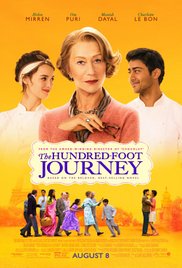
The Hundred-Foot Journey (2014), directed by Lasse Hallstrom

hundred foot journeySome people are passionate about food; others eat simply to be nourished, lacking interest in food preparation and presentation. I remember watching one of my Torah teachers eating a piece of gefilte fish almost every day for lunch in the Yeshiva. He ate at his desk in the study hall and did not want to waste a moment in walking to a nearby restaurant.

I also vividly recall spending a Friday night meal with the two heads of the Yeshiva I attended in ninth grade. I accompanied them on a fund-raising outing to the Five Towns where they attempted to storm local pulpits and appeal for money to sustain the Yeshiva in difficult financial times. On Friday night, our main course consisted of hard-boiled eggs, but that did not dampen the rabbis’ enthusiasm for the holy Sabbath. They sang sacred melodies until the wee hours of the morning. In contrast, in The Hundred-Foot Journey, money does not limit the ability of people to eat fine food, and all the characters are students and worshippers at the shrine of good cuisine.

Because of political turmoil and danger to life in Mumbai, India, Hassan Kadam and his family move to France where they hope to open a restaurant similar to one they owned in Mumbai. When their van breaks down, they are forced to rely on the kindness of strangers and one kind stranger does appear. She is Marguerite, a young woman who volunteers to take them to a local car mechanic and who also serves them platters of scrumptious and attractive food. The Kadam family is impressed both with her generosity and with her cooking.

While waiting for the repair, Papa Kadam wanders around the town and discovers an abandoned restaurant for sale. He sees the purchase of the restaurant as somehow divinely ordained, a message from his deceased wife that his car did not break down in this village for no reason, but rather to enable him to find a suitable location for his restaurant. Against family objections, he buys the property and the family works diligently to transform the decrepit property into Maison Mumbai, a food emporium specializing in Indian cuisine.

All is not fine, however, when Madame Malory, the owner of a award-winning restaurant across the street, about 100 feet away, sees Maison Mumbai as a serious competitor encroaching on her business. Meanwhile, Hassan, a gifted chef, strikes up a friendship with Marguerite who he discovers is the sous chef at the competing restaurant. She shares with him her passion and love for cooking food.

War breaks out between Papa Kadam and Madame Malory when Madame Malory asks to see the menu of Maison Mumbai, and then proceeds to go the market and purchase all the ingredients that Papa needs to cook his food. Papa retaliates by doing the same thing to Madame Malory, and so the hostilities continue.

Tempers boil until someone torches Maison Mumbai. Then Madame Malory, feeling guilty for encouraging a negative attitude towards her competitor, tries to expiate her sin by helping to fix the damaged restaurant. Papa and Madame become friends and Hassan becomes the bridge of their reconciliation.

Clearly recognizing Hassan’s amazing talents as a chef, they both encourage him to go to Paris where he will fine tune and broaden his cooking repertoire in the world-class restaurants of the city. Hassan, however, is conflicted during his sojourn in Paris. Does he truly want to be in the rarefied ambiance of one of the great culinary cities of the world, or does he want to be with Marguerite in his adopted hometown in rural France? Wherein lies his destiny?

Food preparation and presentation is at the heart of The Hundred-Foot Journey, but the film suggests that there are more important things that motivate people. It is good to appreciate passionately the sundry varieties of food that God has given us, but it is more important to passionately value our human connections, which endure beyond mealtime.

For the Jew, the Sabbath is the day that celebrates the enjoyment of food. The Sabbath table is supposed to be beautiful and enjoyable because it marks the Sabbath as a day different from the rest of the week. During the week, the emphasis is on the nourishment value of food. The Jerusalem Talmud states: “The world can live without wine, but it cannot live without water; the world can live without peppers, but it cannot live without salt.” The comment is a reminder of the value of simple fare that enables us to live. We should eat to live and not live to eat.

Purchase this movie from Amazon.com.

Beyond the Sea (2004), directed by Kevin Spacey

beyond the sea posterThere is a brief scene in Beyond the Sea, a biopic of singer Bobby Darin, which resonates with me personally. Bobby unbuttons his shirt and reveals his scar from open-heart surgery. It looks like a long zipper on his chest. I, too, have had open-heart surgery and remember other patients telling me I am now a member of the “zipper club,” all of whose members brandish an extended scar on their chest.

But there is something more that animates those who have experienced this kind of operation. All of us have an intense appreciation for the everyday miracle of good health, and all of us are sensitive to the reality that life is unpredictable and we have to both treasure and maximize our moments. This is the subtext of Bobby Darin’s meteoric rise to fame.

The film begins with the early history of Bobby Darin as a young boy plagued by many bouts of rheumatic fever which leave him with a weak heart. Doctors tell his mother that her son will be lucky to live past his teen years. Bobby, upon hearing this dire prognosis, is motivated to make the most of every moment of his life. He wants to rival Sinatra’s success; and so he forms a band, playing any venue he can to solidify his fan base and to develop his talents.

He achieves success with a recording of “Splish Splash,” a rock and roll song that makes him a teen idol. But Bobby does not want that kind of fame. He aspires to sing melodies with a big band, and eventually achieves major renown with his iconic version of “Mack the Knife.”

Bobby’s burgeoning success gets the attention of Hollywood where he is cast in a movie with Sandra Dee, an eighteen-year actress whom he marries after a brief courtship. Later he receives an offer to appear in Captain Newman, M.D. as a shell-shocked soldier, a performance that earns him an Academy Award nomination.

As musical tastes change, Bobby finds himself out of sync with contemporary musical trends and his popularity plummets. Bobby, however, does not give in to despair but rather finds a way to redefine himself as a musical artist for a new generation of admirers.

Bobby values the moment, does not take life for granted, and wants to make the most of the time he is given on earth. His childhood realization that he will not live into old age stays with him for his entire career, making him a super achiever. Although he died at age thirty-seven, his music still remains vibrant in the 21st century.

The Ethics of the Fathers cautions us to repent on the day of your death. How do you know when is your last day? You do not; therefore, repent every day since any day might be the end of your life. It is instructive to watch Bobby and Sandra resolve a heated argument. Bobby throws around furniture and smashes windows on his car, driving away in anger. He returns a few minutes later and, embracing his wife, realizes that life is short and he cannot let anger rule him. He must reconcile right away so that he and his wife can get back to the same page of their basically loving relationship.

Scripture tells us that it is better to visit the house of mourning than the house of feasting. The Sages explain that in the house of mourning, we entertain thoughts of our own mortality; and that is a spur for us to use time wisely, not to waste a moment.

Moreover, our forefather Jacob always felt he did not deserve God’s many kindnesses and so he constantly felt vulnerable. Feeling vulnerable makes you want to achieve more because you do not know what tomorrow may bring. This kind of sensibility pervades the psyche of Bobby Darin, who understood that any moment might be his last. Beyond the Sea reminds us of the brevity of life and to treasure every minute.

Purchase this movie from Amazon.com.

The Best Years of Our Lives (1946), directed by William Wyler

best years of our lives posterWhen I was in high school, I had a part-time job at a local pharmacy, working the evening shift from 4 PM until 11:30 and all day Sunday. It was the only store open on Sunday during the late 1950s, before the days of 24/7, or 24/6 in Israel.
One Sunday, a customer entered with a frightful face that was hard to look at. It looked like part of his face had been blown off. He had no nose, just a hole in the middle of his face where a nose was supposed to be, and his ears were deformed as well. Although his mouth was distorted, he spoke normally and I understood all of his requests. In fact, he was the best customer I had all day, for he bought gifts for his family that he would see later that day.

Many years later when I was reading Dalton Trumbo’s controversial anti-war book Johnny Got His Gun, I thought of him. I thought of him again when I heard Bob Dylan’s anti-war song “John Brown,” which is about a boy who leaves for war amid cheers and returns damaged both physically and mentally.

The classic film The Best Years of Our Lives deals with the aftermath of war and the challenge that servicemen face when they re-enter the world after their wartime experiences. The movie presents three different responses in the narratives of Fred Derry, Al Stevenson, and Homer Parish. The world has moved on, and these men come back to an unfamiliar landscape, but one to which they must adjust if they are to lead successful lives.

Fred was a captain in the Air Force, where he served valiantly to protect his fellow soldiers, but prior to the war he was a soda jerk with little education and without much of a future. Al was a sergeant who saw action in the Pacific, and he returns to an executive position at the bank for which he worked before the war. Homer was a star athlete, but lost his arms below the elbow in a ship fire. For him, the tragic legacy of the war lingers because of his physical disability. Now he has hooks instead of hands and his self-esteem has plummeted.

Homer, engaged to Wilma, feels that people see him as a freak of some kind, causing him to withdraw from Wilma. He does not want to be a burden to her, yet he loves her dearly. In a sublimely touching scene, he shows her what he has to do to manage his disability, for he cannot button his pajamas or open a door. With tenderness, Wilma buttons his pajamas and pledges her love to him. It is a happy ending to a stressful time in Homer’s life.

Jewish tradition has a special take on disabilities of all kinds. In the Talmud, there is a strange story about an extremely ugly person. The Talmud recounts that Rabbi Shimon ben Eleazar encountered this man; and when the ugly man extended a greeting to him, Rabbi Shimon mocked him. The ugly man then responded: why not go to the Artisan who made me and tell him “how ugly is the vessel You made.” Rabbi Shimon realized that he spoke cruelly, forgetting that God is the final arbiter of disability, and begged the man for forgiveness.

What the story teaches us is that God is the artisan that made all men, some ugly and some beautiful, and physical appearance has little or nothing to do with the way God sees us. God relates to what is inside, not to what is on the surface. This reflects how we should relate to the disabled, not with insensitivity, but with compassion and love, recognizing that we all are created in God’s image. Homer’s story in The Best Years of Our Lives reminds us to treat all people, and especially the disabled, with kindness, with respect, and with love.

Purchase this movie from Amazon.com.

The Railway Man (2013), directed by Jonathan Teplitsky

railway man posterA friend once told me when he was going through some difficult times that his wife counseled him never to let someone live rent-free in his head. In other words, if you have issues with someone, resolve the issue and do not allow it to weigh you down or preoccupy your thoughts. Preoccupation with a negative experience or negative person can prevent you from accomplishing your goals. It is wise to let go of the past so you can have a future.

This essentially is the dramatic crux of The Railway Man, the story of Eric Lomax, a British officer captured by the Japanese in World War II. Sent to a prisoner-of-war camp, he is brutally tortured for building a radio receiver out of spare parts. Although his only goal was to hear news about the progress of the war that might lift his spirits and those of other prisoners, his captors view him as a spy and punish him savagely. The scars of that torture remain with him even after the war, giving him nightmares and horrific memories that disturb his emotional equilibrium.

For many years, Lomax suffers psychologically because of his wartime torture. It is only after his marriage to Patti, a calming influence in his life, that he decides to confront the demons of the past so that he can have a normal life, free of frightening dreams that take him back to his Japanese incarceration.

Eric discovers that the Japanese secret police officer, Takeshi Nagase, who brutalized him escaped prosecution as a war criminal and now works as a tour guide at the site of the old POW camp. Lomax travels there and confronts his old nemesis, threatening to kill him. But Eric is essentially a decent man unable to kill an unarmed man. His humanity touches his former nemesis, who reveals his sincere remorse for his actions so many years before. He reminds Eric that he did what he did because he thought his country’s survival was at stake. Only after the war did he see the objective cruelty of his behavior.

The encounter with Eric paves the way for reconciliation between villain and victim. Their portentous meeting is cathartic for Eric and allows him to move beyond the memory of his past suffering into a happier, more life-affirming existence. After their meeting, he writes to Takeshi: “Dear Mr. Nagase, the war has been over for many years. I have suffered much, but I know you have suffered, too. And you have been most courageous, and brave in working for reconciliation. While I cannot forget what happened in Kanchanaburi, I assure you of my total forgiveness. Sometime the hating has to stop.”

What enables him to forgive Takeshi is Eric’s deep love for his wife, Patti, who truly wants Eric to move beyond his past suffering into a happy future. His abiding affection for her motivates him to transcend painful yesterdays and focus on the present. Patti never pushes him to confront his past; rather she gently and lovingly suggests that he needs to confront the past so that they can build a happy marriage, free of painful memories. She is the helpful, supportive presence that enables him to move forward with his life.

When Adam marries Eve, the Bible uses a strange phrase to describe Eve’s relationship to Adam. The Hebrew phrase is ezer k’negdo, which literally means “she is a helpmate in opposition to him.” It is a contradictory and confusing description. The Sages explain the phrase as follows: if a man is worthy, then his wife will help him achieve his goals in life. If he is not, then she will work against him and prevent him from accomplishing his life’s goals.

Eric is a worthy man, blessed with Patti as his wife, for she enables him to confront former times and become emotionally healthy for the balance of his life. Patti does not judge him or criticize him. She only seeks to help him, and she does this by giving him the psychic room to resolve the issue on his own. The Railway Man is a testament to the resilient spirit of man, which can often be attributed to the resilient and wise spirit of his wife.

Purchase this movie from Amazon.com.

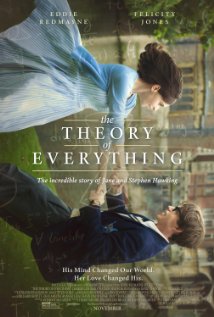
The Theory of Everything (2014), directed by James Marsh

theory of everythingI saw The Theory of Everything shortly after I underwent an unplanned coronary bypass operation. For the first time in my life, I understood experientially what it means not to have control over one’s body. I felt completely vulnerable and the experience evoked much introspection. It, therefore, was not difficult for me to relate to the catastrophe that takes over the life of Stephen Hawking, a Cambridge Physics student who suddenly discovers he has a motor-neuron disease, which is known today as ALS. It is a progressive disease in which one loses all physical control of one’s body. Only the brain is still functional.

The narrative begins at Cambridge where Stephen meets Jane Wilde, a literature student. In addition to being physically attracted to one another, they have a strong intellectual compatibility and soon fall in love. When Stephen discovers his motor-neuron disease, Jane does not abandon him; instead she decides to marry him and be a source of love and support through his difficult medical journey.

Stephen continues at college and receives his doctorate in physics. He shows great promise in the world of academia, but as his illness progresses his relationship with his wife is strained. Amazingly, they have three children in spite of Stephen’s physical challenges and his marriage miraculously survives for a number of years.

To manage her stressful life at home, Jane joins the church choir, which for her is a natural extension of her faith. Her religious sensibility is something which Stephen does not share; being the detached scientist, he can only relate to that which is objectively verifiable.

As the disease worsens, technology comes to the rescue, enabling Stephen to talk through a computer with a built-in voice synthesizer. He becomes deeply engaged in his work and less engaged with his wife, who is finding life with Stephen difficult and stressful. Eventually, they divorce amicably as Stephen’s academic career blossoms allowing him to be productive intellectually in spite of his debilitating physical state.

Later on when they visit the Queen of England for an important personal audience with Her Majesty, Stephen asks his former wife and his children to accompany him. He smiles broadly at his children and says to Jane, “Look what we made.” Stephen understands that his greatest and most satisfying legacy is not his scientific publication but rather his children. They are the legacy that matters.

The first commandment in the Bible is to be fruitful and multiply. Having children creates a legacy. According to Jewish law, this commandment is fulfilled when one has a son and a daughter. Rabbi Mordechai Becher insightfully observes: “having children also helps the individual achieve his purpose in creation, by improving his character. Nurturing, caring for and educating children encourages the development of sympathy, mercy, and sensitivity to others.” Having kids compels one to think of others, and not be totally absorbed by one’s own needs.

Moreover, Jewish tradition mentions ways people can have “children” even if they physically cannot produce children. If one is not blessed with the ability to have kids, then a legacy of good deeds can resonate into the future. If one is a teacher, one can raise many disciples because students are viewed as one’s children. When a teacher passes along wisdom to subsequent generations, he is leaving a legacy of wisdom for his students and the children of his students.

The Theory of Everything reminds us that Hawking’s greatest gift to the world may not be his scientific theory, but his children who are the living embodiment of his thoughts and his hopes for the future. The insights and wisdom he imparts to them in the crucible of daily life find expression in the words and personalities of his children who live after him.

Purchase a copy of this movie from Amazon.com.

The Nutty Professor (1963), directed by Jerry Lewis

nutty professor posterIn high school, I was not a very serious student, so it was unsettling for me when I entered Yeshiva University as a freshman and found myself in a class with very bright students who masterfully controlled the ebb and flow of class discussion. Because of my low opinion of my own academic background, I rarely raised my hand when I had a question and rarely contributed to class discussion. It was a case of low self-esteem that had ripple effects. Because I thought little of my own intellect, some of my professors thought the same of me. Because of my non-participation, they thought I was not capable of adding to the discussion, and so they didn’t call on me. It took me a couple of years to overcome this feeling of intellectual inferiority; but when I did, things changed for me and in my teachers’ evaluation of me as well.

Self-esteem is what The Nutty Professor is all about. Professor Julius Kelp is a shy, socially inept teacher, whose classroom experiments often end in disaster. When a bully humiliates him, he is motivated to join a fitness club in the hopes of overcoming his lack of style and poise. It does not work. However, in the recesses of his chemistry lab, he is able to concoct a potion that transforms him, albeit for a short time, into the suave lady’s man known as Buddy Love.

As Buddy Love, he has the confidence to pursue a relationship with Stella Purdy, an attractive student of his. Stella is repelled by Buddy’s arrogance but finds him attractive in a strange sort of way, suspecting that beneath his pompous and crude persona rests a person of genuine worth.

Complications ensue when the mystery concoction wears off at inopportune times, leaving Julius conflicted and confused. Eventually Julius comes to the realization that he has to be himself in order to become a whole human being.

Accepting himself as he is, he finally declares: “ I don’t want to be something that I’m not. I didn’t like being someone else. You might as well like yourself. Just think about all the time you’re going to have to spend with you. And if you don’t think too much of yourself, how do you expect others to?” It is a simple statement, but full of wisdom as Julius embarks on a new stage of his life with Stella, who now sees him as a genuine and likeable human being.

Self-esteem is a major focus of the works of Rabbi Abraham Twerski, a psychiatrist specializing in problems of addiction. He defines self-esteem as “a true and accurate awareness of one’s skills, capabilities and limitations.” If the awareness is not rooted in reality, then one is living a delusion. Twerski believes that a great many psychological problems are due to low self-esteem in which a person devalues himself. He possesses a negative self-image, which leads him to accomplish little and feel downcast most of the time.

A positive self-image grows where a person feels he has value. The Bible tells man he is created in God’s image, which implicitly means he has value. God does not command us to succeed in everything we do; rather He simply wants us to live a life of godliness as prescribed by the commandments in the Bible.

The Jewish institution of the minyan, the required ten men needed for public prayer, drives this point home. Nine great wise men cannot enable public prayer. You need a tenth, and how much wisdom he possesses is not part of the equation. Everyone counts. No matter how low on the status scale, you are still capable of making things happen, of enabling the community to thrive. The Nutty Professor reminds us to be ourselves, to understand that everyone matters, and to continually nurture our self-esteem.

Purchase this movie from Amazon.com.

Greystoke: The Legend of Tarzan, Lord of the Apes (1984), directed by Hugh Hudson

greystoke poster When I was a student at Yeshiva University many years ago, there was a rabbinical student that was blind. Because of his disability, I was not at ease in his presence. I did not know how to connect to him and so I said nothing. Gradually, however, I noticed that some senior students and my teachers spoke to him easily, with warmth and genuine friendship, engaging him on a wide variety of topics. They, by example, showed me that I had to leave my preconceptions at the door, and relate to the disabled as regular people, and not treat them as social oddities.

This memory resurfaced as I watched Greystoke: The Legend of Tarzan, Lord of the Apes, a reimagining of the classic Tarzan myth but based primarily on the original source, Edgar Rice Burrough’s novel. The narrative begins in Scotland in 1885 where the newly married John Clayton of the affluent House of Greystoke is departing for a sea voyage to Africa with his pregnant wife, Alice.

Off the coast of Africa, the ship is caught in a storm and sinks, leaving John and his wife stranded in the jungle. They set up living quarters as best they can, and Alice bears a son. Soon after, she falls ill and dies, and John dies in a confrontation with a violent gorilla. The surviving baby, reared by a clan of apes, grows up thinking that it is an ape, emulating all their behaviors.

Many years later, Phillippe D’Arnot, a member of an English hunting party discovers the boy, Tarzan, and brings him back to Greystoke, the family estate, where he is reunited with his grandfather. The young man’s adjustment to his new home is not simple as depicted in a formal dinner scene in which Tarzan, now known as Johnnie, piles large amounts of food on his plate, is reluctant to return his plate to the waiter, and drinks his soup directly from the dish.

What is instructive and illuminating is the response of Johnnie’s grandfather to this bizarre behavior. He puts aside his soup spoon and also drinks his soup directly from the bowl. He understands immediately how strange Johnnie’s behavior appears to the rest of those dining and wants to provide a different paradigm of how to deal with someone who is different. Johnnie is not the other; he is one of us. Johnnie may not have a typical disability, but it is a social disability and the guests need to accept the “otherness” of the other, and make him feel at ease.

A similar story is recounted about Rabbi Yisrael Salanter, a great teacher of Jewish ethics and character development. When a dinner guest felt embarrassed because he spilled wine on the table, Rabbi Salanter spilled his own wine glass, claiming the table was not steady; therefore, the guest should not feel uncomfortable at his own faux pas.

The Torah does provide a general approach for relating to people with disabilities. First and foremost is the Biblical notion that we are all created in God’s image. This means that everyone, even those who are mentally challenged, deaf, or blind, have to be treated with respect because they all reflect an aspect of the divine. Moreover, understanding that we are all in God’s image implies that we accept the inherent diversity amongst all men, and we should do our utmost to connect to everyone, not only those who look and think like us. For example, the Sages rule that a blind man can be called to make a blessing over the Torah in the synagogue just like a sighted person even though the blind man cannot read the text. The goal is participation and integration into the community.

Greystoke, which deals with the odyssey of one man’s journey from the wild terrain of Africa to the civilized world of Scotland, is not a story of how to relate to people with disabilities. It is essentially a gripping tale of adventure that considers specifically whether Johnnie Clayton, aka Tarzan, can transition from the jungle to civilization. Can he survive all the emotional and psychological trauma that he faces in managing the dissonance between such disparate worlds?

The film presents no easy answers; but, along the way, considers the question of how we treat those who are different from us. Do we regard them as curiosities or do we welcome them into the family of man?

Purchase this movie from Amazon.com.

Big Miracle (2012), directed by Ken Kwapis

big miracle posterWhen I moved to Israel, I had trouble understanding the political system here. Unlike the United States, there are many, not just two, political parties jockeying for power. In the recent elections, I saw first hand the implications of this multi-party system. Every party has its own agenda and pushes it strongly. However, when there is a crisis and one issue dominates everyone’s thinking, then the smaller parties promote the larger party in order to insure that the issue driven by crisis is resolved for benefit of the entire nation. Crisis brings everyone together, even if in ordinary circumstances they would not agree on anything.

The notion that crisis brings people of different viewpoints together is at the heart of Big Miracle, a family film about the extraordinary rescue of whales who, as they make their 5000 mile annual migration, are trapped because of rapidly forming ice in the Artic that blocks their route to the open sea.

Adam Carlson, a TV newsman working in Barrow, Alaska, would like warmer climes and a broader marketplace for his talents, but destiny gives him an opportunity to pursue a great human interest story just when his commitment to being in Barrow is flagging. When he reports on the local news about the plight of the trapped whales, the story is picked up and featured on the national networks. His ex-girlfriend, Rachel Kramer, an avid environmentalist working for Greenpeace, encourages Adam to enlist the aid of everyone to save the whales both because it is the right thing to do and because it is good public relations to participate in the rescue effort. Representatives from oil companies who want to drill in wilderness areas and environmentalists, normally hostile enemies, join ranks to save the whales. Moreover, journalists of competing entities descend on Barrow to witness the rescue attempt and to write about a story that is mesmerizing people around the world.

Soon a working coalition forms between the local Alaskan whale hunters, environmental advocates, and the oil drilling companies. Even the American and Russian militaries join to free the trapped whales. Each employs a different strategy to rescue the whales, but all strategies are coordinated with one another.

The Midrash tells us that when the Jews first came to Egypt, they were twelve tribes who saw themselves possessing a common destiny as articulated by their father Jacob. Once there, however, factions developed over time; and as the slavery of the Jews progressed, there was more friction between the people. Only when the punitive decrees of Pharoah intensified did they become more unified. Adversity drove them together, until finally at Sinai, the unity of Israel was restored as they accepted the Torah as one, unified nation. A common goal took disparate elements of a nation and melded then into one people.

This reality of working for a common purpose is what underpins the miracle in Big Miracle. It is a familiar case of different interest groups leaving their personal baggage at home because of a desire to fulfill a larger purpose that transcends the individual.

This is an important insight to keep in mind when building bridges between people and institutions. A focus on the big issues that connect people enables one to accomplish a lot more than one individual could. An illustrative example is the requirement in Jewish law for the presence of ten men for communal Jewish prayer to take place. There is no requirement that the ten men think alike or practice their faith in identical ways. All they have to do to reach God is to stand together as one.

Purchase this movie from Amazon.com.

A Tale of Two Cities (1935), directed by Jack Conway

tale of two cities posterI recently had dinner with a friend who shared with me his disappointment that his son at age 37 was still unmarried and was leading a life contrary to the values with which he had been raised. I told him that his son is still on a journey. It is not yet complete and his son may yet fulfill his hopes and dreams. The important thing was never to give up for the future is unknown. Past mistakes don’t always predict tomorrow’s consequences.

A Tale of Two Cities is a story of one man’s personal redemption from sinner to saint. The Talmud tractate of Avodah Zarah (10b) observes that there are people who can earn their portion in Olam Haba, the world-to-come, in one hour, suggesting that an entire life of sin can be overcome by repenting in the final moments of one’s life. This basically is the narrative arc of the life of Sidney Carton, the hero of A Tale of Two Cities.

The film opens on the eve of the French Revolution when Lucy Manette travels to France from England to rescue her aging father, who has been a prisoner in the Bastille for many years. During the trip, she meets Charles Darney, a French aristocrat, who is sympathetic to the plight of the downtrodden French citizens.

Charles, however, is the nephew of the Marquis de St. Evremonde, an aristocrat with little regard for the wellbeing of the poor. Aware of Charles’ favorable view of the poor, the Marquis frames his nephew for treason, recognizing that Charles is a potential danger to the French aristocratic establishment because of his heretical views. The case against Darney fails, however, because of the clever defense of Sydney Carton, an attorney who drinks to excess and has led a dissolute life.

When Lucie thanks Carton for his efforts, he falls in love with her; however, he inwardly understands that her love for Darney transcends any emotional attachment to him. After Darney and Lucie marry, move to England, and have a daughter, Sydney continues to remain a loyal friend of the family.

A crisis arises when Darney is tricked into returning to France during the Reign of Terror in order to defend a friend who has been unjustly accused of sympathy for the now deposed aristocracy. In a trial full of passion and anger but bereft of logic, he is sentenced to death by guillotine because of his familial connection to the Evremondes, who are symbols of tyranny.

Carton understands the danger and devises a plan to save Darnay from the guillotine. The plan hinges on Carton switching places with Darnay, who is incarcerated in prison awaiting execution. It becomes clear that Carton is willing to sacrifice himself to save those he loves.

As the image of the guillotine fills the screen, we hear Carton uttering his last thoughts: “It’s a far, far better thing I do than I have ever done. It’s a far, far better rest I go to than I have ever known.”

Carton’s final words reflect his changed worldview. For him, life is no longer a journey, but rather a destination. He has said farewell to his wasted past and enters the next world personally redeemed.

In some ways, the last moments of his life parallel the story of Samson, the judge who, although basically a good man, led a licentious life. Recognizing his faults, Samson decides at the end of his life to sacrifice himself so that others can survive. Sidney Carton’s final moments follow this example of repentance.

Purchase this movie from Amazon.com.

The Namesake (2006), directed by Mira Nair

namesake posterA friend of mine lamented that his son never asks him for advice. He wants to be relevant in his son’s life, but throughout his teen years and into adulthood his son has never consulted him about important life choices. The present reality is that his son has made many mistakes in life. He is now unemployed, devoid of savings, and is unmarried. The father yearns to be mentor to his son, but his son is not interested. I was reminded of this as I watched The Namesake, a wise narrative about a man born in India, who journeys to the United States for his education and for a job.

Ashoke Ganguil is very much an Indian at heart, but circumstances compel him to see his destiny in America. Although he marries Ashima, an Indian girl, they move to America where they raise their children, a boy, Gogol, and a girl, Sonia.

The film chronicles Ashoke and Ashima’s adjustment to a new land, which includes a gradual emotional separation from their parents and their ethnic traditions. A sore point between the father and son is the bestowing of the name Gogol on his son. His son has heard many times that his father considered Gogol a great writer and that is why he bears his name. However, Ashoke hints at various times that there is deeper reason for giving his son that strange name.

When the adult Gogol brings his girlfriend to meet his parents, Ashoke senses that the time to engage his son in meaningful conversation is dwindling. Ashoke insists upon having some private time with him to explain why he gave him the name Gogol. Ashokke wants to talk to him heart to heart, free of any distractions. He takes Gogol for a drive and stops to share the story of the origin of his name with him.

As he was was riding in a train in India many years ago, he was reading Gogol’s famous short story “The Overcoat.“ Another passenger noticed how wrapped up he was in the book and encouraged him to travel, see the world, and learn about life first-hand. Ashoke responded that this is what books are for. They allow you to travel to faraway places and still stay where you are.

The next moment the train crashes and his fellow passenger is killed along with many others. Ashoke miraculously is saved; in the hospital recuperating, he resolves to see the world up close, not through books. The trauma of almost losing his life while reading Gogol made him want to memorialize the moment, and so he named his son Gogol to always remember his good fortune at being rescued from almost certain death.

At that moment, Gogol begins to see his fatherly differently. He is no longer the titular head of the family; he is the wise man who is sharing wisdom with his son. He wants to leave him a meaningful legacy. He wants to teach him the value of life, the supreme value of time. The name Gogol transmits this life-affirming message.

The Torah, the repository of Jewish wisdom, is to be transmitted from generation to generation, from father to son. The Sages compare Torah to a living tree that gives spiritual sustenance to all who study and practice it. The father is the agent of that transmission. Just as a mother innately wants to nourish her child with milk, so does the father want to nourish his child with wisdom, for wisdom shared grows exponentially. The reality, however, is that children are often not ready to listen.

The wisdom of Mark Twain is relevant, for it advises us to shift our paradigms when it comes to parental guidance. He observed: “When I was a boy of fourteen, my father was so ignorant I could hardly stand to have the old man around. But when I got to be twenty-one, I was astonished at how much the old man had learned in seven years.”

Purchase this movie from Amazon.com.