Category Archives: Romance

On the Waterfront (1954), directed by Elia Kazan

on  the waterfrontIn Orthodox religious circles, consulting with a wise man about personal challenges or problems is standard operating procedure. The wise man usually is a rabbi who possesses a lot of wisdom and life experience, and one who ideally knows the questioner personally. Therefore, when he considers the question, he combines his encyclopedic knowledge with a human touch to give the best advice that he can. The questioner implicitly trusts the wise man, whom he knows has no personal interest that will prevent him from making a good decision purely in the questioner’s best interest. In my own life, I have often consulted with such a sage when faced with personal challenges, knowing that I am getting the best possible guidance.

Terry Malloy in On the Waterfront has no such mentors, no one to help him navigate the rough moral terrain that he faces on the New York docks where he works for Johnny Friendly, the corrupt boss of the longshoremen’s union. Terry innocently sends his good friend Joey to meet with his boss’s cohorts on an isolated rooftop thinking that they only want to talk to his friend. Instead, he witnesses his friend’s brutal murder.

Soon after, two officials from the Waterfront Crime Commission approach Terry asking him to consider testifying in court regarding the death of his friend. When Terry refuses, they tell him they will subpoena him to compel him to appear in court. Now he is faced with a dilemma. Shall I be loyal to my boss on the docks who has given me employment and is a long time family friend, or should I testify against him for the murder of a close friend?

A local priest and the sister of the murdered man become the voices of conscience to Terry, slowly motivating him to rethink his passive approach to the corruption he sees around him. His disappointment in himself and those closest to him reach a crescendo when he has a heart to heart conversation with his brother Charlie, who encourages him not to testify in court against Johnny Friendly. In the course of that dialogue, Terry has an epiphany. He realizes that it was his brother who, many years before, pressured him as a professional boxer to take a dive to pay his brother’s gambling debt. Instead of encouraging him to fight to win a bout that could have given him a chance at the title, Charlie counseled him to surrender;  and Terry naively passed on his one opportunity to gain recognition as a champion and to gain exceptional financial rewards. Terry poignantly acknowledges to his brother, “I could have been a contender,” and we hear the overwhelming disappointment in his voice.

What could have been, what should have been, what might have been are all questions that haunt the narrative. After a series of personal trials, Terry emerges from self-doubt to a person who possesses a clear moral center, unafraid of physical pain or financial consequences. This inspires the dock workers who finally challenge the rule of the corrupt union boss, viewing Terry as the agent of their redemption.

The Ethics of the Fathers, a major piece of Jewish wisdom literature, encourages every man to “make for yourself a teacher.” The Sages explain that this means every man should acquire a mentor, someone to help him navigate life’s challenges. Seeking advice from someone older and wiser than you is a good thing. It is not an admission of weakness or stupidity. Rather it is a recognition that you do not know everything, that you welcome criticism, that you are open to improvement, and that you value the opinion of the wise. On the Waterfront reminds us how important and valuable is a good mentor who has our best interest at heart and who can enable us to fulfill our latent potential.

Purchase this movie from Amazon.com.

House of Flying Daggers (2004), directed by Zhang Yimou

house of flying daggers posterMy wife is an artist and over the years I have developed a strong sensitivity to matters of color, light, and composition. Her technique is original, fusing her own hand-dyed silks to acrylic paints to create dimensional nature images of trees and rocks. What fascinates me, in particular, is how she often will paint only a small part of the tree, and within that fragment will show the infinite variety of design and color that makes for a glorious view of nature, which in her view reflects the infinite wisdom and creativity of God.

Color and composition are at the heart of House of Flying Daggers, a Chinese epic dealing with the intrigues and fighting that went on when the Tang Dynasty was in decline in the year 859 CE. The plot concerns rebel groups such as the House of Flying Daggers which challenge the authority of the government. Indeed, the rebel group is very popular because their agenda is to rob from the rich and give to the poor.

When the local authorities kill the leader of the Flying Daggers, they emerge even stronger and two police captains strategize to kill the new leader. In this conflict, there are three major actors: Jin and Liu, the two police captains, and Mei, a blind dancer who poses as the daughter of the old leader of the Flying Dragons. Mei is perceived by the authorities as the key to finding out who is the new leader so that he can be assassinated. The narrative takes many twists and turns, and not all is as it seems. Characters hide their true motives, switch loyalties, and even fall in love with the enemy. The plot complications engage the viewer who is swept along by the actions and intrigues of the protagonists.

What separates House of the Flying Daggers from other action films is its resplendent use of color and composition. The Chinese dancers wear beautiful garb, rich in color and design. The scenes in the forest capture the beauty of trees swaying in the wind. The fight scenes are choreographed like a ballet. There is fluid motion in nature and in the movements of the soldiers, who literally fly through the air both to attack and to avoid harm.

One particular scene is extraordinary in its visual imagery and its simultaneous metaphorical meaning. Two adversaries, fighting with passion and agility, begin fighting in the autumn when the leaves are turning orange. As their battle continues, snow begins to fall and soon the entire wood is covered in white, suggesting that the ongoing battles between sworn enemies never end until there is a tragic consequence. It is a clever use of imagery and a brilliant commentary on the brutality of war which makes brutes of essentially decent men.

Judaism encourages the appreciation of nature, for nature is, in truth, a window into God’s supernal mind and a reflection of His power and wisdom. Observing a beautiful nature scene is another way of getting to know God. Maimonides observes in his Code of Jewish Law that man learns about God through His words, the Bible, and though His works, namely, through nature. Throughout Psalms, the poet King David reiterates the identification of nature’s beauty with a revelation of God. Psalm 19, for example, dramatically states: “The heavens describe the glory of God; and the firmament shows His handiwork.” In fact, Jews say a blessing when seeing a great sea or mountain range, or any great natural wonder.

Sustaining the natural world is one of God’s everyday miracles. House of Flying Daggers is at one level an exciting action film, but its innovative visual style invigorates our perception of nature in ways that make the film a transcendent cinema experience.

Purchase this movie from Amazon.com.

Hugo (2011), directed by Martin Scorsese

Hugo posterI recently had a conversation with a friend who moved to Israel ten years ago. I asked him why he made the move at the age of 50 when he was gainfully employed in a senior technology position with a well-established company. He told me that, in spite of the outward perception of his success, he saw the handwriting on the wall in terms of his professional life in America. Younger people were rising in the company who were more adept and knowledgeable, and he knew it was simply a matter of time before he was let go. That reality motivated him to move to Israel and reinvent himself here where he started a “quickie-lube” automobile service center, which is now thriving.

I thought about my friend as I watched Hugo, an engrossing, imaginative story of an innovative businessman, Georges Melies, who is left behind as the world changes and technology advances. Unlike my friend, he is unable to reconcile his creative past life with a future that is changing every day, and so he becomes depressed and sad over a fate of which he has no control.

The agent of his emotional redemption is Hugo Cabret, a 12-year-old boy orphaned when his widowed father dies in a museum fire. A bond between father and son is the movies. In particular, the imaginative films of Georges Melius, whom Hugo’s father adored, is the favorite of father and son.

After his father’s death, Hugo is taken in by his alcoholic uncle who maintains the clocks in the railroad station, and Hugo learns how to maintain and repair them. While managing all the timepieces, he tries to fix a broken automaton, a mechanical man, which his father bought many years ago. It is this project which animates Hugo, who senses that his father has left him a message which only the automaton can reveal. Desperate to keep his father’s memory alive, Hugo steals mechanical parts to repair the automaton, but he is eventually caught by a toy store owner named Georges Melius who makes and fixes toys. Their relationship is at first tense, but when Hugo discovers that the toy store owner is the same Georges Melius, the moviemaker and creative genius who was beloved by his father, he wants to repair not just the automaton but Georges Melius as well.

We learn that Georges was a master filmmaker, who introduced clever and original special effects into his silent movies. Unfortunately, the advent of World War I changed the entertainment landscape in France where the story takes place, and Georges is forced to sell his movies in order to survive financially. Hugo discovers that Georges actually created the automaton, which was the only surviving remnant of his creativity. Hugo, of course, possesses it and wants to return it to its creator. How he does that is the stuff of a magical movie, with exquisite art direction and cinematography which makes Hugo a contemporary masterpiece.

King Solomon tells us in Proverbs that “the righteous fall seven times and rise again.” The message to all men is never to despair after setbacks or tragedy. God is orchestrating things behind the scenes, and one can find meaning even in the most dire of circumstances. The proper response to adversity is to learn from it, not to give in to it. When Georges Melius finally has his emotional awakening, he acknowledges his debt to a brave young man “who saw a broken machine and, against all odds, fixed it. It was the kindest magical trick that ever I have seen.” The reference is both to fixing the automaton and to Hugo’s rekindling of Georges’s creative fire, enabling him to join the larger community of artists from which he had been detached for so many years.

Hugo reminds us to help those broken souls who need human connection, and to “fail forward” and learn from adversity rather than wallow in despair.

Purchase this movie from Amazon.com.

Cinderella Man (2005), directed by Ron Howard

Cinderella Man posterA few years ago, a friend of mine wanted to borrow some money from me. Ordinarily, I would have been happy to give it to him. But there was one problem. I lent him a substantial amount of money a year before and he never paid me back. I told my friend that I could only lend him a small amount this time because of what happened in the past.

Everybody understands that people go through hard times and they may need help to survive a financial crisis. However, lenders lose patience with people who do not make a good faith attempt to pay back their debts. I shared with my friend my experience serving on school scholarship committees. Committee members all want to help, tolerating low payments as long as they are made regularly. But when the debtor does not pay even a small amount, the mood changes. Committee members get angry when people stop paying altogether. Our Sages reinforce this approach to borrowers when they tell us that a person who borrows and does not pay back his debts is a bad person.

Cinderella Man, the fact-based narrative of boxer James Braddock, is about a man who pays his debts. After a successful beginning in his boxing career, Braddock loses everything in the Great Depression. He is so desperate that he begs for money from old friends in order to pay a heating bill to keep his children warm in the dead of winter. He dilutes milk with water so that his kids can have some nourishment in difficult times. Reluctantly, he asks for government relief money when he confronts extreme poverty. All this he does to provide for his family. However, when he achieves a modicum of success after a number of years, he returns the welfare money even though he is not required to do so. When a reporter asks him why he did this, he says: “I believe we live in a great country, a country that’s great enough to help a man financially when he’s in trouble. But lately, I’ve had some good fortune, and I’m back in the black. And I just thought I should return it.”

Jewish tradition says that one must do everything one can to avoid becoming a burden on the community. James Braddock lived by this creed. In fact, the Talmud states that a man should flay a carcass in the street, never feeling that work is demeaning no matter how great a scholar he may be. The Talmud actually mentions many great sages who did manual labor in order not to become a burden on society.

We can also admire Braddock as a parent. When times are tough and his son steals salami from a local vendor, he takes him to the butcher to confess his sin and to return the stolen meat. What he says to his son is instructive: “We don’t steal, no matter what happens. There are people who are worse off than we are.” Braddock recognizes the value of a teachable moment.

In a coda at the end of the film, we are told that Braddock “served honorably in World War II, later owned and operated heavy equipment on the same docks where he labored during the Great Depression, bought a house in New Jersey with the winnings from his celebrated come-from-behind victory over Max Baer, raised his children in that house and lived there with his wife Mae for the rest of his life.” Success never went to his head. He remained a modest man, content to live quietly and productively for the rest of his life. Our Sages tell us that we can learn from every man. James Braddock was such a man.

Purchase this movie from Amazon.com.

Tristan and Isolde (2006), directed by Kevin Reynolds

tristan and isolde posterWhen I was a synagogue rabbi, a very agitated young man once confessed to me that when his girlfriend revealed that she was pregnant, he broke off his relationship with her and told her to get an abortion.  Now, several months later, he was overwhelmed by guilt. Life had moved on; he could no longer correct the situation, and he was very depressed and upset with what he did. Despite his insensitivity, his irresponsibility and his moral weakness, I intuitively understood he needed to feel that all was not lost. It was important to transmit the message that failure is not terminal. You can make terrible mistakes, but you can perform redemptive acts that mitigate punishment.  This is an important life lesson.

Tristan and Isolde deals with young people who make grave mistakes in judgment and the consequences of those mistakes. It is a tragic love story that takes place in medieval times when war raged between the British and Irish. The English are divided into clans and are routinely attacked and killed by the Irish. Lord Marke of Cornwall plans to unite the various tribes of Britain by becoming king and leading a united people to victory over the Irish. Marke is respected by most of the lords; his courageous demeanor in battle adds to his luster and the promise of his inspiring leadership.

Joining him in battle is Tristan, an orphan boy, who was saved from certain death by Lord Marke. Tristan is a loyal and brave warrior and fulfills Marke’s expectations as his heir apparent. But in a fierce contest with the Irish, he is wounded by a poisoned sword, and assumed to be dead. His funeral boat washes up on the Irish coast, where he is found by Isolde, the king’s daughter, and her maid. Slowly, he is nursed to health and Tristan and Isolde fall in love. However, circumstances force him to return to Britain.

Through a series of events, Tristan is reunited with Isolde in Britain, but she is now promised to Lord Marke as a wife by her father. She reluctantly goes through with the wedding, but the love which began on the shores of Ireland runs deep. Passions rage and Tristan and Isolde begin an illicit relationship that both know is doomed.

From the beginning, they are conflicted. Tristan says “I feel on fire and a guilt I can’t comodify.” Isolde agonizes: “Why does loving you feel so wrong?” It is a tortured relationship, in which two souls are divided by loyalty to a dear friend and benefactor, Lord Marke, and a burning desire to forget all moral boundaries and commit to loving one another in spite of what people say or think.

Lord Marke recognizes that their commitment to one another predated his marriage to Isolde and, in a magnanimous gesture, offers them an opportunity to escape together. At that moment, however, Tristan understands what is at stake for Lord Marke and the nation. He sends Isolde away, reminding her that if they were to flee together “for all time people would say it was our love that brought down a kingdom.” Duty triumphs over personal feelings and Tristan joins the battle against the Irish, ultimately sustaining a mortal wound.

Our Sages tell us that one hour of repentance and good deeds in this world is better than the entire life in the world to come, and that one can acquire eternal life in one moment of repentance. The sin of Tristan and Isolde cannot be dismissed. It is an egregious moral fault. But while we are alive, we can still influence our spiritual future. One selfless act, even one committed by a sinner, can change our eternal destiny and the destiny of others.

Purchase this movie from Amazon.com.

The Impossible (2012), directed by J.A. Bayona

impossible posterA year ago, I landed in Ben Gurion Airport in Israel without a working cell phone. I had contracted with a car service to pick me up, but time was passing and the driver was nowhere in sight. I began to get panicky because of my inability to contact my driver, and decided to ask someone to borrow a cell phone. The first person I spoke to told me he could not lend me his cell since it was running low on power and he needed to conserve power to insure that he could contact his family. The second person I addressed happily lent me his phone and I was able to reach my driver.

I thought of this incident as I watched a scene in The Impossible, a gripping narrative of a family’s survival after being caught in the deadly 2004 tsunami in Thailand. Swept along in a flood, the Bennett family is separated. Husband Henry, mother Maria, and sons Lucas, Tomas, and Simon are tossed by powerful waves and wind up isolated from one another. Henry desperately wants to make a phone call to determine the safety of his family and at first is rebuffed by someone whose cell phone is low on power; but a second request is answered and Henry can finally make his call. It is a touching scene that reminds us how important is the kindness of strangers when one is in dire straits.

Maria and Lucas soon find one another and set about to locate a safe haven. However, Maria spots a small boy alone crying for his family. She insists that they rescue him in spite of Lucas’s protestations that this detour will place them more at risk. Maria reminds him that the child could have been their missing sibling and Lucas acquiesces.

Kindness in the face of adversity is a central theme of The Impossible. When Maria is finally found by locals and taken to the hospital, she encourages Lucas to help reunite families. Lucas collects names and tries to match them as he scours the crowded hospital corridors. When someone recognizes a name he has called, Lucas is overcome with joy, a joy that intensifies when he actually witnesses a father and son reunite. As his search to bring together family members continues, Lucas moves from focusing on self to focusing on others.

There is a compelling story in Genesis in which Abraham prays for Abimelech, king of Gerar, who, thinking that Abraham’s wife Sarah was his sister, took Sarah into his royal home. As a result, the Bible tells us, all the wombs of Abimelech’s household were closed and no one could bear children. Abraham prayed that they be healed and they were.

The next section in the Bible details the story of the birth of Isaac, who was born to Sarah at the age of ninety after many years of infertility. The great medieval commentator Rashi, quoting a passage in the Talmudic tractate of Baba Kamma, states that the juxtaposition of these two narratives teaches us that if someone prays for mercy on behalf of another when he himself needs that very same thing, he is answered first. This conceptually represents what happens to Lucas. When he shows compassion for others and is concerned for their welfare, he himself is rewarded with the survival of his own family.

The Impossible depicts the chaos that surrounds any rescue mission after a large natural disaster. Survivors search for loved ones, identities are confused in the ensuing hours and days, and medical help is hard to find. The narrative of the Bennett family reminds us of the enduring bond between all survivors of a catastrophe and of the need to be involved with the destiny of all, not the destiny of one.

Purchase this movie from Amazon.com.

The Best Exotic Marigold Hotel (2012), directed by John Madden

best exotic marigold hotel posterWhen I turned sixty, I realized that in spite of the fact that I felt at the top of my game in terms of the skill set I brought to Jewish high school education,  I was no longer perceived as such by potential employers.  They wanted younger people to assume positions as school heads. I was part of the past, not the future. This is one of the reasons why living in Israel has been exciting for me. Here I can recreate myself as a Jewish educator, not as a head of school but as a valuable piece of a larger educational entity. Here I can redefine my mission.

This is the essential narrative arc of all the characters in The Best Exotic Marigold Hotel, who have an emotional epiphany as they stay at a hotel “for the elderly and beautiful.”  Marigold  captures the pain of growing old, its challenges, and its possible joys if one approaches this time with a positive attitude, and focuses on what one can do, not on what one cannot do.

Old age is a time of loss but also a time of freedom and redefinition. All of the principals come to this picturesque hotel because of an attractive brochure; but, in fact, the hotel is in a state of disrepair and neglect. In a sense, the hotel is a mirror of its new guests who also are “elderly and beautiful.”

Evelyn, recently widowed, is forced to sell her home to cover her late husband’s huge debt and her vacation is a reprieve from the pressures she faces on the home front. Graham, a retired judge, has come to India to find a long lost lover. Jean and Doug come because it is an affordable vacation after giving their daughter most of their savings to start a business. Muriel, a retired housekeeper, comes because she can obtain a hip replacement in India at a fraction of the cost in England. Madge is seeking a husband, and Norman is seeking sexual adventure and companionship.

The intertwining stories, however, share a common thread: how do we come to terms with old age, with declining physical strength, and the knowledge that our life is coming to close? How do we deal with feeling marginalized or ignored?

All the characters in the story have an emotional awakening. Most are able to redefine their life. Some sadly cannot and remained paralyzed by yesterday’s perceptions. They see, as one character says, neither light nor joy and are unable to seize life’s new opportunities. There is a remarkable piece of wisdom, articulated at several points in the film, which suggests the proper approach for senior living. Sonny, the hotel manager, a young man with senior insight, offers the following perspective when things are not going well and the worst is expected: “everything will be all right in the end. If it’s not all right, then it’s not yet the end.”

This is a point of view which is expressed in the Talmud when the Sages tell us that whatever God does for us is for the good. It may not be apparent immediately because we see only a part of the picture. If we were to see everything from beginning to end, we would understand that, in the final analysis, from the aspect of eternity everything is good. A conversation between Muriel and Evelyn encapsulates this philosophy in a humorous way. Evelyn observes: “Nothing here has worked out quite as I expected,” to which Muriel responds:  “Most things don’t. But sometimes what happens instead is the good stuff.”

The Best Exotic Marigold Hotel reminds us that retirement does not have to mean the end of life as we know it. It can be a time of self-evaluation, a time for redefinition, and a time for the assumption of new and worthwhile tasks. In truth, in the Bible there is no word for retirement. Abraham doesn’t retire.  He is productive until his last breath. Moses also does not retire. He is active until the final day of his life. They lead a life of purpose, in which every day has meaning. Their senior years are golden because they use them to clarify life’s goals and to implement a strategy for purposeful living.

Purchase this movie from Amazon.com.

Brothers (2009), directed by Jim Sheridan

brothers posterMany times I have read in the newspapers about post-traumatic stress syndrome as it relates to soldiers coming home after serving in combat. I understand it intellectually, but it is something very far from my personal experience. In conversations with my son-in-law, one of the few Orthodox Jews who served in the Marines, he gave me some idea of what soldiers face in the battle. Although stationed in Kuwait and not in an active battle theater, he described the training he received for combat which focused on learning how to kill efficiently.

After watching Brothers, a powerful drama about the aftermath of military service, I have a better understanding of the daily stress of those who serve in battle and how service in the thick of combat can change lives for many years afterward.

Sam Cahill, a solid family man, is a Marine captain about to leave on his fourth tour of duty. Married to his high school sweetheart, Grace, and the father of two beautiful daughters, his parting is fraught with a quiet anxiety as family members take leave of one another.

Sam was a star high school athlete and student who never quit or backed away from a tough assignment. His brother, Tommy, in contrast, avoided responsibility at all costs. We first meet him as he leaves jail after serving time for armed robbery, and he arrives just in time to bid farewell to Sam as he embarks for Afghanistan in October of 2007.

News soon arrives that Sam’s helicopter has crashed, killing all of the Marines aboard. But in truth, Sam and his childhood friend, Joe Willis, have been taken captive in a remote mountain village. The film alternates scenes of Sam’s brutal incarceration with scenes of his family back home, who mourn for Sam and who at the same time try to reconstruct their lives without him. His brother Tommy becomes an anchor to Grace and the children who see in him a hint of their father and husband. Tommy and his friends even redecorate the family kitchen to give Grace an emotional lift.

A bond develops between Grace, her girls, and Tommy, in which they genuinely mourn for Sam while at the same time create isolated moments of happiness to make the present bearable. All this transpires as Sam and Joe are tortured brutally, both physically and mentally. Eventually, Sam does an unspeakable act which goes against his very nature, and the psychic residue of that act remains with him when he eventually is rescued and returns home. His adjustment to normality is complicated and involves his relationship with many family members who realize that something has changed within him. He is no longer the person he once was and may be unstable psychologically. The film approaches his adjustment in a complex way and we observe how a friend’s minor gesture can evoke major emotional reactions in Sam.

In the darkest of hours, Jewish tradition always tells us to focus on the light. Our Sages tell us the cycle of the moon reminds us that when all is dark, light will come. Bad times are not forever. The new moon will appear shortly, signaling that happiness and healing can begin. It is a message of hope that after tragedy will come joy and redemption. In Brothers, the response is not so clear, but it is evident that love between husband and wife can be the bedrock of a new beginning. Moreover, when Sam, in a moment of lucidity, says that in spite of what he has gone through, he should be so happy that he is alive, we realize that he is on a road to recovery. Appreciating the gifts we have in the present allows us to have a healthy future.

Purchase this movie from Amazon.com.

Mr. and Mrs. Smith (2005), directed by Doug Liman

mr and mrs smith posterIn my work as a volunteer matchmaker on an internet site, I often see self-descriptions of people that are totally bland and uninteresting. One girl writes: “I love to read, listen to music, and I enjoy following sports and spending time with friends.” I wrote a note to her advising her to share something about her goals in life, what moves her spiritually, what makes her different from someone else. I find that men do not want a shallow mate. They want to marry a person who thinks deeply and who will have something to say to them about important life issues.

I was reminded of this as I watched Mr. and Mrs. Smith, an action-saturated comedy about two assassins who marry one another and do not reveal their professions to each other. Over time, they have little to say to one another except bland platitudes, and the film opens as they are participating in a marriage counseling session to rejuvenate their union.

We learn that John and Jane Smith first met in Bogota, Columbia where they both were being pursued by the authorities. It was love at first sight and soon after they married. Working for different firms, they conceal their true vocations and lead a life in which duplicity is the norm, each lying to the other whenever they leave the house on a mission. Things come to a head when they both are assigned to eliminate the same target. Almost killing each other, they discover each other’s true profession. At first, their professional goals come first and they attempt to kill each other; but love asserts itself and in an epiphany of honest affection, they reunite as a couple and rediscover their original passion for each other.

John and Jane soon find out that their employers want them dead. Assassins who marry one another are a liability and the Smiths become a target for a veritable army of assassins. How they cleverly evade their pursuers and untangle the web of lies that they have woven over the five or six years of their marriage provides a humorous and fascinating narrative of marital therapy taken to extremes.

Judaism places a high value on preserving marriage and insuring good relations between husband and wife. So important is this that even the name of God can be erased from Scripture in order to sustain the marriage bond and to create a peaceful household. For example, when a woman is suspected of adultery, she is required to participate in a ritual that demands the erasure of holy text to restore her good name. The Sages all agree that for that lofty purpose, God’s name can be blotted out. The sanctity of the home is paramount.

Tensions inevitably arise in a marriage where two people are sharing every day together. One can always find something to complain about. But that is not what marriage is all about. On the contrary, marriage is about finding the good in another person, and not finding fault and constantly criticizing the other.  In truth, it is much easier to love someone from afar because that love is not tested daily as it is in marriage.

Mr. and Mrs. Smith reminds us that the bedrock of a successful marriage is a combination of unconditional love, honest communication, and a focus on the future instead of the past. In a moment of crisis when they are both facing possible annihilation, Jane tells John “There’s nowhere I’d rather be than here with you.” That’s a message that resonates with John, who knows that whatever the outcome, he and his wife possess a shared destiny.

Purchase this movie from Amazon.com.

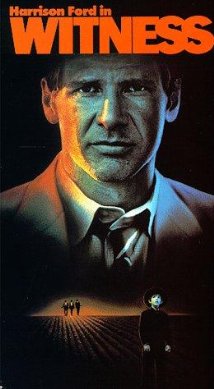
Witness (1985), directed by Peter Weir

Witness posterRecently I had a conversation with a recent immigrant to Israel and he told me he never picks up ultra-religious men who are hitching a ride. He feels they are lazy, exploitative of community funds, and are disloyal to the state of Israel. In sum, they are takers and not givers and should be less influential in the Israel political scene. Therefore, he does not want to reward them by giving them free rides. I told him that I do pick up such hitchhikers because I really don’t know them well and do not want the actions of a few to permeate my consciousness and cause me to view all the ultra-religious as takers.

Stereotyping those who are unfamiliar to us is the subtext of Witness, a police thriller which utilizes the Amish culture of Pennsylvania as a backdrop for its story. Rachel Lapp, a young Amish widow traveling by train with her 8-year-old son Samuel to visit her sister, stops at the Philadelphia station. Here Samuel wanders into the men’s room, where behind closed doors, he witnesses a brutal murder. Captain John Book is assigned to the case; and at the police station, Samuel identifies one of the killers as a narcotics officer who was involved in a drug raid in which the drugs mysteriously disappeared.

As events unfold, we learn that Book’s superior officer was behind the robbery of the contraband, and Book is now targeted by his sinister boss for execution. A gunfight leaves Book wounded and he flees to Amish country with Rachel and Samuel who are now in mortal danger.

Collapsing from loss of blood, Book stays with Amish until he gradually heals. Rachel and Book develop an affection for one another during his recuperation period and Book’s view of the Amish changes. They are no longer strange and backward, but people whose uncomplicated, wholesome perspective on life impresses Book as honest and purposeful. Book and Rachel both know that, coming from two different worlds, their relationship is a non-starter; but that does not stop them from caring for one another and seeing the world from the other’s vantage point.

Eventually, the corrupt police officers locate Book and travel to Amish country to kill him, and it is the Amish tradition of non-violence that figures prominently in the film’s denouement. Book is traveling into town by horse and buggy when his party is accosted by local bullies, who stereotypically regard the Amish as weak and out of touch with modernity. They pick a fight with Book’s group, not realizing that Book is not Amish. Book, incensed at their brazenness, decides to retaliate by breaking the nose of one of the bullies, an action totally out of character for the Amish. This leads to a police report which finds its way to his corrupt superiors, giving them Book’s location, the scene of a tense and bloody climax.

Jewish tradition tells us everyone is created in the image of God and, therefore, has infinite value. Being different does not mean being less worthy or less important. The Talmud states that baseless hatred was the cause of the destruction of the Second Temple. The great medieval scholar Moshe ibn Ezra said “Love blinds us to faults; hatred to virtues.” When we view others who are different from us in a negative light without even knowing them, we do not appreciate the good that is often within them. The Ethics of the Fathers further tells us that “hated of people removes a man from the world.” Witness reminds us that beneath the strange clothing of a religious sect, there may be values worth emulating. When we view the unusual looking stranger as a friend, we open up ourselves to growing intellectually and emotionally.

Purchase this movie from Amazon.com.