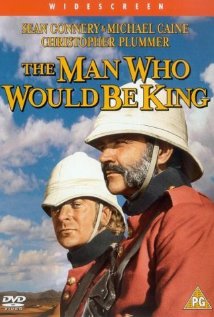
The Man Who Would Be King (1975), directed by John Huston

Man who would be king posterI once had a brilliant teacher in college who I admired greatly because of his intellect and his charismatic personality, marveling at his encyclopedic knowledge of text and human nature. One incident, however, changed my perception of him. He verbally assaulted a student who disagreed with him. The professor, full of himself, assumed that his way of perceiving things was the only way, and the student implicitly was stupid.

In truth, the student was devastated by the teacher’s remarks, and afterwards confided in me that he, too, looked up to the teacher but was totally unnerved by his comments. To ease his emotional pain, I told my friend that the teacher may have been under unusual stress and that is why he responded so harshly to him. But, inwardly, I was troubled by the entire interchange.

Subsequently I discovered that the teacher, brilliant as he was, actually believed the press releases that praised him. He lacked humility, thinking that he deserved all the accolades that were heaped upon him. Several years later, he lost his position at the college and labored for the rest of his life in academic obscurity.

This human trait of believing you are more than what you are is at the core of The Man Who Would be King, the story of two British sergeants, Peachy Carnehan and Danny Dravot, who travel to a remote mountain village in Afghanistan to seek their fortunes. Arriving in Kafiristan, a land plagued by marauding bands, they offer their services to the local population whose homes are continually attacked. Serving as military advisors and soldiers, they lead the locals to victory over the enemy.

In one of the battles, an arrow strikes Danny in the chest, but he does not die. The natives do not realize that the arrow has lodged in a leather ammunition belt beneath his shirt. They simply see Danny as a divinity, impervious to death.

Soon after, they are invited to the holy city of Sikandergul, where the chief high priest sets up a test to determine whether Danny is a man or a god by seeing whether or not he bleeds. An archer shoots an arrow at Danny, who flinches. When the people seize him, thinking he is a fraud, they discover that Danny is wearing a Masonic jewel, whose symbol the priest recognizes is the symbol of Alexander the Great, who passed through the country many years before. That linkage convinces the holy men that Danny is a direct descendant of Alexander, and they lead Peachy and Danny to the storeroom where Alexander’s riches are stored, a formidable treasure which now belongs to Danny as king.

Peachy now wants to leave as soon as possible, taking with him as much treasure as possible. Danny, however, does not want to go. He enjoys being king, and even wants to take a wife to insure that his descendants will rule after him and foster Kafiristan’s continued stability. That desire to maintain his position as king proves to be his undoing.

Jewish tradition praises the humble person. Moses, the humblest of all men according to the Bible, wants neither recognition nor power. Moreover, the Talmud tells us to be wary of overreaching. If you grab too much, say our Sages, you will acquire nothing. This lesson Danny does not learn until it is too late.

The Man Who Would Be King is a rousing adventure story, but it is also a cautionary tale about the dangers of arrogance and not being content with what one already possesses.

Purchase this movie from Amazon.com.

Argo (2112), directed by Ben Affleck

Argo posterMany years ago, I wanted to make myself more accessible to my students as principal of my school.  At the time, I taught one or two literature classes but I wanted to feel connected to more of the students. The question: how to do this in an unobtrusive but effective way?

I took my cue from Frank Boyden, the late, revered headmaster of Deerfield Academy, a prestigious private high school in New England. Boyden moved his office to the school hallway. He did not wait for students to come to him. Instead, he was visible at every class change and used these face-to-face encounters to engage students in conversation about how the school day was going, about their plans for later in the day, about life in general. Boyden thought out of the box to come up with the right solution, and his educational strategies made Deerfield one of the most successful high schools in the United States.

Argo is all about thinking out of the box, about finding a solution to a problem that defies conventional analysis. It is November 4, 1979, and militants have taken over the US embassy as payback for the United States giving refuge to the recently deposed Shah. We learn that six Americans have found refuge in the home of the Canadian ambassador. The challenge: how to extract them from Iran without being discovered?  Tony Mendez, an extraction expert at the CIA, has to devise a rescue plan in a matter of days. The out-of-the- box solution: create a fictitious movie company that wants to shoot a science fiction fantasy using Iranian locations, and then smuggle the Americans out of Iran on regular commercial aircraft under the guise of being movie professionals exploring location possibilities. The idea is preposterous; but it is the best option among a range of other bad choices, and so the ruse begins.

Mendez contacts John Chambers, a Hollywood make-up artist, who has previously worked for the CIA, who in turn connects him with film producer Lester Siegel. Together they establish a phony film company, publicize their preliminary work on the film, and successfully create the illusion of developing Argo, a science-fiction fantasy similar to Star Wars, to lend verisimilitude to their efforts. Meanwhile, the escapees inside the ambassador’s residence are growing frantic at the possibility their hiding place will be revealed at any moment and they will be executed. Argo is realistic, tense, and ultimately cathartic as it details the nerve-wracking and precise maneuvers that the trapped hostages will use to find their way to freedom.

Jewish tradition also encourages thinking out of the box. Looking at Talmudic discussions and arguments gives us a window into the creative thinking of the intellectual giants who populate the pages of this magnum opus. It is a place where we can observe firsthand the development of higher order thinking skills. Ethics of the Fathers, a centerpiece of Jewish wisdom, describes the intellect of a number of great Talmudic sages. It praises the serious student, who retains everything he learns, and it also lauds the one whose mind is a bubbling stream growing stronger and stronger each day, the master of innovation who can always come up with a new perspective on an age-old problem. Conventional wisdom is good, the Talmud suggests, but creativity also has its proper place in Jewish learning.

Argo reminds us that whenever we are faced with what we perceive to be an insurmountable problem, we should not give up and reconcile ourselves to abandoning our mission or goals. On the contrary, this is the time to use our mental potential to create new and innovative paradigms for success.

Purchase this movie from Amazon.com.

The Iron Lady (2011), directed by Phyllida Lloyd

Iron lady posterWhen I was first married, I attended Sabbath services at the rabbinic school where I studied. Present at the services were many of the rabbis who taught me during the week. I recall very vividly one occasion when the young child of one of the rabbis grossly misbehaved. He began to hit his father and used unbecoming language. In spite of the child’s appalling behavior, his father did not hit him or rebuke him publically.  He did not shout at him nor scold him nor physically grab him.

At the time, I wondered whether the father was teaching his son by example how to show restraint and how to control emotions or whether the kid was in control of the situation and mocking his father. To this day, I don’t know the answer. All I saw was one snapshot in time, from which no conclusions could be drawn. However, a recollection of the incident reminded me of how complicated it is to be the child of a celebrity or prominent leader in the community.

It can be a blessing or a curse. Consider for a moment the children of Margaret Thatcher as depicted in The Iron Lady, an exceptional film about a young civic- minded girl who rises in political power to become Britain’s prime minister.

The film opens when Margaret Thatcher is past her prime, now a frail and elderly widow functioning in the present but often swept back to the past through imaginary conversations with her dead husband Denis. She has much of which to be proud. Restoring England’s financial power in the face of great economic challenges, navigating the volatile relationship between Ireland and England, successfully managing the Falklands War are all high points of a long and illustrious political career. She also is a wise woman who enjoys sharing insights about life.  One particular speech encapsulates her lifelong wisdom: “Watch your thoughts for they become words. Watch your words for they become actions. Watch your actions for they become habits. Watch your habits, for they become your character. And watch your character, for it becomes your destiny! What we think we become.”

But there is a dark side. Her family pays a price for her rise to power and for the maintenance of that power.

Margaret Thatcher had twins, a boy and a girl, who have a lukewarm relationship with their mother. They are dutiful children, respectful, yet distant emotionally. There is love between mother and daughter but the connection is strained. Her son Mark lives in South Africa and is not always available even by telephone. At one point in the movie, Margaret watches a DVD of her little children playing on the beach, but it is only a hazy memory of a warm and loving time long since gone. Even her devoted husband is ambivalent about the price the family has had to pay for Margaret’s dedication to serving England.

Children of people in leadership roles do not travel a simple road. The eyes of the community are upon them. Sometimes it is fine and the children rise to the community’s and parent’s expectation. Sometimes they do not. It is instructive to note that there is little in the Bible said about the son of the greatest Jewish leader Moses. His son, Gershon, is a footnote in Jewish history, suggesting that Moses paid a personal price for his leadership of the children of Israel. Gershon never rises to a position of leadership or prominence. He remains average in spite of the fact that he was Moses’ son.  Instead, Joshua, Moses’s trusted student, assumes the mantle of leadership once Moses is gone.

The Sages tell us that it is good to work on behalf of the community, and blessings will accrue to you because of that valuable work. But clearly, the Sages also warn us about the potential negative effects of community involvement. Every one of us has to make a careful calculation of the costs and benefits of such holy labor.

Purchase this movie from Amazon.com.

Unstoppable (2010), directed by Tony Scott

Unstoppable posterMany years ago, I asked a friend to mail a $10,000 check for me. He mailed it from the post office, but neglected to send it by registered mail as I requested because the line at the post office was long and he did not want to wait. Unfortunately, the check was lost and it took months before the situation was resolved. The check never was found, and no real harm was done, but the incident reminded me how one simple error in judgment can lead to an avalanche of problems.

An errant check is not the problem in Unstoppable; rather it is an errant train that can unleash a cargo of toxic chemicals if it is not stopped. The problem originates with a lazy railroad worker, Dewey, who decides not to connect the air hose to the rest of a long train, thereby removing the air brakes that are critical to stopping the train. Compounding his mistake, he leaves the locomotive cab when he sees that the train is lined up to go on the wrong track and runs to manually switch the track. Unfortunately, the train’s control levers move on their own accelerating its speed, and Dewey cannot reboard the train in time. Now the train is unmanned and moving very quickly towards populated areas.

Two heroes emerge to deal with this crisis: Will Colson and Frank Barnes. Colson is a young newly minted conductor, and Frank Barnes is an engineer who has been working with the railroad for 28 years. Together, they use the physical strength of youth and the wisdom of advanced years to devise strategies to stop the train, even at great personal risk. Both men, knowing that their lives are in danger, want to connect with family. Will, who is estranged from his wife, wants to speak with her but is fearful of being rejected by her. He doesn’t call but his thoughts turn to his wife and child, whom he may never see again. Frank, a widower, phones his daughters to tell them he loves them. It is a 9/11 kind of call, full of love and uncertainty about the future.

Jewish tradition emphasizes how important it is to obey the rules, especially in problematic or dangerous times. The Bible informs us that even the king is not to veer from the commandment; for if he does, his kingdom will not endure. Rashi, an 11th century Bible commentator, explains that Saul lost his kingship because he did not follow the instruction of the prophet Samuel. Samuel had told him to wait seven days for him to arrive before offering a sacrifice. Saul does not wait for the prophet to arrive and, as a result, loses his kingship. The commentators opine that Saul did not realize the importance of his position and how careful he had to be to perform his obligations correctly.

Neither does Dewey in Unstoppable. Dewey takes his work responsibilities casually, and people pay a price for his unprofessional conduct. He makes the mistake of a lifetime, jeopardizing the lives of many innocents. In a coda at the end of the film, we learn that Dewey no longer works for the railroad but now is employed in the fast food industry.

Unstoppable reminds us to take our professional responsibilities seriously. No matter how mundane our jobs may be, we are required to give it our best effort for our sake and for the sake of all those who depend upon us. We lead a different kind of life when we realize that every action of ours has a reaction in the lives of others.

Purchase this movie from Amazon.com.

127 Hours (2010), directed by Danny Boyle

127-hours-posterMy wife and I enjoy visiting America’s national parks and going for short hikes. I am a bit impulsive on the trails and am ready to start walking at almost any trailhead. My wife is more methodical. She wants to know if the trail is a loop, how long the hike will take, and whether we have enough water to sustain us for the duration of the hike. As I get older, I realize the wisdom in her words, and now I plan carefully for such adventures to insure that I do not put myself at risk.  I thought of my own hiking experiences in the Canyonlands in Utah as I watched 127 Hours, the true story of Aron Ralston, an extreme sportsman who finds himself trapped in an isolated canyon in Utah after a boulder falls on his arm.

The story begins on Friday, April 25, 2003, when Aron is preparing for a day of hiking in Utah’s Canyonlands National Park. Excited about his upcoming adventure, he is careless about his preparation. A clever camera shot of his hand trying to find stuff in a closet reveals that he forgets to take his trusty Swiss knife with him, a fact that will have consequences later on.

Once into his hike, Aron climbs over and through narrow stone passageways, and then tragedy strikes. He dislodges a large boulder, which crushes his right arm against the canyon wall. He calls for help, but no one can hear him. He is in a remote section of the park with no one nearby. Moreover, he has told no one where he was going that day, and his situation soon turns desperate. Realizing that his fate is in his hands only, he begins a video diary with his portable camera and starts to ration his water and food.

As his strength ebbs away, he understands that the sole way to survive is to amputate his arm, a near impossible task with a dull-bladed knife on a multi-tool device. With each passing hour, Aron gets groggier, and thinks about his friends, his family and his uncertain future. Finally, he accepts the reality of his situation and methodically plans to amputate his arm with the crude devices he has available. It is both wrenching and riveting to watch his ordeal.

The ordeal changes Aron. Instead of being the independent adventurer responsible only for himself, he now understands that he needs others. His tortured cry for help at the end of his trial is a recognition that living for oneself is ultimately a lonely existence.

On another level, Aron’s ordeal reminds us of the importance of properly preparing for a dangerous trip, letting people know of your whereabouts, and evaluating the inherent risk before attempting a perilous task. Furthermore, it reminds us to think about the definition of an acceptable risk when it comes to engaging in problematic behavior which may lead to loss of life.

Jewish law is prescriptive regarding the notion of acceptable risk. The Bible says “you shall guard your souls,” which means that we should not do anything that jeopardizes our health and safety. The Talmud even instructs us not to walk next to an unstable or shaky wall. Furthermore, if we build a house, we have to insure that it is safe. If it has a roof that people can traverse, the roof must have a fence. If we own a dog that bites people, we have to make sure that the dogs are in a secure location so that guests to our home are free of danger. Recent codes of Jewish law forbid smoking under the same guideline. Smoking is hazardous to your health and, therefore, is considered an unacceptable risk.

127 Hours is a gripping narrative of survival. Embedded within the story are many life lessons. It encourages us to celebrate and enjoy life, to value the presence of significant others in our lives, and not to be careless and place ourselves in unnecessary danger.

Purchase this movie from Amazon.com.

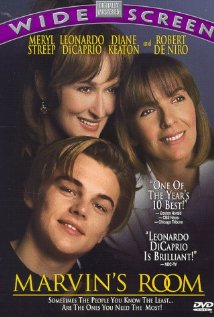
Marvin’s Room (1996), directed by Jerry Zaks

marvins-room-posterBoth of my parents died suddenly while they were still leading active lives. I never had to think about elder care or nursing homes. It was not until a friend of mine asked me to accompany him on a visit to some assisted-living and nursing home facilities that I began to understand the dilemma that families experience when they are facing the reality of caring for a loved one who cannot take care of himself. Children want to do the right thing, but decisions are often made not by considering what’s best but by what is affordable.

There is a scene in Marvin’s Room, a serious drama with lots of comic relief, which captures this dilemma. Two daughters, opposite in temperament, are visiting a senior care facility for their father who has been “dying for the past twenty years,” and who now needs full-time attention. One sister, Bessie, has been caring for Marvin, her father, for the past 17 years, even since he had his first stroke. The other sister, Lee, has been absent all those years, and even now does not want to make a personal sacrifice for her ailing father. She fears that her future will be compromised and states unequivocally: “In a few months, I’ll have my cosmetology degree. My life is just coming together; I’m not going to give it all up, now!”

What brings the sisters together after so many years in the sad news that Bessie has leukemia and may not be able to care for her father any longer. Bessie contacts Lee, who has two boys, and asks her to come with her kids so that they all can be tested as potential bone marrow donors. They may be able to save her life; and as a consequence, Bessie can continue to care for their father. If Bessie passes, the responsibility will fall to Lee. That possible scenario is the catalyst for their visit to the elder care facility.

Complicating factors is Lee’s oldest son, Hank, who has been in a mental institution after deliberately burning down their house in a act of rebellion against his mother whom he hates and who he feels was the cause of the split between his parents. Hank idealizes an absentee and abusive father who he barely knew and his mother feels the brunt of this anger. Family dysfunction abounds.

Marvin’s Room gives us a window into the world of families faced with awesome decisions. It exposes the raw nerves of a family, both challenged and confused by an inevitable future. The film depicts two points of view, one very dark and one optimistic, suggesting that confronting the mortality of a loved one can be a stimulus for reinventing one’s life and reordering life’s priorities. In fact, Lee and Hank finally undergo an epiphany in which they understand that living fully means giving to others, not just being concerned about one’s own needs.

The Talmud tells us that it is better to visit the house of mourning than the house of feasting because the lessons learned there are so profound and so meaningful for purposeful living. Moreover, the Bible exalts the commandment of honoring parents, which is defined in books of Jewish law as providing for the needs of parents, especially when they get older and cannot take care of themselves. This includes feeding them, clothing them, escorting them, and respecting them. Marvin’s Room provides a textbook case of varied responses to a life problem facing many, and in its own idiosyncratic way recommends that love trumps all. Family endures when children and parents care for one another.

Purchase this movie from Amazon.com.

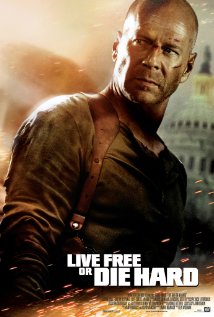
Live Free or Die Hard (2007), directed by Len Wiseman

mv5bndqxmde1otg4nv5bml5banbnxkftztcwmtmzotqzmw-_v1_sy317_cr00214317_The computer teacher, the techie, is often the most powerful member of the teaching staff in a high school. He controls the keys to the kingdom of the Internet. He can enable teachers and students to enter the portals of Google, Wikipedia, and a variety of social networks. He can expand their worlds.

As a school principal for many years, I observed the transformation of the school office via computer applications. Instead of two or three secretaries, we eventually needed only one. Instead of dictating speeches and correspondence through a Dictaphone machine, we now wrote and corrected our own material using Microsoft Word. Furthermore, we mostly used the more convenient and speedy electronic mail rather than snail mail, which was slower and used so much paper. Currently, when I have to inform my parents and students in Israel of school news and changes in class schedules and syllabi, we use email and social media outlets, not letters or phone calls.

The computer guru, in truth, can be a beacon of light bringing wisdom and enlightenment to the world, but he can also be a sinister force for evil if he uses the computer to lord over others and take advantage of them. In truth, the computer can be a powerful means to control and shape politics and economics in a destructive way. Such is the premise of Live Free or Die Hard, part of the Die Hard series of movies starring Bruce Willis. In it, a computer genius, Thomas Gabriel, designs a plan to create worldwide chaos so that he can profit from the ensuing panic and destruction. Can he be stopped in time is the classic question in this formulaic but exceptional action-packed thriller. Gabriel begins by sabotaging the nation’s infrastructure. Traffic signals malfunction, trains and planes come to a halt, the stock market closes, and the financial systems of the nation are breached. He then launches a plan to take out the nation’s power grid. Gabriel is able to do this because, as a former national security director responsible for building the security systems, he knows the systems inside and out, including all its vulnerabilities.

Why is he so hell-bent on causing so much human damage through computer manipulations?  The back story informs us that many years earlier he attempted to interrupt a Joint Chief of Staffs meeting to share his professional expertise and to point out weaknesses in the nation’s security system using only his laptop. At the time, he was rebuked and publically humiliated. As a result, he now wants to show all those who mocked him that he truly does have the power to control events and they do not. He wants money and he wants revenge.

Watching this film reminded me of the many people I have observed in positions of power. The best of such people work selflessly for the community with no personal agenda. The worst see the possession of power as an opportunity for payback, to control, and to intimidate. It can be very scary for one who falls within their orbit.

The Talmud tells us in many places that the possession of power brings with it responsibilities. The classic example is King David. He does not seek kingship. Rather it is thrust upon him, and he struggles to leave a positive legacy. He is not perfect, but he tries to be loyal to God and beneficent to his subjects. All he wants is for his people to actualize their spiritual potential, to be all they can be. David understands that power may corrupt, and that it is wise to temper power with an abiding sense of community responsibility. Power is neutral. It is our job to harness it for good.

Purchase this movie from Amazon.com.

Chronicle (2012), directed by Josh Trank

Chronicle posterThe unexpected violence at Newtown, Connecticut, sparked much controversy about legislating tougher gun control laws. Moreover, there has been much discussion about mental illness and the role it plays in these nightmare scenarios where children are murdered by a depressed or belligerent teenager. How can we identify the loner, the mentally unbalanced person, before he acts out his violent fantasies?

Chronicle does not answer any questions, but as a former high school principal for many years, I can tell you that the alienation and loneliness of Seattle high-school teenager Andrew Detmer depicted in this dark, disturbing, and profanity-laden film ring true. I recall vividly a student in my school who always was absorbed in her own world, who had very little meaningful connection to her peers, and who generally seemed depressed. About five years after she graduated, I read in the newspaper that she had been murdered. I never learned the details, but her tragic end was not surprising to me. She was the victim, not the perpetrator, but her social isolation set the stage for a turbulent future.

In Chronicle, we can actually trace the evolution of a high school loner into a full-fledged murderer. To those who interact with him in a pleasant way, Andrew is a decent guy; but under the quiet façade is an angry young man poised to do terrible things.

To combat loneliness, Andrew buys an expensive camera and takes it everywhere to record his life. He is obsessed with filming his day to day existence, which is very unhappy. His mother is dying of cancer, his father yells at him and beats him, and the kids at school bully him. Using the video camera enables him to distance himself from the sordid life he is actually living and allows him to create his own reality.

The crux of the film details the encounter of Andrew and his friends Matt and Steve with a strange substance that gives all of them telekinetic powers. At first, the use of these special gifts is a game, but they soon realize that it is a gift that can be used for good or bad, to create or destroy, to help or to harm.

Over time, Andrew becomes more isolated from everyone and hostile to those who make fun of him. Away from friends and family, he begins to see himself as an “apex predator,” someone who feels no guilt for using his power to inflict pain on those who hurt him. His isolation grows and he ultimately decides to steal and physically to hurt other people to accomplish his personal goals, which to him are reasonable and just. As Andrew’s power grows, he uses it more to advance his own personal agenda, and people feel his wrath.

The Talmud instructs us not to separate from the community. The community is the anchor to normality and connects us to concerns other than our own. Moreover, the community elevates us and enables us to achieve higher levels of spiritual transcendence and holiness. That’s why Jews pray preferably pray in a quorum of ten because ten in Jewish tradition represents the community. Separation from it creates risks for all. Andrew’s aberrant behavior reminds us of this.

Linkage to community perhaps is the antidote to the loneliness that fosters disconnectedness and, in a worst case scenario, destructive behavior. The violence at Newtown should make us think about the idea and reality of community. Do we do enough to welcome the stranger, to make the loner feel accepted as part of a larger community? Do we bring the loner into the family of man or do we let him struggle as he defines himself as an outsider? Jewish tradition tells us that there is more that binds us than divides us. We are all created in God’s image, and there is no fixed image of a godly person. In truth, it is the divinity within every man that connects us all, regardless of how we look or present ourselves to others. If we understand this, then we can make the outsider an insider.


Purchase this movie from Amazon.com.

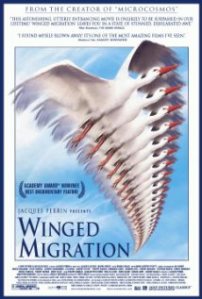
Winged Migration (2001), directed by Jacques Perrin, Jacques Cluzaud, and Michel Debats

winged-migration-posterThere was a time when my vacation trips would be spent traveling to historical points of interest, exploring museums and art galleries, and learning everything I could about the place I was visiting. In recent years, my downtime is spent differently. I no longer feel motivated to learn facts about specific tourist sites. I just want to travel to new locales and observe. I want to see natural landscapes and soak up the ambiance of the place. I do not want information. I want to feel connected to the universe. I want to see and hear the quiet energy that lies beneath the surface of everyday life. It is a different kind of experience and that is why I enjoyed Winged Migration, an unusual documentary about the yearly migration of birds.

This film tracks a number of species of migratory birds over a span of four years. Some travel over a thousand miles to find food each year; and then when food runs out at their destination, they return the same distance to their point of origin to find nourishment. They miraculously always fly the same route using the stars and familiar landmarks on land, in the sea, and in the sky to locate food sources and to get back home. Familiarity helps them to survive just as it helps us navigate difficult moments in life. In moments of crisis, we can return to our old routines and derive some stability in a stressful environment or situation.

Using in-flight cameras, the bulk of footage in the film consists of birds flying in the air. You can hear the air move under their wings and you have the sensation that you are flying alongside the birds. You are with them in the cold snow of the Arctic regions, you are with them when they escape a powerful avalanche, and you are with them in the bloom of summer with trees and flowers all around. The terrain, seen from the perspective of the birds, is breathtaking. The film truly is a visual work of art.

There is almost no narration in the film. There are just scenes of different species of birds traveling thousands of miles, crossing continents and oceans in search of food. There is no conventional plot. Instead, there are extraordinary images of birds desperately flapping their wings flying from one country to another. The key theme unifying all these migrations is survival. The birds cannot survive if they stay where they are. Movement is critical for survival.

The dominant visual in Winged Migration is a bird desperately flapping its wings to stay airborne on its long journey. For me, it was a metaphor of the human journey through life. All of us want to survive and thrive in life in spite of the adversities and challenges we all face. Like the bird, we have to keep moving and not allow challenges and occasional failures to cripple us.

The Biblical metaphor which captures this Jewish approach to confronting life’s challenges is the ramp upon which the priest walks when he approaches the altar to offer sacrifices. The priest does not climb steps. Rather he traverses a ramp, which has no natural place to stop or rest. The message to the priest, and for all men since the priest represents all of us, is to constantly strive, not to give up in the face of adversity. The Sages of the Talmud suggest that a successful life requires constant forward progress, constant movement and activity. The birds in Winged Migration teach us this valuable lesson.

Purchase this movie from Amazon.com.

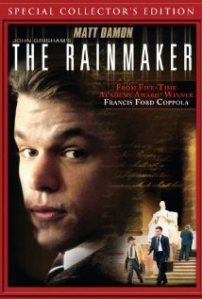
The Rainmaker (1997), directed by Francis Ford Coppola

rainmaker-posterA friend of mine has been studying for the actuarial examinations for the past several years, but without success in passing them. He has hired private tutors to help him, taken online courses, and devotes an hour daily to working on practice tests; but the examination still eludes him. He is a very intelligent young man, a National Merit Scholar in Math, but his paycheck is small without the credential of Enrolled Actuary. Presently, he works for a pension fund company which hired him with the hope that he will soon pass the test that will qualify him for more responsibility in the office and a bigger salary. In the interim, his keen analysis of data and company files has enabled his company to save millions of dollars because of discoveries he has made in the accounting processes of his firm, even though he lacks an official actuarial credential.

There is a character in Francis Ford Coppola’s exceptional legal drama, The Rainmaker, who mimics what happened to my friend. Deck Shifflet is a paralegal who has failed the bar exam six times, but he is a master at locating critical information about insurance companies and their economically driven claims policies. His resourcefulness enables him to get hired by law firms who take advantage of his knowledge at a fraction of the cost of a full-fledged attorney.

The Rainmaker revolves around the case of a middle-aged couple, Dot and Buddy Black, who file suit against an insurance company, Great Benefit, which denied insurance coverage for a bone marrow transplant for their 22-year old son Donny Ray, dying of leukemia. In spite of religiously paying their premiums for many years, they are victimized by small print in the insurance contract which precludes the company paying for aggressive procedures to cure their son. Moreover, Great Benefit has a corporate policy of denying all claims when they are first presented. It is only the customers who press on despite initial rejection of their claim who receive any compensation at all.

Rudy Baylor, a young attorney representing the Blacks against the high-powered lawyers for Great Benefit, has just passed the Tennessee bar exam; but he has never before argued a case in front of a judge and jury. It is a daunting task for a rookie attorney, but he has a secret weapon in Deck Shifflet. When all seems lost, it is Deck who repeatedly comes up with an innovative strategy that potentially can win the case, or locate a crucial witness who has long since dropped out of sight.

The Ethics of the Fathers tells us that the wise person learns from every man. Deck in professional terms is a loser, but he possesses the street smarts needed to be successful in the sinister world of insurance fraud. Deck reminds us that the possession of a credential, a degree or a license, does not guarantee wisdom, insight, or financial success.

Rudy recognizes Deck’s value and partners with him in his law practice. It is a partnership founded on genuine friendship, mutual trust, and respect. Each one relies on the other for expertise in the area where they are weak. Rudy’s sincerity and humility impress the jury, but it is Deck’s resourceful research and knowledge of human nature that buttress Rudy’s legal arguments before the jury.

Our Sages teach us that we should never belittle any man for every man has his hour of glory, his moment in the sun. The synergy of Rudy and Deck remind us that every person has something to contribute to the greater good regardless of pedigree, regardless of intellectual or social background. No one should be considered insignificant.

Purchase this movie from Amazon.com.