 A few weeks ago, I had hip replacement surgery. Over the past several years, my hip has degenerated. I have moved from becoming an avid runner to an avid walker, to a part time cyclist and swimmer, to a struggling walker who walks at an extremely slow pace. When friends told me about the benefits of hip replacement surgery, at first I was reluctant; but as my hip continued to get worse, I felt I had little choice if I wanted to improve the quality of my life. And so I had the surgery. But there was one problem: I did not fully grasp the complicated and arduous road to rehabilitation, which would take 4 to 6 weeks.
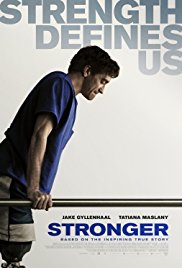
The complicated rehabilitation road is a central theme in Stronger, the profanity-laden true story of Jeff Bauman, a working-class Bostonian who tragically lost both of his legs in the Boston Marathon bombing in 2013. Jeff is not running in the race. He is there at the finish line to welcome his girlfriend Erin who is running to raise money for the hospital at which she works. In the days after the blast, he is hailed as a hero when he identifies Tamerlan Tsarnaev, one of the bombers. In truth, Jeff is uncomfortable with the mantle of hero and his mental state is fragile. The realization that his life is forever changed and physically compromised is a haunting and painful reality that is not easy for him to accept.
Patty, Jeff’s alcoholic mother, pushes Jeff to do interviews and basks in the refracted glory of her son’s celebrity. But she is weak emotionally and begins to become an enabler of Jeff’s drinking and lackadaisical approach to his rehabilitation. This leads to confrontations between Patty and Erin, each of whom has a different take on what is best for Jeff.
Things change when Jeff meets Carlos, the man who pulled him out of the carnage and saved his life. Carlos relates a sad story in which two of his sons died. One is a Marine who lost his life in Iraq; the other committed suicide. Carlos, a man with overwhelming guilt, confides to Jeff that rescuing him enabled him to find a measure of peace after his personal tragedies. Hearing Carlos’ narrative gives Jeff a sense of what his mission in life should be. He realizes that his desire to live in spite of personal tragedy gives people hope and inspiration, and he gracefully listens to many people who share stories of how they have been positively influenced by him.
Rehabilitation is slow, whether physical or spiritual. Rabbi Abraham Twerski, a Torah scholar and physician specializing in addiction, uses the model of the 12-step program for alcohol addiction to apply to the general process of changing negative behaviors. Several of the twelve steps, in particular, occur in the rehabilitation of Jeff Bauman. (1) He recognizes that his life has become unmanageable. (2) He makes a fearless, honest moral inventory of himself. (3) He admits his mistakes. (4) He is willing to make amends to anyone he has harmed.
Once Jeff recognizes that his life is out of control, he begins to put it back together. When he realizes that Erin loves him in spite of his physical disability, he understands that he has not treated her with respect and kindness. When he finally apologizes to her for his insensitive behavior, they can start their relationship anew.
Things do not change overnight for Jeff. Changing his behavior will take years just as his physical therapy will take much time and concerted effort. Stronger reminds us that only through hard work over an extended period of time can we indeed make ourselves into better men.
 I first saw Lawrence of Arabia in 1962. It was a cinematic event, panoramic in scope and intellectually engaging. The central character, T. E. Lawrence, a brave and psychologically complex British lieutenant, was not a conventional movie hero and the story was complicated. I remember being impressed by the dramatic visuals, but I was not touched emotionally by the narrative.
 A friend of mine scheduled hip replacement surgery. He and his wife visited the surgeon who had been recommended by many. After the meeting, my friend and his wife came away with different impressions. While both felt the surgeon was highly competent, the wife detected a streak of arrogance in the doctor, and it bothered her. She preferred a surgeon who radiated humility, not pride. The husband felt that, at the end of the day, God is the healer, not the surgeon, and the surgeon’s arrogant attitude was not a reason to choose another doctor.
 I recently read a book by my son, Rabbi Daniel Cohen, entitled What Will They Say About You When You’re Gone: Creating a Life of Legacy. Drawing upon his synagogue experiences and officiating at hundreds of funerals, he poses the question of how we want to be remembered. Through personal anecdote and sharing interviews with movers and shapers in the worlds of business and art, he suggests ways to re-engineer your life so that when your life is over, you will be remembered for things that matter, not for how much you acquired.
 When I was about to enter college in 1960, I thought I was going to be a high school teacher. Somewhere along the way, my Judaic studies at Yeshiva University became my academic focus and I resolved to be a pulpit rabbi. My professional career began in Atlanta, Georgia, where I was the assistant rabbi at a large Orthodox synagogue.
 When I was around ten years old, my father took me to the office of a veterinarian and we came home with a dog. It had the face of Lassie, but it was mixed breed without a distinguished lineage.
 My parents were not social butterflies. They had many friends because they were good friends to others. They were people who always kept their word and always were there to help relatives and friends during the hard times. For me, they were role models of reliability and champions of kindness. They were the friends upon whom you could count, and that notion of friendship was absorbed by me.
 As a young teenager, I had deep feelings. When I dated a girl in the innocent 1950s, I thought I was going to marry her. It was devastating for me when I discovered that she was dating another guy. It took me a long time to recover, but I did and life moved on.
 When I was principal of an elementary school, I saw bullying for the first time. We had a black Jewish student, a very sensitive and gentle boy, enrolled at the school. He had trouble making friends, sensing he was different from the rest of the students.
 A friend of mine was recently given the opportunity to move to a better paying position in his company if he would relocate to the West Coast. He had just bought a home in Westchester and had planned to stay in the Northeast for the foreseeable future. But then this “once-in-a-lifetime” chance at improving his financial bottom line presented itself and for a few moments he was in a quandary.
 Kosher Movies