 I do not know how to play chess, but it seems to be a mentally engrossing game. One of my sons actually was a chess champion when he played competitively as a member of his high school chess team. From watching him and other students play, it seems clear that to be successful at the game, one must be able to envision the next moves of your adversary. You have to consider not just one move ahead, but many moves ahead to be victorious.
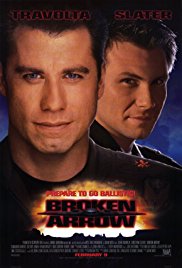
This kind of mental maneuvering takes place between Major Vic Deakins and Captain Riley Hale, two pilots in the United States Air Force who are tasked with transporting two nuclear bombs in a training exercise in the tense thriller, Broken Arrow.
Their flight begins calmly, but once airborne Deakins, on a mission of his own, attempts to kill Hale. The end result: Deakins ejects Hale from the plane and, using parachutes, steals the nuclear warheads with the goal of threatening to detonate them if a huge sum of money is not deposited in Deakin’s Swiss bank account. The title Broken Arrow refers to the code name for lost nuclear weapons.
Hale lands safely, and with the help of Forest Ranger Terry Carmichael, attempts to thwart Deakins’ plans. Deakins and Hale know one another well. As the action progresses, each tries to anticipate the other’s moves. Deakins leads them to red herrings, but Hale sees through the obfuscations. After all their chess-like moves, in which each tries to anticipate the next move of the other, there is a final physical confrontation between Deakins and Hale.
Rabbi Nathan Lopes Cardozo writes about the analogy between chess and life. By doing so, he sheds light on the respective strategies of Deakins and Hale and the exhilaration of combat experienced by both of them. Cardozo writes: “The chessboard becomes the world; the pieces are the phenomena of the universe; the rules of the game are the laws of nature; and man roams freely once he applies the rules to such an extent that a whole new world is revealed. But let us never forget: He who knows all the rules is not necessarily a great player. What makes him a formidable opponent is his ability to use these rules to unleash an outburst of creativity, which emerges only because of the game’s unbearable limitations. It is mental torture, but it is the height of beauty as well. It is poetry to the game, as melody is to music — like one gentle brushstroke of Rembrandt on a colorful canvas, making everything look radically different; or like the genius musician playing her Stradivarius, re-creating the whole of Mozart’s Violin Concerto No. 5. It transports the chess player to heaven.”
This poetic description of chess suggests the satisfaction that both Deakins and Hale feel when they have figured out the next move of their adversary. Deakins and Hale engage in a war of the minds, and both savor the combat.
It is fascinating to observe how Deakins and Hale try to outguess the other. A case in point. Law enforcement has to determine where the bomb may be detonated. Deakins plants clues that indicate the location will be in Salt Lake City to the west. In fact, Deakins plans to obliterate Denver to the east. The authorities at first head west to surround Salt Lake City, but then, in an “aha” moment, Hale realizes that Deakins has planted clues that serve as a subterfuge for his true intention, which is to attack Denver.
Broken Arrow is a high caliber action film. It delivers all the fights and explosions that one expects in escapist entertainment, enabling the viewer to enjoy the cathartic release of good triumphing over evil. Along the way, it provides an insight into the strategies of those who want to destroy others. Not only do they want to win the battle, but they may also enjoy intellectually checkmating their opponent.
 When I first started out in 1970 as an assistant rabbi in a large Orthodox synagogue in Atlanta, I also had the title of educational director. This reflected the fact that I was in charge of the afternoon Hebrew school which catered to kids who were not enrolled in the local Jewish day school. With the arrogance of youth, I thought I would be a perfect professional and not make any mistakes. I soon realized that I was, indeed, fallible.
 A few years ago, I had cardiovascular bypass surgery. I was planning to travel to the US for the wedding of my son, Ezra. Feeling occasionally short of breath, I went to my cardiologist in Israel and, after examining me, he told me that I should not travel since my risk of having a heart event was significant. And so I experienced the wedding virtually on Skype instead of being there in person.
 I have learned over the years both as a parent and as a school principal that it is good to withhold judgment when forming an opinion about teenagers. They are works in progress and often what you see is only a brief snapshot in time that does not reflect who they really are.
 An essential challenge in the life of administrators is to decide issues based upon whether something is good for the many or only good for the few. I confronted this often as a school principal. In my early years on the job, I made exceptions to the general rule because I wanted to do what was best for the individual child, and also because I was interested in boosting enrollment for what was then an unknown and untested institution. Having a large enrollment was outwardly a sign of success and it meant more tuition dollars to support the school’s programs.
 I know a woman who likes to shop. I am grateful not to be the person in the store who sells her things because she is always dissatisfied with her purchases. One example. I watched her shop for athletic shoes on one occasion. She took close to an hour trying on different pairs of shoes in different sizes. She finally decided on one pair and made the purchase. Two days later I happened to be picking up a tennis racket for a friend, and I saw her again. She was unhappy with the purchase and returned to the store looking for refund or for a different pair of shoes. The same obsessive behavior was observed when she bought a piece of jewelry or a hat.
 Friends of mine have a daughter poised to enter her senior year in high school. Their relationship with her is challenging. She wants to attend an out-of-state Ivy League school, but they are not wealthy and prefer that she attend a more affordable state university. The daughter also feels that her local high school is intellectually claustrophobic, and she yearns for a more stimulating educational environment in college, one that will allow her to dream and think out-of-the-box.
 I know people who are very busy in their professional careers, but who always find time for family, and especially their children. One rabbi friend of mine who works for a number of companies in the pension fund industry in order to make a living for his large family always finds time to study Torah with his children. It is a weekly commitment that he rarely misses, and I admire him greatly. That kind of devotion to family is absent in the life of Austrian mountain climber Heinrich Harrer in Seven Years in Tibet, a picturesque drama that chronicles his life before, during, and after World War II.
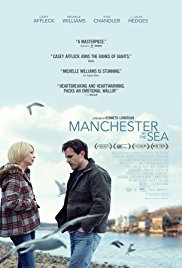 In 1991, I read about the tragedy of famed rock musician Eric Clapton’s son, Conor. He was only four-years old when he fell out of a window on the 53rd floor of Clapton’s New York City high-rise. It was a calamity that could have been prevented, so the pain of Conor’s loss was especially intense.
 A friend of mine recently told me that, during his senior year at high school, he was caught by his History teacher for plagiarizing a term paper. It turns out that he copied the paper from his sister who, a number of years earlier, had submitted the paper to a different teacher at the same high school and she received an “A.”
 Kosher Movies