 As principal of a high school, I would often interview teachers for positions in the school. Resumes often were superb, but the person had no teaching experience. I remember one candidate in particular who took pride in the fact that he had a perfect SAT score. I did not hire him because there was no empirical evidence that he would succeed, let alone survive, in a high school classroom.
The difference between someone who possesses sterling academic credentials and someone who possesses exceptional real world experience is at the crux of Sully, the film that depicts the famous “miracle on the Hudson,” in which the pilot, Captain Chesley Sullenberger, landed a commercial jet, US Airways Flight 1549, carrying 155 people on the Hudson River in New York with no loss of life.
The opening scenes of the film depict the investigation of the incident by the airport authorities, who question why Sully chose to land on the Hudson River rather than simply fly back to LaGuardia Airport from which they had just departed. They argue that computer simulations of the flight that replicate the large flock of birds that flew straight into the plane’s engines indicate it was possible for it to return to LaGuardia safely.
Through flashbacks, we see the flight as it unfolded in real time. It becomes clear that the flight simulations do not consider the human factor in making the right decisions under pressure. When the group listens to the cockpit recordings, they understand how critical the human component is in making good decisions at stressful moments, when life and death are at stake. Sully reminds them: “No one warned us. No one said ‘You’re going to lose both engines at a lower altitude than any jet in history. But, be cool, just make a left turn for LaGuardia like you are going back to pick up the milk.’ This was duel engine loss at 2800 feet followed by immediate water landing with 155 souls on board. No one has ever trained for an incident like that. No one.”
Jewish tradition shows great respect for the learning that one acquires over a lifetime. The Bible exhorts us to stand up before the aged, even if the old person is not necessarily a scholarly man. We simply revere age because it tells us that a person has experienced much in life, and that experience makes him a valued and respected member of society.
Rabbi Noach Weinberg writes: “People have some idea that there’s nothing to learn outside of a university. We think: What does the average person on the street know? This attitude is destructive because it stops us from learning the many bits and pieces of wisdom that are available. Just the fact that someone survives from day-to-day, and copes with life’s obstacles, means he’s picked up valuable tips on living.” Moreover, Rabbi Weinberg observes: “We assume that unless a person is a recognized scholar, or successful business person, he lacks wisdom. But the truth is, anyone who’s had life experience possesses great wisdom. You may be shocked to find out how much your parents know about the issues you’re grappling with right now. As Mark Twain said, ‘I spent four years in university, and I was amazed at how much wiser my father got while I was away!’ “
Sully’s many years of experience as a pilot enabled him to do extraordinary things when an emergency demanded a quick response to a life or death scenario. Textbook learning alone would not have prepared him for dealing with such an unknown and unpredictable crisis. Only through the crucible of life experience, for which there is no substitute, do we acquire the practical wisdom that enables us to overcome life’s challenges.
 Rescue missions are inherently unpredictable. In Israel there are many rescue narratives, the Entebbe rescue being the most famous. Before any rescue attempt is made, the plan is intensely scrutinized to obtain the optimum results: saving those in danger and making sure no one, including the rescuers, gets hurt. That is why the Entebbe rescue is so highly praised. The lives of ninety-four hostages, primarily Israelis, and the 12-member Air France crew were in jeopardy, all of whom were threatened with death. As a result of the 90-minute Israeli operation, 102 were rescued.
 In Israel, I am a member of a synagogue with a large cadre of volunteers. The volunteers serve in many different capacities, each calling upon their unique talents to strengthen the infrastructure of the congregational community. One person may help with organizing the prayer service, another may focus on taking care of members who have suffered the loss of a loved one, another may be in charge of building repairs, and so on. There is a clear recognition that people are different and contribute in different ways to the overall health and wellbeing of the community.
 I taught an eighth grade class for a number of years in an ultra-Orthodox Jewish school in Israel. The secular class began in late afternoon and there were only two hours per week devoted to English language study.
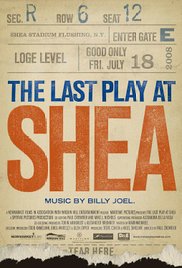 In the 1970s and beyond, Billy Joel was one of my favorite musical artists. At the start of his career, I had an opportunity to hear him in Atlanta, but I missed that chance. I finally saw him in concert at Madison Square Garden in New York in 2017; the show was one of those one-of-a-kind concerts that remains in your memory for a long time after. So it was with great anticipation that I watched The Last Play at the Shea, a 2010 documentary that recorded the 2008 Billy Joel concert that was the last concert at Shea Stadium, a huge sports venue that was scheduled for demolition the following year.
 After five years of teaching English in Israeli schools, I now have no official job. The school in which I worked cannot hire me because I am beyond retirement age. What do I do now? I learn Torah every day and I exercise every day. Additionally, I write almost every day. Mostly, I write film reviews that appear on the Internet and, when I visit the States, I lecture on “kosher movies,” films that have something meaningful to say about life and the subject of my recent book, Kosher Movies: A Film Critic Discovers Life Lessons at the Cinema. Such writing compels me to think, to remember certain aspects of my life, and to formulate life lessons to impart to the reader. Writing keeps me engaged with the world.
 One of the important lessons I learned over my long career in education is that kids are works in progress. If a student seems like a loser in high school, that does not mean he will always be a loser. I have witnessed many a student who has undergone a metamorphosis academically and spiritually. In high school, they were incorrigible; as adults they were exemplary human beings. I recall one student in particular, Daniel, who gave me grief every day he came to school, yet I controlled my response to his negative behavior and never said anything to him I regretted. Many years later, I received a phone call from Daniel apologizing for his confrontational behavior in high school. He then gave the school a sizable donation.
 I enjoy and respect the company of people of faith, as long as they are not functioning as missionaries. Let me give you an example. When I was principal of a Jewish high school, I learned that one of our very fine Jewish general studies instructors was living with someone other than his wife. It was a private matter until I discovered he was hiring our students as babysitters for his paramour. At that point, I asked myself: if I were a parent, would I want my child to be exposed to a situation which was contrary to my own value system by a teacher in a school that shared my value system. Flash forward to another teacher in the school, the Christian mother of five children who was an outstanding science teacher. In her spare time, she wrote poetry about the details of God’s creation and always emphasized the renewal of God’s sustaining powers on each day of a person’s life, a message very much consistent with the ethos of our Jewish day school.
 My son-in-law is a special education educator focusing on autistic students. He helps kids and their families cope with a disability that manifests itself in different ways depending upon many idiosyncratic factors such as age and family background. Therapies that work in one situation may not work in another.
 As I have gotten older, I have less and less interest in acquiring things. I remember that as a young man, I had a serious interest in cameras and in audio systems. I no longer possess such interests. I am guided by what the great Jewish Sages have said about how to conduct one’s life; namely, that the only thing we take with us to the after-life is our good deeds; and so I spend my time learning Torah, trying to make the world a better place through my writing both on the Internet and in books, and doing acts of kindness. This mindset made me very receptive to the inspiring documentary about Warren Buffet entitled Becoming Warren Buffet.
 Kosher Movies