Category Archives: Romance

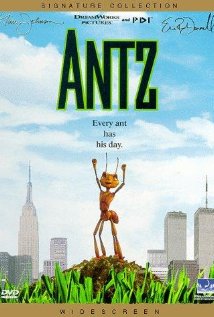
Antz (1998), directed by Eric Darnell and Tim Johnson

antz posterIn high school, everybody wanted to look the same. Elvis was the fashion icon, and we all grew sideburns and dressed to look cool. Many years later, I was at an Orthodox Chassidic wedding, and I realized I was the only person there with a grey hat and suit. Everyone else was dressed in a black suit and wore a black hat. They all looked the same just as my buddies from high school looked the same with their pompadours and pegged pants. The common thread: similar dress indicated similar mindset. To be different branded one as an outsider looking in. Individuality was suspicious.

Confirming to the majority is the challenge facing “Z,” the hero of Antz, a hilarious animated feature, which deals with expressing one’s individuality in a world where conformity is the ideal. The narrative begins in an ant colony in Central Park in New York where Z-4195, also known as “Z”, longs for the chance to express himself as an individual. He is depressed over living in a totalitarian society that frowns upon and, in most cases, forbids veering from the norm. Into his world enters Princess Bala who meets Z at a bar to which she has escaped from her suffocating life at the palace.

Their union is aborted when the princess suddenly has to leave. However, Z, mesmerized by her, is undaunted by their different positions in society. He gladly exchanges his worker ant status with a friendly soldier ant to seek an opportunity to see Bala again and pursue their relationship.

Crisis arrives when the soldiers are sent into battle by General Mandible, the power-hungry leader of the army of ants. Z barely escapes with his life and resolves to seek a better world where individuality is valued. Mandible and Z represent two conflicting ideologies: conformity versus individuality. The worker ants have to choose between the two, or learn to strike some kind of balance between the two.

Jewish tradition offers such a balance. Jewish law requires conformity in practices related to rituals and moral behavior. Everyone who is with the program possesses a belief in God and in the divinity of sacred text. Once those basic principles are accepted, then there is room for individual expression.

Although everyone is created in God’s image, which means that everyone is unique and possesses infinite value, it is good that not everyone is exactly the same. We should appreciate the differences once common core principles are accepted. The classic model is the Talmudic discussion that takes place between Sages who may see the same reality but use different eyeglasses to arrive at different conclusions.

Rabbi Dr. Nathan Lopes Cardozo, in an intriguing article praising non-conformity and rebellion within Jewish education, observes that the Torah itself was the first text of rebellion to appear in world history. Abraham challenged existing beliefs and protested the status quo. The goal of the Bible was to be the catalyst for a “rebel movement of cosmic proportions.” Furthermore, Rabbi Cardozo writes that the Torah “protests against complacency, self-satisfaction, and negation of the spirit. It calls for radical thinking and drastic action without compromise, even when it means standing alone, being condemned and ridiculed.”

This is exactly what happens to Z when he foments revolution among the worker ants. The powers that be mock him, but Z does not despair. He is convinced that individuality is to be celebrated even when society operates with a totalitarian vision. The key is balance.

Antz is a wildly imaginative movie with lots of laughs, especially since Z is voiced by Woody Allen, articulating the neurotic pessimism that characterizes his humor. Beneath the surface, however, is a serious statement about preserving the integrity of the individual voice even when the majority wants to drown it out.

Purchase this movie from Amazon.com.

Splendor in the Grass (1961), directed by Elia Kazan

Splendor in the Grass posterI saw Splendor in the Grass in 1961 when I was 19 years old. I was in college taking a course in English Literature and we had just read Wordsworth’s “Ode to Intimations of Immortality” focusing on the classic lines which make up the title of the movie: “Though nothing can bring back the hour of splendor in the grass, glory in the flower, we will grieve not; rather find strength in what remains behind.” The lines penetrated my psyche, and I had one of those “aha” moments as I connected the words to my own experience. I was not in love with anybody at the time, but I still had memories of my ninth grade infatuation that ended badly when I was rejected by my then girlfriend for another boy. It was devastating and it took me a long time to recover my psychological equilibrium. I too had come to the realization that I could not recapture the past; all I could do was “to find strength in what remains behind,” and reconstruct myself emotionally.

Splendor in the Grass is a sad but very wise movie. Although it ends with a piece of senior wisdom, a lot of teenage angst is portrayed along the way in all its raw emotion. Bud Stamper, the high school jock, cannot have an honest conversation with his father who wants to make Bud in his image rather than allow Bud to discover who he is on his own. Deanie Loomis, his girlfriend whom he loves dearly, cannot have a conversation with her mother without her mother depositing a truckload of guilt behind. “What we’ve got here is a failure to communicate” is the famous tagline from the popular film Cool Hand Luke, but it fittingly describes the relationship between Bud Stamper and his father and Deanie Loomis and her mother. Parents talk at their children but do not see beyond their own perspective and interests.

The story begins in 1928 in Kansas. Deanie and Bud are in love, and as a teenager in love once myself, their love seems real, not deep but definitely real. Bud’s dad does not want Bud to marry right after high school. He wants him to attend Yale and then embark upon a career. He even encourages Bud to be promiscuous, naively thinking that Bud’s desire for love can be assuaged with a coarse physical relationship. Dad, in truth, has little understanding of true love as can be seen from his loveless relationship with his own wife.

Bud and Deanie feel a strong physical attraction, but Deanie wants to remain virginal, and Bud thinks of Deanie as a “good girl;” inwardly he does not want her to be like others who might compromise their innocence. All this leaves them passionately connected to one another but under enormous emotional stress. Eventually, they break up with catastrophic consequences.

Years later they meet. Both have moved on with their lives, but they recognize the specialness of what they once had. They know that their strong affinity for one another cannot be resurrected, but that does not diminish the possibility of each one having a happy life with someone else.

In Jewish matchmaking, there is the notion of one’s bashert, one’s destined one or soul mate. I have wondered what happens when you meet your destined one, but do not recognize her or you do recognize her but lack the will to move forward. Time passes and your destined one marries another. What are you left with? Many Sages think that the notion of bashert is not part and parcel of Jewish law and should be applied only metaphorically. Rabbi Josh Yuter, in a masterful article explaining the concept, opines that bashert applies to how you view your spouse after marriage. In other words, when married couples go through rough spots, they should view their spouse as their destined mates and resolve to solve their problems rather than escape from them. Alternatively, one can say that the bottom line is that you have to seek out someone who fits with you emotionally and intellectually as well as physically.

One cannot be fatalistic in Judaism and just wait for the right one to appear. Rather we should find the missing part of ourselves that Adam lost in Eden and build our lives using the best information we can obtain at the time. Splendor in the Grass reminds us to do our best at whatever stage of life we are. Let us find glory in the flower even in the autumn of our lives.

Purchase this movie from Amazon.com.

Roxanne (1987), directed by Fred Schepisi

roxanne posterAs a synagogue rabbi for a number of years, I have officiated at many weddings. I am sometimes surprised at the disparity of appearance between the two partners. One may be exceptionally handsome, the other unattractive in conventional terms. Over time, however, I have realized that the two partners have much in common emotionally and intellectually, and that kind of connection is enduring. What seems to count is spiritual synergy, not transient beauty.

I sense the same emphasis on spiritual compatibility when I observe people getting married in Israel. Let me elaborate. When I drive home on my way home from work every day in Beit Shemesh, I pass by a wedding hall in a charedi (ultra-religious) neighborhood of Beit Shemesh, Israel. Very often, I see a marriage canopy set up in the outdoor courtyard in front of the building, signaling a wedding that evening. I know that in most cases bride and groom have only recently met and actually seen one another very few times. The essential compatibility for marriage is determined by the possession of a common spiritual direction, not how the other looks. Appearances again count but for little. What is paramount is union of souls, not bodies. This deeply shared perspective on life lies at the core of Roxanne, a hilarious comedy in which C.D. Bales, played by comic virtuoso Steve Martin, reconciles himself to a vicarious love affair with Roxanne Kowalski, all because his huge nose, a physical anomaly, is perceived by him to be an impediment to any serious love connection.

C.D., the fire chief in a small town in the Pacific Northwest, has a very large nose. He knows that it makes him look like a freak, but he is unwilling to undergo cosmetic surgery to fix it. He has gotten used to it and he is upset when anyone makes fun of it. Into this scenario enter two people who change his life: Roxanne, a serious and beautiful astronomer temporarily living in town, and Chris, a good-looking but simple-minded fireman attracted to Roxanne.

Following the general plot outline of Edmond Rostand’s Cyrano DeBergerac, the film illustrates C.D.’s growing love for Roxanne and Roxanne’s infatuation with Chris, whom she thinks is both handsome and highly intelligent. Chris, in reality, is not the brightest bulb in town, and chokes up at the thought of even speaking to Roxanne. As a result, he enlists the aid of C.D. to help him woo her. C.D. accomplishes this by writing witty and passionate love letters to Roxanne, letters that are signed by Chris. The ruse works for a while with great comic ingenuity, but eventually the truth comes out.

After the truth is revealed, Roxanne has an epiphany of her own, and confesses her feelings to C.D.: “You know, I’ve been thinking about what attracted me to Chris. It wasn’t the way he looked. Well, that’s not true, at first it was the way he looked. But it was how he made me feel. He made me feel romantic, intelligent, feminine. But it wasn’t him doing that, was it? It was you. You and your nose, Charlie. You have a big nose! You have a beautiful, great big, flesh-and-bone nose! I love your nose! I love you, Charlie.”

The Book of Proverbs, authored by the wise King Solomon, expresses the paradigmatic Jewish view of beauty. It is something that transcends the physical. In his paean to the Jewish woman, which is recited in traditional Jewish homes every Friday night, the husband clearly proclaims that “grace is deceitful and physical beauty is evanescent. Only the woman that is God-fearing is the one to be praised.” The passage expresses a constant message about what really matters in a relationship. Moreover, it is a reminder to one’s children and subsequent generations that in choosing a spouse, one should seek out beauty of character more than beauty of outward form. Roxanne reminds us to value substance over style in defining our loving relationships.

Purchase this movie from Amazon.com.

Begin Again (2013), directed by John Carney

begin again posterAt our Friday night dinners, we enjoy having guests. I am very busy during the week, and I rarely have time to engage people in conversation other than to give a quick hello and how are you. The Sabbath, however, is a day that moves slower than the rest. I disengage from my mundane activities and can think about life, about relationships, about getting to know people better.

On one recent Friday night when we invited a number of people I did not know well, I learned that one of our guests seriously considered becoming an actress. But she realized early on that such a career would be challenging for one who wanted to observe the Sabbath. Being an actress would raise other lifestyle issues as well. So many in the entertainment industry lead lives outside of conventional morality and the whole scene would be problematic for a person of serious religious faith. Therefore, she decided to stay away from a career in which her values might be compromised.

I thought of this as I watched Begin Again, the entertaining story of Gretta, a young singer/songwriter, who has a chance at stardom, but who, through the crucible of life experience, ultimately foresees the pitfalls of fame.

The story opens as Dan, a music producer who has fallen on hard times, discovers Gretta in a Greenwich Village bar singing one of her iconic songs. Dan is taken by her music and offers to sign her with his former record label. Though at first reluctant to work with him, Gretta decides to give it shot and see what happens. At first, nothing does happen, but then Dan gets the idea of recording Gretta’s album on the streets of New York. Dan, recruiting a number of talented musicians who are between jobs, is able to produce an album that might possibly be a huge success.

The entire experience of working together to produce the album bonds Dan with Gretta artistically and emotionally. Gretta takes an interest in Dan’s personal life, encouraging him to reconstruct his own life, which is in shambles. Divorced from his wife and disrespected by his teenage daughter, Violet, Dan is emotionally fragile and his friendship with Gretta gives him a new sense of purpose in life.

Gretta’s recent breakup with her unfaithful boyfriend Dave, also a singer/songwriter, has left her emotionally scarred. Gretta appreciates the honesty of Dan, who shares her love for music that is authentic and not crafted just to be commercial. To her and Dan, making music is not just about making money; it also about stirring the soul. In contrast, Dave is animated by the business of music. He puts great stock in the opinion of others and is quick to leave his principles behind. Gretta comes to understand this when she sees Dave performing before a packed house of female admirers who Gretta knows will satisfy Dave’s desire for fame and adulation.

Gretta wisely decides to assert her autonomy and chart her own course to success. For Gretta, music is her muse. Success means being able to share your creativity with the world. She will not compromise her principles, and so she allies herself with Dan who makes no demands on her and understands her need to preserve her artistic independence.

The Talmud instructs man to stay far away from a bad neighbor, someone who potentially can influence you to do bad things. The advice relates to choice of friends both on a personal level and in the marketplace. Gretta in Begin Again chooses to stay away from negative influences, from those people who value compromise over personal integrity.

Purchase this movie from Amazon.com.

Heaven Can Wait (1978), directed by Warren Beatty and Buck Henry

heaven can wait posterWhat kind of legacy will you leave the world? When will I complete my mission on earth? Can I explain why is it that some people die in the prime of youth and others live until old age? The Talmud tells us that these questions are unanswerable by men, but can only be answered by God from the aspect of eternity. Heaven Can Wait, a romantic fantasy, raises these questions without definitively answering them. What the movie does do is suggest some possible approaches to how we understand tragedy.

Joe Pendleton, backup quarterback for the LA Rams, is given an opportunity to start. On that fateful day, he is struck by a car as he is bicycling through a tunnel. The next scene reveals that Joe is now in some way station in the clouds about to depart for the afterlife. Escorted by two men, Joe discovers that his death is a divine mistake carried out by a first-time escort who, before Joe died, plucked him away from life. The escort tries to remedy the situation, but is too late. Joe has been cremated and there is no body in which to place him.

Mr. Jordan, one of the escorts, presents Joe with several possible choices, and Joe selects the body of millionaire Leo Farnsworth. His choice is motivated by a desire to develop a relationship with Betty Logan, a teacher who is an advocate for a small town that is about to be taken over by one of Mr. Farnsworth’s business empires.

Joe begins to live the life of Farnsworth, but is bothered by Farnsworth’s ethics and lifestyle. He expresses his feelings at a board meeting, which unnerves all the board members. They do not understand how a tough-minded CEO with ruthless financial goals can change into a liberal, sensitive executive with genuine compassion for the little man affected by board decisions taken many miles away.

Moreover, Joe still misses football. He decides to contact his old trainer Max, asking him to train him for a return to the Rams. To solidify his chances to play, he buys the team and sets up a scrimmage in which he is the quarterback. After some initial setbacks, he convinces the team that, indeed, he can play at a professional level. However, all his plans fall apart when his escort reappears to inform him that he can no longer use Farnsworth’s body.

How this dilemma is resolved is the stuff of fantasy. What sticks in my mind, however, are two ideas that are embedded in the film. Firstly, how long we live is not in our control. We have free will, but it is limited. We can influence our future but we cannot determine it. Secondly, how do we measure our life, by the years we live or by the way we live our years?

Heaven Can Wait suggests that each of us has a mission. Sometimes that mission is accomplished over the span of many years and sometimes it is completed in a very short time. We all know people who live long lives but who accomplish very little. There are others who live brief lives, but lives packed with meaning and accomplishment. In truth, we do not know why bad things happen. Such matters are left to God who sees the continuum of past, present, and future. Mere mortals can only see the present. Perhaps when we hear about or experience the premature passing of a loved one, it is useful to contemplate that, from the aspect of eternity, a life well lived, even for a brief time, is part of a larger divine plan that guarantees meaning to every life.

Purchase this movie from Amazon.com.

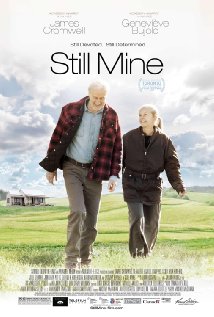
Still Mine (2012), directed by Michael McGowan

still mine posterI have noticed over the years that I have less material interests. I used to buy new clothes for the holidays every year, but I have not bought a new suit for at least fifteen years. The old ones do just fine, and I no longer enjoy the shopping experience. Although I live in the present, I am nostalgic about the past. There is a scene in Still Mine, which captures this nuanced approach to aging. Craig Morrison, in his 80s, is looking at a dining room table he crafted many years ago. When he first constructed it, he would be upset whenever it was scratched. Now the scratches are things to admire, precious memories of events that occurred around that table.

I imagine this view of material things is a part of getting older. We become less focused on things and more focused on the intangibles of life, the precious conversations with family, the time we spend developing our souls and minds. It is not necessarily a time of retirement, but a time when we see life differently and treasure the moments of connection with others. This special rhythm of life is captured in Still Mine, an engrossing story of a man determined to actively care for his wife in the twilight of their lives.

Craig and Irene are senior citizens living on a small coastal farm in Canada, and Irene is beginning to lose her memory. They have a led a full life and have good children, some of whom are still working the land that their parents gave them many years before. Craig realizes the physical and mental changes that are on the horizon for Irene. He knows that his current home will be physically unsuited for her since Irene has trouble climbing the stairs. In view of this oncoming reality, Craig decides to build a one-story home on his property. The problem: he does not comply with all the building codes. He thinks that since he is building on his own land, he does not need to comply with any state or local regulations. In the midst of this bureaucratic quagmire, two of his children, observing their mother’s decline, want their father to provide more conventional care for their mom. They are uncomfortable with dad assuming all care for their mother since he is aging as well. In their judgment, he cannot adequately take care of her. Craig, however, is adamant and feels he is the best caregiver around and refuses to delegate taking care of his wife to any third party. He exclaims to his kids: “Age is an abstraction, not a straitjacket.”

As time moves on and Craig continues to build his new home for Irene, he comes up against unsympathetic bureaucrats who present him with more and more rules with which to comply, resulting in a long list of building code violations that threaten to nullify all his efforts to provide comfort and peace of mind to Irene as her dementia advances.

Based on a true story, Still Mine describes Craig’s fight to build his dream house for Irene in spite of many obstacles. The discussions between him and his children about how to care for Irene illuminate the various approaches we can take towards care of our elderly parents. There is more than one way, and Jewish law suggests we have to consider carefully all possible remedies and their ripple effects. Two Talmudic scholars of the past, Maimonides and Raavad, suggest alternate approaches. Maimonides in his Code of Jewish Law writes that a child should always care for his parents unless the situation is severe, in which case one can hire third party professional caretakers. The Raavad, a contemporary of Maimonides, rules differently and insists that the family should remain as the caregiver of the parent, no matter how severe the malady, and not delegate others to fulfill their family responsibilities. Still Mine shows the complexity of decision-making when it comes to the care of aging parents, and asserts the power of mature love to overcome even the most challenging of circumstances.

Purchase this movie from Amazon.com.

The Secret Life of Walter Mitty (2013), directed by Ben Stiller

secret life of walter mitty posterThe Secret Life of Walter Mitty is a film with two essential messages, and I had to think a long time before choosing which aspect of the movie I wanted to write about. One message is to live life to the max. Make every day a masterpiece by participating in life, not just observing it. Another message is to value the work of every day because ultimately greatness comes through hard work, perseverance, and a daily dedication to perfection. I chose to amplify that message for this review.

Walter Mitty works for Life magazine and is in charge of cataloging its large storehouse of photo negatives, a seemingly boring job in which Walter takes pride, knowing that he is working with great photographers whose pictures are potentially life-transforming to the viewer. We learn that in the past Walter had an adventurous streak, but when his father died at a young age, Walter was forced to abandon his dreams and get a job to support his family. Therein lies the emotional core of the film. Walter lives a very mundane outward existence, but lives an imaginative inner life, daydreaming of scenarios in which he imagines that he is a man of decision and action. Hence, the title of the film, The Secret Life of Walter Mitty.

Mitty for many years has worked with famed photojournalist Sean O’Connell, and Sean sends him negatives of his latest works including a photo that he thinks will be fitting for Life’s final print edition before it re-emerges as a strictly online publication. But there is a problem. The negative is missing from the contact sheet he sent Walter and Sean cannot be found to clarify the whereabouts of the missing negative. Walter then embarks on a real-life adventure trying to locate Sean. His travels take him to Greenland and Iceland, with a series of hair-raising and hilarious encounters.

An air of mystery surrounds both Sean and the missing negative. It becomes clear that Sean, an idiosyncratic artist, values individualism, but he also values the contribution of the little guys in the company who work ceaselessly to see that his work is seen as he sees it: a thing of beauty and meaning that transcends the moment.

The Ethics of the Fathers reminds us that “every man has his hour.” The artist may be in the limelight but those who work laboriously behind the scenes also deserve recognition for their contributions. Both have their hour in the sun. Moreover, in Judaism there is the notion that every person has his unique mission in the world. When Jacob on his deathbed gives his blessing to each of his twelve sons, the blessing reflects the unique personality of each one. They are parts of one united family, but they fulfill their destinies in their own special ways. A classic example is the symbiotic relationship between the brothers Yisachar and Zebulon. Yisachar is charged with devoting his life to the study and teaching of Torah; Zebulon is charged with providing the financial support which underpins that holy work. Both are necessary for the ultimate destiny of the Jewish nation to be secured.

The Secret Life of Walter Mitty is a paean to the average man who labors diligently in his job each and every day. The public accolades may never come to him, but this does not devalue the work that is being done. In his own special way, his contribution behind the scenes may be more important than the one for whom he works. Let us praise the quiet ones who abide by the unwritten rules of excellence.

Purchase this movie from Amazon.com.

Enough Said (2013), directed by Nicole Holofcener

enough said posterAfter my wife died suddenly of a brain aneurysm almost 25 years ago, my world fell apart. Emotionally adrift for a year, I then decided to remarry not to replace what could never be replaced but to begin a new chapter in my life. After a year of traveling from Atlanta to New York to date women, I married a divorcee. I had six kids and was busy working as a high school principal.

Marriage at that time in my life was entirely different from what I experienced in 1965 when I got married for the first time. Now I needed not only companionship, a friend and confidant, I also needed someone to help me manage my stressful professional life, and to help me with my children that were still living at home. These were complications and challenges that I did not imagine as a 22-year-old getting married. Watching Enough Said, a story of two divorced people trying to connect romantically when they are both mature and wise in the ways of the world, reminded me that love at mid-life is totally different from the star-crossed love of youth.

In Enough Said, Eva, a masseuse and a divorced mother of a teenage girl, meets Albert, also divorced and the parent of a teenage daughter. Although not initially attracted to one another, they date and a relationship develops. Concurrently, Eva takes on a new client, Marianne, a poet who has also been through an unpleasant divorce. Eva and Marianne commiserate with each other, during which Marianne unloads all the idiosyncratic shortcomings of her ex. Eva and Marianne become fast friends until Eva discovers that Albert is Marianne’s former husband.

Instead of revealing this to Marianne, she prods Marianne with questions about her ex-husband to learn more about Albert. She is worried that Marianne may be right in her assessment of Albert and she may be wrong. Having gone through divorce once, Eva does not want to set herself up for another mistake.

Things come to a head when Eva’s duplicity is revealed to Marianne and Albert, whereupon Eva’s relationship with both of them dramatically changes. Enough Said begins as a comedy but becomes a serious meditation on second marriages and honest communication between couples and friends.

Second marriages pose special challenges. Both parties come with lots of baggage from the previous relationship. Moreover, stepchildren are a wild card since they often are unwilling to accept the new spouse. In divorce, you are building upon an edifice of ruins. In a first marriage, two people often are driven by intense emotion in response to physical desire and do not fully consider compatibility of dispositions and shared values. An unsuccessful first marriage is a reminder that passion alone does not make for a happy union. The first match may be ordained from Heaven, but that does necessarily mean it will be a happy union.

The Sages say that the success of one’s second marriage is dependent upon one’s merits, and it may be a more accurate indicator of long-term stability and happiness if it is not defined by the body but by the mental and emotional components of a relationship. Albert is overweight and Eva is no longer the svelte person she once was, but both recognize at this point in their lives that marriage transcends the physical. It endures when it connects the mind as well as the flesh. Interestingly, the commandment to love one’s neighbor as oneself is interpreted, in the view of the Talmud, to refer to one’s spouse, who ideally should be one’s best friend, not only one’s lover.

It is not good for man to be alone, says the Bible. Solitude breeds all kinds of emotional distress. Whenever possible, say our Sages, one should remarry after divorce or the death of a spouse. Connection with other human beings enriches life, for it reminds us to focus not selfishly on oneself but on significant others in our lives. Enough Said cautions us that relationships can weather many storms when they are founded on emotional, not just physical, compatibility and on honest communication.

Purchase this movie from Amazon.com.

The Artist (2011), directed by Michel Hazanavicius

artist posterWhen I was a principal of a day school in Denver, I decided to stage a Shakespeare Festival in which students in the 7th and 8th grades would read and enact excerpts from the bard’s great oeuvre. I gave speaking parts to the students, and I had a particular interest in giving Dimitry, a student who had emigrated from Russia, a chance to perform. When the performance day arrived and Dimitry spoke his lines, I was astonished. Not only did he pronounce the words properly, but he read them like a professional thespian, with understanding and feeling. It was a wonderful performance that forever changed our perception of Dimitry, who until then had not participated in oral presentations in any class. He finally found his groove, and his teachers were overjoyed. His sound made us forget about his silence.

The Artist is an anachronism. It is a silent movie made in 2011, which makes us reflect on the power of words and the power of sight to create art as a representation of life. George Valentin, a silent movie star, is at the top of his game in 1927 as his movies enthrall the audience. Serendipitously, he meets Peppy Miller, a young actress, outside the premiere of his latest movie, and he promotes her for a part in his next film. With guidance from Valentin, her show business savvy and talent grows until she becomes a major star in her own right.

Crisis comes two years later when talking films take over. Valentin dismisses them as a passing fad, but he is dead wrong. His efforts to produce a financially successful silent film when people want sound prove to be disastrous. Moreover, the Stock Market Crash of 1929 further destroys his wealth. George’s inability to respond to changing times leads to depression, which Peppy tries to dispel. Their relationship flourishes and flounders as George tries to navigate the new world in front of him, where everything hinges on the spoken and audible word.

Generally, Jewish tradition encourages silence as a fence to wisdom. More words often bring more gossip, more slander, and more criticism of others. However, sometimes it is important to talk, to protest, to engage, to share feelings with others.

A classic case of where it was important to speak and the absence of speech led to tragedy is the story of Bar Kamtza and Kamtza in the Talmud tractate of Gittin (55b-56a). Here the lack of speech led to the destruction of Jerusalem by the Romans. The Talmud records that a man invited his friend Kamtza to a party and, inadvertently, his enemy Bar Kamtza was invited instead. When Bar Kamtza arrived at the feast, the host was angry and insisted that Bar Kamtza leave in spite of the fact that Bar Kamtza would be greatly embarrassed and in spite of the fact the Bar Kamtza even offered to pay for the entire party. After being unceremoniously thrown out, Bar Kamtza vowed revenge because the rabbis at the party who witnessed this behavior said nothing; and saying nothing implied approval of what transpired. Bar Kamtza then decided to inform against the Jews to the Romans, which eventually led to the destruction of the Temple by the Romans. Speech was required and the rabbis were silent.

The Artist, an innovative retrospective look at another time in the history of cinema, is many things. It is a story of a September-May romance. It is also a meditation on how people deal with change in their lives. Do they adjust to new realities or do they remain paralyzed in the present? It is, moreover, a thoughtful reflection on the power of silence and the power of words to change our lives.

Purchase this movie from Amazon.com.

Barry Lyndon (1975), directed by Stanley Kubrick

MV5BMTczNzkyMjQ4N15BMl5BanBnXkFtZTcwOTQ2NjU4Mw@@._V1_SX214_AL_One of the “ah-ha” moments of my undergraduate career was reading William Makepeace Thackeray’s novel Vanity Fair: a Novel without a Hero. I was not a big reader in high school and what I read was not of a classic nature. But at college, I was exposed to great works of literature and it was a mind-blowing experience. I was introduced to worlds I never knew about and people who captured my attention and my imagination. What excited me about Vanity Fair was that I really cared about what happened to the people described in the book. Their problems and their challenges became mine and I was engrossed in their lives, even though none of them was a conventional hero. What they all shared was a common humanity, struggling to survive in an indifferent and sometimes cruel world; and their stories fascinated me. Barry Lyndon is another of Thackeray’s great novels, and it has been transformed cinematically into an opulent and engaging story similar in tone to Vanity Fair. It could be called “a film without a hero.”

The narrative begins in the 1750s in Ireland when Barry’s father is killed in a duel. Raised by his mother, he is sheltered from the harsh realities of learning how to earn a living. Instead, he tries to move upward on the social and financial ladder by allying himself with people in positions of power and influence. After numerous years of drifting and gambling, he finally secures the hand in marriage of a rich countess, Lady Lyndon, whose aged and sick husband has recently died.

Although they have a child, Barry is unfaithful to Lady Lyndon. Lord Bullingdon, Lady Lyndon’s son by her first marriage, observes this behavior and sees Barry as an opportunist interested only in his mother’s money. He is correct and, unfortunately, Barry’s life of excess drives the family to the brink of financial ruin by spending his wife’s fortune trying to become a respected and influential member of high society. He throws lavish parties to ingratiate himself with those in power and purchases overly appraised works of art. Eventually, he regrets his selfishness and apologizes to his wife, but only after much damage has been done. The dysfunctional relationship between Barry and his stepson, Lord Bullingdon, continues, however, with tragic consequences.

Kubrick, a masterful director, captures the opulence and physical beauty of the idle life of the wealthy and privileged with rich and exquisite images. Every scene looks like a museum painting. But beneath the outward beauty is a corrupt society focused only on power and pleasure, a society which disdains work and worships those with influence.

The positive value of work is nowhere to be seen in Barry Lyndon, which portrays a life of excess and leisure. This is in stark contrast to Jewish values. The Talmud, indeed, places great value on work. It is filled with comments abhorring idleness, suggesting that it leads to mental illness and sexual immorality (Talmud Bavli 59b). Moreover, Rabbi Yehuda and Rabbi Shimon state that work honors the workman (Nedarim 49b), and they themselves would deliberately carry heavy loads to show that manual labor was to be respected. Furthermore, Rabbi Yehuda Ben Besayrah remarks: “If a person has no work to do, what should he do? If he has a dilapidated yard or field, he should go and occupy himself with it.” Work is therapeutic, for it keeps man mentally healthy. Further, the Sages warn us “not to be tempted by opulence and not to be jealous of those who maintain positions of authority.” To be idle, in Jewish tradition, is to lead an unproductive life. Work, in contrast, gives man stability, a sense of self-worth, and happiness. Barry Lyndon reminds us that the life of idleness prevents one from leading an emotionally rich and balanced life.

Purchase this movie from Amazon.com.