Crimes and Misdemeanors (1989), directed by Woody Allen

crimes and misdemeanors posterAs principal of a budding Jewish day school, part of my job was to raise money as well as be the educational leader of the school; so it was with great joy when out of the blue I received a number of envelopes in the school mail box with thousands of dollars of cash. Over several months they mysteriously appeared and I attributed the gifts to an anonymous admirer and supporter of Jewish education. Several months later, the gifts suddenly stopped.

Soon after, I read in the local newspaper about the incarceration of a friend of mine for selling drugs. I never made a connection between the gifts of money and my friend’s crime until I visited him in prison some months later. It was then he confessed to me that the money he gave the school was from the profits of his drug sales. He wanted in some way to assuage his guilt and giving money to a Jewish day school was his atonement.

I was reminded of this incident as I watched Crimes and Misdemeanors, the disturbing story of ophthalmologist and philanthropist Judah Rosenthal. Judah has had an affair with a woman for several years, and she now threatens to ruin his life if he doesn’t marry her. His brother Jack suggests having the woman killed and this presents Judah with a major question of conscience: allow his life of wealth and privilege to continue or to hire a hit man to murder her. He reminisces: “I remember my father telling me that the eyes of God are on us always. What a phrase to a young boy. What were God’s eyes like? Unimaginably penetrating, intense eyes, I assumed.” At first the idea of murder is abhorrent to him, but then he equivocates. He has committed adultery, he has made incredibly stupid mistakes, but he knows that the revelation of his indiscretions to his wife will ruin him both in the eyes of his wife and the greater community. And so he decides to authorize the murder.

A parallel plot of the movie concerns Clifford Stern, a documentary filmmaker who is trying to produce a film on a great scholar who in spite of personal tragedy is able to affirm life with honesty, optimism and courage. It is his philosophy that counterbalances the sordid narrative of Judah Rosenthal. Professor Levy, the subject of the documentary, says in an interview that “we are all faced throughout our lives with agonizing decisions. Moral choices. Some are on a grand scale. Most of these choices are on lesser points. But we define ourselves by the choices we have made. We are in fact the sum total of our choices.”

Although Crimes and Misdemeanors plays like a comedy in many ways, at its core it is a deep philosophical meditation on the nature of morality in the contemporary world. In the Talmud, our Sages tell us one sin leads to another. Once we cross the line of morality and decency, we traverse a slippery slope and many sins are committed in the wake of one transgression. This is why the rabbis of the Talmud, who understood human nature profoundly,  often set up protective fences or decrees around the law to insure that the primary Biblical law is not broken.

Judah Rosenthal rationalizes his crime and it is unsettling to hear his self-analysis. First plagued by an overwhelming guilt, he hears the voice of his father who gave him a sense that God is watching him, and Judah feels that he has violated the moral universe. On the verge of a breakdown, he awakes one day and his moral crisis has vanished. Life goes on. There is no Divine retribution and he returns to his normal life.

Jewish tradition argues that guilt is sometimes good for a person and can even be redemptive. King David used guilt to spur him on to a life of good deeds and accomplishment. But David admitted his faults and did not rationalize his behavior when he sinned. It is this model that serves as a positive example for all of us who stumble occasionally as we navigate the moral choices that confront us.

 

Purchase this movie from Amazon.com.

Collateral (2004), directed by Michael Mann

collateral posterAs I scan the news every day, I see a recurrent theme. People who commit terrible crimes want very much to seem normal, regular guys who just want to preserve peace and order. In Syria where thousands are being killed by government forces, President Assad in a TV interview projects moderation and reason. Recently in Iran, leaders project charm and openness to the world while at home anyone who veers from the party line is subject to harassment or death. The politicos always want to portray themselves as reasonable men who are doing reasonable things, even if this means the murder of many innocents. I was reminded of this as I watched Collateral, a tense thriller in which a paid assassin conducts himself like an ordinary Joe.

The film begins when Max, a cab driver in Los Angeles, picks up Vincent, a friendly passenger, who offers him $600 to drive him around throughout the night as he makes a number of stops. Driving through Los Angeles, Vincent observes that the city is impersonal with no one really caring for one another. He shares a vignette with Max about a dead man on a subway who wasn’t even noticed by the other travelers. The viewer senses that Vincent really cares about the abandoned and forgotten. As the night wears on, however, we learn that Vincent is a paid assassin and at each one of the stops, he plans to murder someone. Max wants to escape after the first murder; but Vincent does not allow him to flee, and so Max’s ride with the devil begins.

Vincent executes two more people out of the five he has contracted to kill, and then orders Max to visit Max’s sick mother in the hospital. Before going up to her room, Vincent buys her flowers. Although his goal is to make Max’s delayed response to her phone calls seem normal, he goes the extra mile by purchasing the bouquet and engaging in sweet conversation with his mother. Vincent projects a solicitous attitude towards the old and infirm, but Max knows the truth and is emotionally unnerved by the sight of a confirmed killer by his mother’s bedside.

Vincent and Max then go to a night club filled with customers dancing to loud music. In the club is a heavily guarded target of Vincent’s. When Vincent attempts to assassinate the target with the FBI, the LAPD, and assorted underworld hit men in the room, a melee breaks out in which bullets fly. When someone mistakenly tries to shoot Max, it is Vincent who saves his life by killing the shooter, thereby adding another layer of confusion to Max’s relationship to Vincent.

All this gunplay and tension unravel Max, who in desperation wrecks his cab as he and Vincent make their getaway from the crime scene. When Max realizes that Vincent’s final hit is a passenger that he chauffeured earlier in the day, he goes out of his way to warn her. Vincent is determined to kill her in spite of his ambivalent feelings for Max; for at the end of the day, he is an assassin for hire, not a person who lets emotions get in the way of his mission.

The Ethics of the Fathers exhorts us to judge every man favorably, to give people the benefit of the doubt. However, once you know with certainty the evil nature of someone, you should be vigilant. As our Sages say, don’t judge anything by its outward appearance; rather judge it by its contents. No matter how charming an evil person is, that does not excuse immoral behavior. Judaism mandates that we judge people by their actions, not by their appearances.

Purchase this movie from Amazon.com.

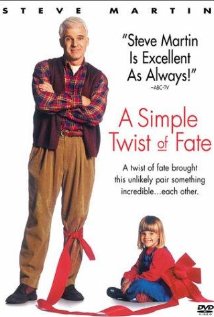
A Simple Twist of Fate (1994) directed by Gillies MacKinnon

simple twist of fateA friend of mine many years ago confided in me that he did not want to have children. He saw them as an inconvenience and simply preferred to own pets which would never make demands on him, argue with him, or keep him up at night. He would also not be required to pay exorbitant tuitions for Jewish day school education. When I countered that the Bible commands us to try to have children and that one of the first questions we are asked in the heavenly court is whether we truly attempted to have children, he dismissed my arguments. When I shared the practical reality that children take care of us emotionally and physically when we are older, and that they are a living extension of the legacy we create during our lifetime, he again rejected my thinking. To him, present creature comforts trumped everything.

A Simple Twist of Fate, based on George Eliot’s Victorian novel, Silas Marner, reminds us that to parent a child is a blessing that can make our own lives more meaningful. When we learn to care for child, we are leaving our own egocentric desires at the door and becoming better human beings by giving to another who cannot take care of himself. This is what happens to Michael McCann, a high school music teacher, when he adopts a small child who serendipitously finds her way into Michael’s home on a stormy winter night after her mother dies in the snow.

Until that transformational moment, Michael has led a reclusive life as a carpenter crafting elegant furniture and amassing a collection of gold coins which he counts every evening and jealously guards. On one fateful night, his coins are stolen, and Michael is shaken to the core. Depressed and irritable, his mood changes when he discovers Mathilda, the foundling, and rears her as her father. Life becomes meaningful for him as he learns to parent her. Love deepens as he guides her and watches her mature into an intelligent, precocious, and happy youngster.

Complications ensue when Mathilda’s real father attempts to adopt her many years later, citing Michael’s inability to pay for her education at the finest schools and his eccentric life style. Michael, after all, is only a carpenter who earns very little, and his social life is limited. Following in broad brush strokes the outline of Silas Marner, the film depicts the slings and arrows of outrageous fortune that beset Michael as he tries to retain custody of Mathilda. For him, parenting is a calling and he does not want to surrender that privilege.

Jewish tradition places great value on having children and on raising them to be images of the Divine. Being fruitful and multiplying is the first commandment in the Bible. God wants the world to be populated, and having children accomplishes this Divine goal. Moreover, Judaism emphasizes the chain of tradition and passing down values to the next generation. This is expressed in the Passover Seder, where children ask questions of parents, who supply answers to inquiring minds. Furthermore, every Friday night in many Jewish homes parents bless their children, poetically comparing them to the great patriarchs and matriarchs of the past, who carried the message of Jewish living to subsequent generations of Jews. Having children allows one to be a messenger of God in this cosmic plan.

As a parent, I have told my children that my most important title is not rabbi or doctor; rather it is Abba/Father. What my own parents left me was a host of positive memories which played a role in my own self-actualization as an adult. Their values are embedded in me, and that is their legacy, which I try to pass on to my own children.

A Simple Twist of Fate suggests that the best thing a parent can leave a child is a legacy of love and strong family values. These will endure beyond any material gift.

Purchase this movie from Amazon.com.

Zero Dark Thirty (2012), directed by Kathryn Bigelow

zero dark thirty posterWhen I graduated Yeshiva College in 1964, the Senior Class officers asked me to solicit funds for the annual yearbook. One ad I solicited was from the Volkswagen dealership from which I had purchased my first car, a classic Volkswagen Beetle, one of the few cars for which a parking space could be found in Manhattan. A few weeks later, I received a letter in the mail from the editor of the yearbook along with the check from the Volkswagen dealership. He informed me that many Holocaust survivors supported Yeshiva University and it would be offensive and painful for them to see the Yeshiva accept money from a German company. Moreover, a week later, while stopped for a red light in the New York’s Washington Heights neighborhood, someone from an adjacent car yelled: “Why are you driving that Nazi tuna fish can?” It was an “aha” moment for me. I knew no Holocaust survivors and I assumed in my naivete that as time goes on, we forgive and forget; but the incident reminded me that Jews do not forget the evil of the past.

Remembering evil is the subtext of Zero Dark Thirty, the story of the United States manhunt for Osama Bin Laden, the embodiment of evil who commandeered the 9/11 attacks in which 3000 innocents were killed. Spearheading the hunt is a young CIA operative named Maya, who, over a ten-year period, doggedly tries to put together pieces of evidence from a variety of sources. Things begin to fast-track when, in questioning one suspect, she innovates. She decides to lie about the outcome of an attack to a prisoner who has been in total isolation, unaware of events on the outside. Using this ruse, she is able to extract valuable information about the identity of one of the terrorists who planned the 9/11 attacks. This eventually leads to the identification of Bin Laden’s most trusted courier.

Maya’s challenge is to provide actionable intelligence that can justify a strike. The Americans track the courier to gain more knowledge about the location and daily routines of Bin Laden. As the data is gathered, Maya pushes for a strike on the house in which she believes Bin Laden lives. Without absolute proof that he is there, her superiors are reluctant to order a strike; but they eventually come around to her way of thinking even though they are not totally convinced. Her sense of mission, coupled with her determination and intelligence, persuade the decision-makers to support her and Bin Laden is killed in the ensuing strike.

Jews are commanded in the Torah to remember Amalek, the arch enemy of the Jewish people who attacked the weak and infirm, the elderly, and the children as they were departing Egypt. Tradition tells us that Haman, the villain of the Purim story, is a descendant of Amalek. There is a custom in some communities to write the name of Haman on one’s shoe on the holiday of Purim; and while the story of Purim is being chanted, we stomp with our feet every time the name of Haman is uttered, thus causing the name of Amalek to be eradicated today even though his crimes took place 3000 years ago.

It is similar to what animates today’s present day search for Nazis who committed atrocities against humanity over 60 years ago. Zero Dark Thirty reminds us that the passing of time does not minimize the crime. We still hunt for evildoers because we believe there must be accountability for doing evil. When we remember the past, it guarantees that we will have a future.

Purchase this movie from Amazon.com.

Hugo (2011), directed by Martin Scorsese

Hugo posterI recently had a conversation with a friend who moved to Israel ten years ago. I asked him why he made the move at the age of 50 when he was gainfully employed in a senior technology position with a well-established company. He told me that, in spite of the outward perception of his success, he saw the handwriting on the wall in terms of his professional life in America. Younger people were rising in the company who were more adept and knowledgeable, and he knew it was simply a matter of time before he was let go. That reality motivated him to move to Israel and reinvent himself here where he started a “quickie-lube” automobile service center, which is now thriving.

I thought about my friend as I watched Hugo, an engrossing, imaginative story of an innovative businessman, Georges Melies, who is left behind as the world changes and technology advances. Unlike my friend, he is unable to reconcile his creative past life with a future that is changing every day, and so he becomes depressed and sad over a fate of which he has no control.

The agent of his emotional redemption is Hugo Cabret, a 12-year-old boy orphaned when his widowed father dies in a museum fire. A bond between father and son is the movies. In particular, the imaginative films of Georges Melius, whom Hugo’s father adored, is the favorite of father and son.

After his father’s death, Hugo is taken in by his alcoholic uncle who maintains the clocks in the railroad station, and Hugo learns how to maintain and repair them. While managing all the timepieces, he tries to fix a broken automaton, a mechanical man, which his father bought many years ago. It is this project which animates Hugo, who senses that his father has left him a message which only the automaton can reveal. Desperate to keep his father’s memory alive, Hugo steals mechanical parts to repair the automaton, but he is eventually caught by a toy store owner named Georges Melius who makes and fixes toys. Their relationship is at first tense, but when Hugo discovers that the toy store owner is the same Georges Melius, the moviemaker and creative genius who was beloved by his father, he wants to repair not just the automaton but Georges Melius as well.

We learn that Georges was a master filmmaker, who introduced clever and original special effects into his silent movies. Unfortunately, the advent of World War I changed the entertainment landscape in France where the story takes place, and Georges is forced to sell his movies in order to survive financially. Hugo discovers that Georges actually created the automaton, which was the only surviving remnant of his creativity. Hugo, of course, possesses it and wants to return it to its creator. How he does that is the stuff of a magical movie, with exquisite art direction and cinematography which makes Hugo a contemporary masterpiece.

King Solomon tells us in Proverbs that “the righteous fall seven times and rise again.” The message to all men is never to despair after setbacks or tragedy. God is orchestrating things behind the scenes, and one can find meaning even in the most dire of circumstances. The proper response to adversity is to learn from it, not to give in to it. When Georges Melius finally has his emotional awakening, he acknowledges his debt to a brave young man “who saw a broken machine and, against all odds, fixed it. It was the kindest magical trick that ever I have seen.” The reference is both to fixing the automaton and to Hugo’s rekindling of Georges’s creative fire, enabling him to join the larger community of artists from which he had been detached for so many years.

Hugo reminds us to help those broken souls who need human connection, and to “fail forward” and learn from adversity rather than wallow in despair.

Purchase this movie from Amazon.com.

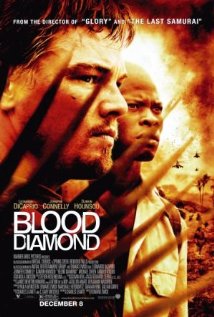
Blood Diamond (2006), directed by Edward Zwick

blood diamond posterI recently completed my second year of teaching in an Israeli school and asked my 6th graders what their plans were for the summer. Many told me they were going to summer camp to study Torah and to play sports. Earlier that same morning, I read an article about Hamas summer camps. What do the kids do there? They learn how to handle weapons, use live ammunition in military exercises, and the best way to kidnap an Israeli soldier. What a contrast! Some spend a summer learning how to love; others spend a summer learning how to hate.

I thought of Hamas summer camp as I watched Blood Diamond, a gripping, violent thriller about commercial traffic in diamonds that is used to finance conflict in budding African nations, often using children as executioners who are taught at a young age how to hate.

The setting is the Sierra Leone Civil War in 1999, where rebel and government forces are killing each other daily and committing unspeakable atrocities. Caught in the crossfire are the townspeople, one of whom is Solomon Vandy, a fisherman from the village of Shenge. In one sudden raid, he is separated from his wife and children and is forced to work in a diamond field under a brutal overlord. His son, Dia, is conscripted into the rebel forces and is brainwashed to shed his previous identity and become a hardened killer, under the banner of doing what is best for his country.

While working in the diamond fields, Solomon discovers a huge diamond worth a fortune, but his efforts to hide it are seen by his commander, who wants the diamond for himself. In the midst of trying to take it from Solomon, government troops launch an attack, at the end of which Solomon is incarcerated. In prison he meets Danny Archer, who is also aware that Solomon had hidden a valuable diamond. Danny offers to find Solomon’s family in return for the diamond, and so begins their alliance and ultimate friendship, punctuated by many tense moments of mistrust along the way.

Dia, Solomon’s son, has been trained to kill. His captors blindfold him and give him a machine gun to execute a man. He pulls the trigger, and when he removes his blindfold he knows that he has a new identity as executioner. The next time he kills, it will be easier because, as a child, he has no conception of the great pain he is inflicting. He thinks that taking another man’s life makes him an adult in the loyal service of his country.

This attitude comes to a head when, after many months, he sees his father, who he presumes is an enemy. He holds him at gunpoint, but then something amazing occurs. Solomon reminds his beloved son of conversations he had a long time ago about getting up early in the morning to go to school to study towards becoming a doctor. This childhood memory connects them in the present and Dia puts the gun down, tearfully embracing his father.

There is a concept in Jewish tradition that subjects learned in one’s youth stay with a person throughout his life. In fact, one of the Sages of the Talmud remarks that his most important teacher was not the one who taught him the sophisticated logic of Talmudic debate but rather the one who taught him the alef-bet, the Hebrew alphabet.

A parent does not always know what will stick in a child’s mind, what childhood memory will be the one that that will inspire him in later years to lead a life of commitment to parental values. Blood Diamond reminds us how important it is to create of reservoir of positive memories in our children that will enable them to remain faithful to our core beliefs and values when they are older.  Planting a garden of love can overcome a harvest of hate.

Purchase this movie from Amazon.com.

Cinderella Man (2005), directed by Ron Howard

Cinderella Man posterA few years ago, a friend of mine wanted to borrow some money from me. Ordinarily, I would have been happy to give it to him. But there was one problem. I lent him a substantial amount of money a year before and he never paid me back. I told my friend that I could only lend him a small amount this time because of what happened in the past.

Everybody understands that people go through hard times and they may need help to survive a financial crisis. However, lenders lose patience with people who do not make a good faith attempt to pay back their debts. I shared with my friend my experience serving on school scholarship committees. Committee members all want to help, tolerating low payments as long as they are made regularly. But when the debtor does not pay even a small amount, the mood changes. Committee members get angry when people stop paying altogether. Our Sages reinforce this approach to borrowers when they tell us that a person who borrows and does not pay back his debts is a bad person.

Cinderella Man, the fact-based narrative of boxer James Braddock, is about a man who pays his debts. After a successful beginning in his boxing career, Braddock loses everything in the Great Depression. He is so desperate that he begs for money from old friends in order to pay a heating bill to keep his children warm in the dead of winter. He dilutes milk with water so that his kids can have some nourishment in difficult times. Reluctantly, he asks for government relief money when he confronts extreme poverty. All this he does to provide for his family. However, when he achieves a modicum of success after a number of years, he returns the welfare money even though he is not required to do so. When a reporter asks him why he did this, he says: “I believe we live in a great country, a country that’s great enough to help a man financially when he’s in trouble. But lately, I’ve had some good fortune, and I’m back in the black. And I just thought I should return it.”

Jewish tradition says that one must do everything one can to avoid becoming a burden on the community. James Braddock lived by this creed. In fact, the Talmud states that a man should flay a carcass in the street, never feeling that work is demeaning no matter how great a scholar he may be. The Talmud actually mentions many great sages who did manual labor in order not to become a burden on society.

We can also admire Braddock as a parent. When times are tough and his son steals salami from a local vendor, he takes him to the butcher to confess his sin and to return the stolen meat. What he says to his son is instructive: “We don’t steal, no matter what happens. There are people who are worse off than we are.” Braddock recognizes the value of a teachable moment.

In a coda at the end of the film, we are told that Braddock “served honorably in World War II, later owned and operated heavy equipment on the same docks where he labored during the Great Depression, bought a house in New Jersey with the winnings from his celebrated come-from-behind victory over Max Baer, raised his children in that house and lived there with his wife Mae for the rest of his life.” Success never went to his head. He remained a modest man, content to live quietly and productively for the rest of his life. Our Sages tell us that we can learn from every man. James Braddock was such a man.

Purchase this movie from Amazon.com.

Tristan and Isolde (2006), directed by Kevin Reynolds

tristan and isolde posterWhen I was a synagogue rabbi, a very agitated young man once confessed to me that when his girlfriend revealed that she was pregnant, he broke off his relationship with her and told her to get an abortion.  Now, several months later, he was overwhelmed by guilt. Life had moved on; he could no longer correct the situation, and he was very depressed and upset with what he did. Despite his insensitivity, his irresponsibility and his moral weakness, I intuitively understood he needed to feel that all was not lost. It was important to transmit the message that failure is not terminal. You can make terrible mistakes, but you can perform redemptive acts that mitigate punishment.  This is an important life lesson.

Tristan and Isolde deals with young people who make grave mistakes in judgment and the consequences of those mistakes. It is a tragic love story that takes place in medieval times when war raged between the British and Irish. The English are divided into clans and are routinely attacked and killed by the Irish. Lord Marke of Cornwall plans to unite the various tribes of Britain by becoming king and leading a united people to victory over the Irish. Marke is respected by most of the lords; his courageous demeanor in battle adds to his luster and the promise of his inspiring leadership.

Joining him in battle is Tristan, an orphan boy, who was saved from certain death by Lord Marke. Tristan is a loyal and brave warrior and fulfills Marke’s expectations as his heir apparent. But in a fierce contest with the Irish, he is wounded by a poisoned sword, and assumed to be dead. His funeral boat washes up on the Irish coast, where he is found by Isolde, the king’s daughter, and her maid. Slowly, he is nursed to health and Tristan and Isolde fall in love. However, circumstances force him to return to Britain.

Through a series of events, Tristan is reunited with Isolde in Britain, but she is now promised to Lord Marke as a wife by her father. She reluctantly goes through with the wedding, but the love which began on the shores of Ireland runs deep. Passions rage and Tristan and Isolde begin an illicit relationship that both know is doomed.

From the beginning, they are conflicted. Tristan says “I feel on fire and a guilt I can’t comodify.” Isolde agonizes: “Why does loving you feel so wrong?” It is a tortured relationship, in which two souls are divided by loyalty to a dear friend and benefactor, Lord Marke, and a burning desire to forget all moral boundaries and commit to loving one another in spite of what people say or think.

Lord Marke recognizes that their commitment to one another predated his marriage to Isolde and, in a magnanimous gesture, offers them an opportunity to escape together. At that moment, however, Tristan understands what is at stake for Lord Marke and the nation. He sends Isolde away, reminding her that if they were to flee together “for all time people would say it was our love that brought down a kingdom.” Duty triumphs over personal feelings and Tristan joins the battle against the Irish, ultimately sustaining a mortal wound.

Our Sages tell us that one hour of repentance and good deeds in this world is better than the entire life in the world to come, and that one can acquire eternal life in one moment of repentance. The sin of Tristan and Isolde cannot be dismissed. It is an egregious moral fault. But while we are alive, we can still influence our spiritual future. One selfless act, even one committed by a sinner, can change our eternal destiny and the destiny of others.

Purchase this movie from Amazon.com.

Trouble With the Curve (2012), directed by Robert Lorenz

trouble with the curve posterMy son called me recently to ask if he could bless his children every Friday night as is the custom in many Jewish homes. Our family custom was to bless the children once a year and he felt that he needed my permission to change a family tradition. I appreciated his call and then proceeded to tell him that if I had to do it all over, I would have blessed the children every Friday night. To be able to look each child in the face every week, to bestow a blessing upon them, and then to hug them and kiss them is a treasured moment that ideally should be done every week. There is no down side to such a practice. I simply had not done it weekly because I had no family Sabbath tradition of blessing the children in my own family and, therefore, only adopted the once-a-year custom as a default position.

I thought of this as I watched Trouble with the Curve, a baseball movie that is really a story about a dysfunctional relationship between a father, Gus Lobel, a baseball scout for the Atlanta Braves, and his daughter, Mickey, a successful attorney on the verge of becoming a full partner in a prestigious law firm. They rarely look one another in the eye, they seldom embrace, and hardly ever speak to one another after the untimely death of her mother when Mickey was only six years old. Gus retreats into his own reclusive baseball world of scouting and she tries to find meaning and success in practicing law, which she has done only to win the attention and affection of her mostly absent father.

Their relationship is tested when Gus discovers that his vision is becoming impaired, severely affecting his ability to judge and evaluate new baseball talent. Coupled with this challenge is the reality of his advanced age, which makes him a candidate for retirement or being fired from a position he has held and nurtured for the life of his professional career. When Gus is offered a comfortable early retirement with the option of collecting disability plus a pension, he sarcastically responds: “Save it. Being comfortable is overrated.”

Gus does not want to retire. Although he is sent to scout one of the top prospects in the upcoming high school draft, his superiors lack confidence in his judgment. Many of them prefer to rely on computer-generated information and devalue the contribution of the veteran scout who sees the player live on the field in a competitive situation.

Mickey wants to be a good daughter and assist her father, but he consistently refuses her aid in a gruff, insensitive manner. In spite of this rejection, Mickey resolves to join her father on his trip to North Carolina where he is evaluating Bo Gentry, the whiz kid who may be the answer to the Braves’ quest for success on the ball field for the next five years. This special time spent together affords them an opportunity to redefine their relationship and to allow the love that was dormant for so many years to re-emerge and create new pathways of understanding between them.

Trouble with the Curve on one level refers to the inability of a batter to hit a curve ball, but, in a deeper sense, it refers to the reality that life is not a straight line. Life throws us curves, and it is our job to adjust to the inevitable change that occurs to all of us. In the face of emotional chaos and confusion, we need to reaffirm our love to those who mean the most to us.

Purchase this movie from Amazon.com.

Lincoln (2012), directed by Steven Spielberg

Lincoln posterOver the course of my career, I have participated in many forums debating funding for Jewish day school education. Most of the time, I was principal of a Jewish day high school arguing for more funding for my school. Across the table often were representatives of Federation, the community funding agency charged with distributing money to a variety of constituent agencies.

In the early days, Federation was the enemy, the force that would potentially deny a Jewish education to needy families. As time passed, I took a different view of Federation. In truth, they were not the enemy. They were decent, intelligent people who wanted to do the best in their stewardship and management of community funds. Theirs was not an easy job: to determine with the wisdom of Solomon how much money went to each agency, all of whom were competing for allocations.

A friend of mine, Geoff Frisch, of blessed memory, with whom I studied Torah weekly, gave me an important piece of wisdom. Geoff, a master salesman, introduced me to the tapes and writings of Zig Ziglar, a motivational guru, who espoused seeing things “from the other side of table,” seeing things from the vantage point of the opposition and recognizing that they have a legitimate point of view, even though you disagree with them. Zig would say: “always look for the win-win situation and you will be successful.” Geoff practiced that approach and imparted it to me as well, and for that I am eternally grateful to him.

I thought of that negotiating approach as I watched Lincoln, a thoughtful and engrossing take on the presidency of Abraham Lincoln. The film deals only with a small piece of Lincoln’s presidency, but it reveals Lincoln’s nuanced tactics to get his legislative agenda passed by Congress.

In January of 1865, the Civil War is almost over, but Lincoln is troubled by the fact that even though the slaves have been emancipated, there is still no constitutional amendment making slavery illegal. Only a constitutional amendment will bring closure to slavery in America. The Thirteenth Amendment, passed in the Senate, still needs House ratification. Moreover, within Lincoln’s own cabinet and party, there is division. Some want to end the war first; others feel that if the war ends first, there will be little incentive to pass the amendment, and so Lincoln initiates a strategy to secure enough votes to pass this critical piece of legislation before war’s end.

The strategy is complex and nuanced. Lobbyists are hired with the explicit goal of securing the votes of those who are not yet committed to vote yea or nay. The approach they use varies from person to person, and Lincoln himself sometimes steps in to apply political and social pressure, always seeing things from the other’s perspective. Ultimately, the amendment is passed and Lincoln feels he has forever ended slavery in America, a historic legacy for which he will be remembered.

It is a remarkable performance by Daniel Day-Lewis that separates this Lincoln from any other film about this illustrious president. We can see and hear the thoughts and words of a man focused on his mission in spite of much political opposition and in spite of stress on the home front where his wife Mary is still grieving of the loss of their son Willie three years before. In the face of these pressures, Lincoln keeps his cool and enables those around him to do so as well. Often he is able to diffuse a situation with an amusing story or the sheer power and logic of his argument.

Jewish tradition fosters argument for the sake of arriving at truth. The Talmud tells us the sages Hillel and Shammai often disagreed with one another, but their respective points of view have endured because of the purity of their motives. So it was with Lincoln and many of his opponents in Congress. Lincoln did not see them as the enemy but as friends who needed to be convinced of the correctness of his position. His nuanced management style is worthy of admiration as we negotiate our own life challenges.

Purchase this movie from Amazon.com.