
Category Archives: Drama

Dr. Strange (2016), directed by Scott Derrickson

dr. strangeA friend of mine scheduled hip replacement surgery. He and his wife visited the surgeon who had been recommended by many. After the meeting, my friend and his wife came away with different impressions. While both felt the surgeon was highly competent, the wife detected a streak of arrogance in the doctor, and it bothered her. She preferred a surgeon who radiated humility, not pride. The husband felt that, at the end of the day, God is the healer, not the surgeon, and the surgeon’s arrogant attitude was not a reason to choose another doctor.

An extremely competent but prideful physician is the main character in Dr. Strange, the origin story of Marvel comic book hero Stephen Strange, a gifted doctor who sees himself as a mini-god. The opening segment of the film depicts a tragic car accident that results in catastrophic injury to his hands. He can no longer work as a surgeon and feels life is over.

One day, however, he hears about a fellow who was paralyzed and who, without medical intervention, regained the use of his limbs. To do this, the man journeyed to a faraway place in Katmandu, Nepal, called Kamar-tal, where he learned to use his mind to overcome his physical paralysis.

Strange decides to travel to Kamar-tal. There he meets people proficient in the mystic arts including The Ancient One, and Mordo, a sorcerer. These practitioners of magic exist in an alternate reality, which strives to rescue the world from enemies existing in other dimensions.

Under their tutelage, Strange moves from being a self-centered egotist to a person genuinely concerned about the fate of others. Moreover, he now believes not only in science but accepts other sources of knowledge that do not function according to the rules of science. At the outset of his psychological journey, he states: “I do not believe in fairy tales about chakras or energy or the power of belief. There is no such thing as spirit! We are made of matter and nothing more. You’re just another tiny, momentary speck within an indifferent universe.” At journey’s end, he comprehends that he is not the center of the universe; but, rather, some spiritual power is. Furthermore, his brush with death has made him value life more. The Ancient One tells him: “ Death is what gives life meaning.” That piece of wisdom resonates within Strange; life’s brevity makes him treasure each moment more.

These valuable life lessons are part of Jewish tradition. The Jewish belief system is built on the notion there is both a spiritual and material world and that what we do on this earth transcends the physical. Indeed, our earthly lives eventually morph into a purely spiritual existence on another plane where we are held accountable for the good and bad things we have done.

Moreover, the Sages in The Ethics of the Fathers remind us to repent one day before we die. Since we do not know when they day will arrive, we are to live with an awareness that each day might be our last. Therefore, each day should be filled with good deeds. Thinking about mortality is good because that thought will spur us on to a life of greater accomplishment.

Neurosurgeon Dr. Stephen Strange does not suddenly become a paragon of humility, but he does learn that life has other dimensions than the physical. Moreover, he learns that a mission-driven life can involve more than one mission, and that a person’s mission can change depending on the turnabouts in one’s own life. Indeed, Dr. Strange, a fictional comic book story, offers one model for cultivating humility and discovering our true destiny.

Purchase this movie from Amazon.com.

The Fault In Our Stars (2014), directed by Josh Boone

fault in our starsI recently read a book by my son, Rabbi Daniel Cohen, entitled What Will They Say About You When You’re Gone: Creating a Life of Legacy. Drawing upon his synagogue experiences and officiating at hundreds of funerals, he poses the question of how we want to be remembered. Through personal anecdote and sharing interviews with movers and shapers in the worlds of business and art, he suggests ways to re-engineer your life so that when your life is over, you will be remembered for things that matter, not for how much you acquired.

The protagonists of The Fault In Our Stars, two teenagers afflicted with cancer, reflect on how they want to be remembered. Recognizing the likely brevity of their own lives gives the question a particular urgency for Hazel Grace Lancaster and Augustus Waters.

Hazel and Augustus meet at a cancer support group. Hazel has stage-4 thyroid cancer and Augustus, in remission from bone cancer, has had his right leg amputated. They share their stories with one another and their literary interests, which deepen their relationship. Hazel’s favorite book is An Imperial Affliction written by Peter Van Houton. The novel ends in mid-sentence when the heroine dies, and Hazel is curious to know the after story of the characters in the book.

Hazel confesses that she has written hundreds of letters to the author asking him to tell her what happens next in the lives of the characters but to no avail. Happily, Van Houton’s assistant responds to Gus when he writes to Van Houton. This encourages Hazel to write Van Houton again and surprisingly he extends an invitation to her to visit him in Amsterdam. Frannie, Hazel’s mom, arranges for the Amsterdam trip for Hazel, Gus, and herself as chaperone.

The meeting with Van Houton does not go as expected. Van Houton is a misanthrope and only has negative things to say about life. Despite his cruel and insensitive outbursts, Gus and Hazel emerge stronger from his excoriations. They dismiss his pessimism and focus on the joy they feel for one another.

As the health of Gus and Hazel goes through peaks and valleys, they ruminate about the eulogy that each might say about the other. They begin to think about what is their legacy given the likelihood of short life spans. When Gus expresses his desire to lead an extraordinary life, Hazel reminds him that an extraordinary life is measured not in things accomplished but in the loving relationships you form on this earth. Hazel proclaims her love for Gus and tells him that her love and devotion to Gus will be remembered. That is the legacy that Gus will leave for Hazel.

Rabbi Daniel Cohen writes that one of the ways we create a legacy is to create memories and that is what Gus and Hazel do. They travel to Amsterdam, have dinner at an elegant restaurant, they discuss literature, and they share everyday experiences, all of which bond them together. Their shared memories animate their conversations as they navigate a precarious and uncertain life.

Rabbi Cohen cites two quotations that reflect the love and passion that Hazel and Gus have for one another. One is a popular quote whose source is unknown: “Life is not measured by the breaths you take but by the moments that take your breath away.” The other quote is by Bob Dylan: “If you want to keep your memories, you first have to live them.” The Fault In Our Stars is sad and tragic, but underpinning the narrative are life lessons about leading a meaningful life, no matter what the obstacles.

Purchase this movie from Amazon.com.

Their Finest (2016), directed by Lone Scherfig

their finestWhen I was about to enter college in 1960, I thought I was going to be a high school teacher. Somewhere along the way, my Judaic studies at Yeshiva University became my academic focus and I resolved to be a pulpit rabbi. My professional career began in Atlanta, Georgia, where I was the assistant rabbi at a large Orthodox synagogue.

In 1976, I began searching for a rabbinical post where I would be the head rabbi. But God intervened in my career path. Even though I had no experience running a Jewish day high school, I was offered the position of principal of Yeshiva High School of Atlanta.

How and why that occurred is not the subject of this film review, but how one chooses a career is. What are the factors that make one choose a career for which one does not prepare?

Their Finest tells the story of Catrin Cole, who in 1940 is requested to interview with England’s Ministry of Information to write scripts for short documentary films about the war effort. While researching a story about twin sisters, Lily and Rose, who are reputed to have sailed their father’s boat to participate in the Dunkirk evacuation, she discovers that their boat had engine trouble and never reached Dunkirk.

Instead of abandoning the story, Catrin, together with co-script writers Tom Buckley and Raymond Parfitt, convince their superiors to continue with the movie as inspirational fiction rather than as a documentary. And so, Catrin finds herself as a scriptwriter not for documentaries but for major theatrical productions. She did not plan this career, but once given the opportunity to spread her intellectual wings, she soars above the rest of her scriptwriting colleagues.

As the shoot continues, Catrin and Tom develop affection for one another as they successfully produce a film that inspires the British nation who are suffering from war fatigue. Tragedy intervenes, however, in the relationship between Catrin and Tom, compelling her to rethink her newfound success as a scriptwriter, a vocation for which she did not prepare, but which ultimately gives meaning and direction to her life.

Rabbi Benjamin Rapaport, referencing Duties of the Heart written by Bachye Ibn Pakudei around 1040, provides some questions to help one find the right career. Here are four of them: Does it attract you? Does it match your resources? Are you willing to invest? Do you have a passion for it?

Catrin Cole at first does not affirmatively answer these questions, but after she is baptized in the crucible of scriptwriting as a career, she truly discovers her life’s calling. She senses her writing will enable her to make a better world, or in Jewish terms, to do tikun olam, to improve and fix the world.

There is another valuable life lesson that Catrin learns about her career. Sometimes your career choice requires you to see the world differently. In particular, working in the arts might force you to see truth not objectively, but as artistic truth. Tom Buckley explains this to Catrin: “Film is real life with the boring parts cut out. Don’t confuse facts with truth, and don’t let either of them get in the way of the story. Why do you think people like films? It’s because stories are structured, have a shape, a purpose, a meaning. And when things go bad, they’re still part of a plan. There’s point to them. Unlike life.”

Their Finest ends on an optimistic note. After personal tragedy, Catrin resolves never to write again. However, Ambrose Hilliard, a veteran actor, reminds her that if she turns her back on opportunities that come her way, even when she has suffered great loss, “wouldn’t that be giving death dominion over life? “ Catrin understands the power and significance of his words and returns to her chosen craft of scriptwriting, where she can continue to influence the world for good.


Purchase this movie from Amazon.com.

A Dog’s Purpose (2017), directed by Lasse Hallstrom

dog's purposeWhen I was around ten years old, my father took me to the office of a veterinarian and we came home with a dog. It had the face of Lassie, but it was mixed breed without a distinguished lineage.

Where the dog came from was irrelevant to me. I did not have lots of friends and the dog, named Shep, was the friend I had always wanted. He was always there to greet me at the end of the school day, overlooking all of my faults and giving me unconditional love no matter what stupid things I might have done during the day.

Regrettably, over a year or two, I did not take care of the dog as I should have and my mother gave the dog away. It was a sad day for me and I cried inconsolably.

A Dog’s Purpose is both a clever and touching film about the strong connections between dogs and their owners. It is told from the dog’s point of view over several generations as the dog is reincarnated into the pets of several owners and tries to discover his purpose in life.

His first owner is Ethan Montgomery, who, along with his mother, rescues him from a heated car where he is in danger of dehydration. Ethan names him Bailey, and over the course of several years affection grows between Ethan and Bailey. In high school, Ethan is his school’s starting quarterback and has a devoted girlfriend, Hannah, who will attend Michigan State on an academic scholarship while Ethan attends the same school on a football scholarship.

Tragedy strikes when Todd Logan, a student jealous of Ethan’s success, places a large firecracker in Ethan’s home starting a fire that almost kills him and his mother. Fortunately, Bailey comes to the rescue by alerting Ethan to the raging flames giving them time to escape.

In the second vignette, Bailey is reincarnated as Ellie, a female German shepherd working as a police dog in Chicago. His owner, Carlos, uses Ellie to track a girl who has been kidnapped. Using her super-sensitive ability to detect smells, Ellie successfully finds the girl and rescues her from near death as she almost drowns in the waters of a turbulent dam.

In the final section of the film, the dog wakes up as Buddy, a mixed breed St. Bernard puppy, who finds his way, after several reincarnations, to his former owner Ethan, now a middle-aged adult. Sensing Ethan’s existential loneliness, he miraculously orchestrates a reuniting of Ethan with his former love, Hannah.

Bailey sums up what he has learned over this reincarnation journey about a dog’s purpose in life: “So, in all my lives as a dog, here’s what I’ve learned. Have fun, obviously. Whenever possible, find someone to save, and save them. Lick the ones you love. Don’t get all sad-faced about what happened and scrunchy-faced about what could. Just be here now. That’s a dog’s purpose.” Although spoken by a dog, it also is a significant life lesson for humans. As humans, our purpose is to enjoy the world God gives us and be of help to others. Be positive about life. Love our fellowman as ourselves and be present in the lives of others.

Many Orthodox Jews own dogs, “man’s best friend.” But the Talmud reminds us that before acquiring an animal, you must be certain that you can properly care for it. King Solomon states: “a righteous person considers the life of his animal.”

Jewish tradition tells us we have to imitate our Creator, and so we must take care of the needs of our animals and alleviate their suffering. Provocatively, the Sages observe that dogs are sensitive to metaphysical matters that humans cannot understand.

A Dog’s Purpose, a heartwarming story of the love between humans and dogs, makes some important observations about how humans should relate to one another. The life of a dog functions as a metaphor for human interactions and there is much from which we can learn.

Purchase this movie from Amazon.com.

Tombstone (1993), directed by George Cosmatos

tombstoneMy parents were not social butterflies. They had many friends because they were good friends to others. They were people who always kept their word and always were there to help relatives and friends during the hard times. For me, they were role models of reliability and champions of kindness. They were the friends upon whom you could count, and that notion of friendship was absorbed by me.
I remember one particular incident when I was in my teens that reflected my view of friendship. The rabbi of our local synagogue in Mt. Vernon, New York, would regularly invite people to his home for Friday night dinner and Torah study. We looked forward to it because we enjoyed the learning and the great meal that the rabbi’s wife prepared for us, especially the tasty desserts.

I made up with a friend of mine who lived in a different section of the city to meet him at a specific street and then we would walk together to the rabbi’s house. Early Friday evening it began to snow. I paid no attention to it because I was focused on meeting my friend. When I arrived at the designated meeting point, my friend was not there. I waited an hour for him expecting him to appear, but he didn’t. I eventually went to the rabbi’s home alone. It never occurred to me that the inclement weather would keep my friend away from dinner with the rabbi.

After the Sabbath, I contacted my friend and found out that he assumed that the bad weather meant our meeting was off. I told him that bad weather never influenced me to break my word to a friend. In a short time, I got over my disappointment and I understood my friend’s perspective. Our friendship survived this bump in the road. The incident, however, did reveal to me that people often have different definitions of friendship.

In Tombstone, there is a powerful example of a solid friendship in the relationship between lawman Wyatt Earp and his friend, Doc Holliday. The story begins after Wyatt has successfully cleaned up Dodge City and has relocated to Tombstone, Arizona, to quietly live as a regular citizen. However, a gang of outlaws, known as “the cowboys,” is terrorizing the community with random acts of violence. This eventually leads to the famous gunfight at the OK Corral. Doc Holliday joins Wyatt in the fight because Wyatt is his friend.

The gunfight on the OK Corral does not end the tyranny of the “cowboys.” There are more shoot-outs to come; and at each one, Doc stands by his friend Wyatt. Wyatt’s ultimate challenge comes from gunslinger Johnny Ringo who is faster on the draw than Wyatt. Here again, it is Doc Holliday who places himself in harm’s way to rescue his friend.

In Doc’s conversation with a friend, Jack Johnson, Jack wonders why Doc puts his own life on the line for Wyatt. Doc responds: “Wyatt Earp is my friend.” Jack then remarks:” Hell, I got lots of friends,” to which Doc answers: “I don’t.” Although this interchange reveals the existential loneliness of Holliday and his desire of human connection, the dialogue always indicates a Talmudic idea of friendship.

The Sages in The Ethics of the Fathers, a classic work of Jewish wisdom literature, tell us to “acquire a friend.” The commentators understand this to mean that we should acquire a friend by helping him, by doing things that make him feel indebted to us. It is not something based only on emotion. We should think of ways to concretize the friendship by doing things for one another that obligate one to the other.

On a purely visceral level, Tombstone is a violent example of the western movie genre. More important, through its depiction of the relationship of Wyatt Earp and Doc Holliday, it provides an example of deep friendship, an illustration of how far friends should go to help one another.

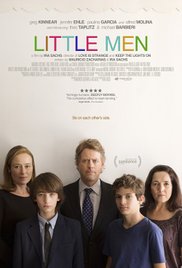
Little Men (2016), directed by Ira Sachs

little menAs a young teenager, I had deep feelings. When I dated a girl in the innocent 1950s, I thought I was going to marry her. It was devastating for me when I discovered that she was dating another guy. It took me a long time to recover, but I did and life moved on.

As I got older, I realized that one disappointment in life does not determine the future. I can learn from my experiences and become more psychologically resilient. This lesson is embedded in Little Men, a gentle coming of age drama depicting two boys who are very good friends for a short time, and then drift apart as they grow up and begin to see life from a more mature perspective.

The story begins as the Jardine family, parents Brian and Kathy and 13-year-old son Jake, move into a Brooklyn apartment they inherited from Brian’s father. On the street floor, there is a dress shop run by Leonor Calvelli and her 13-year-old son Tony.

Jake and Tony are very different from one another. Jake is withdrawn and quiet while Tony is socially adept and gregarious. Jake spends his spare time drawing and painting. Tony goes to acting classes and aspires to go to a high school of performing arts.

The adults in the story see life from an adult perspective. The boys are not privy to what goes on in the minds of their parents. What becomes a central issue is the low rent that Brian’s father had been charging Leonor for her store. The Jardines do not want to evict the Cavellis. They only want to increase the rent to come closer to the fair market value of the rental in a neighborhood where rentals have skyrocketed.

When the Jardines explain their dilemma, Leonor rebuffs them. She recounts stories of how Brian’s father considered Leonor part of his family and wished to keep her as a tenant in spite of the fact that the rent he charged her was way below market value.

Things become more complicated for the Jardines and Calvellis because the boys are becoming fast friends while the parents are becoming more entrenched in their contrary negotiating positions. Each parent is happy that their son has found a good friend, but the financial confrontation between the families looms in the background.

Little Men does not show us how to resolve disputes that are irresolvable, but it does suggest to us that the best way out of a dilemma is simply to go through an experience, learn from it, and emerge stronger emotionally because of it. Rabbi Beryl Wein, a noted Jewish educator, writes: “One of the truly major challenges of life is dealing with disappointment. In my long decades of rabbinic experience I have noticed how children are disappointed in their parents, parents are disappointed in their children, and spouses are disappointed with each other. This even extends to synagogue members who are disappointed with their rabbi, rabbis disappointed with their congregations, in-laws disappointed with other in-laws – and the list is endless.”

The Sages in the Talmud remind us that no person leaves the world possessing even half of his desires fulfilled. The wise person understands that disappointment is a reality for all human beings. To minimize a sense of disappointment, it is wise, says Rabbi Wein, to approach life “with high optimism but also with minimal expectations.” Living a healthy life means not allowing the feeling of disappointment to overwhelm us.

This is the hallmark of Jewish history. In spite of all the setbacks such as the destruction of the two Temples in Jerusalem and the Holocaust, Jews as a people never gave in to disappointment. Hope in the future always triumphed.

Jake Jardine learns this valuable life lesson of not succumbing to disappointment. His friendship with Tony energizes and satisfies him. But when life intervenes and Tony and he go their separate ways, Jake and Tony are resilient young men who do not allow past disappointment to defeat them. The “little men” become big men through the crucible of life experience.

Purchase this movie from Amazon.com.

Wonder (2017), directed by Stephen Chbosky

mv5byjfhowy0otgtndkzmc00ywjkltk1ngetywuxnjhmmmq5zjyyxkeyxkfqcgdeqxvymjmxote0oda-_v1_ux182_cr00182268_al_When I was principal of an elementary school, I saw bullying for the first time. We had a black Jewish student, a very sensitive and gentle boy, enrolled at the school. He had trouble making friends, sensing he was different from the rest of the students.

On one fateful day, a number of his classmates lured him into the boy’s bathroom and beat him up. The boy’s parents were rightfully very incensed that such behavior could occur in a Jewish day school, but it did and I had to deal with it administratively. The entire event reminded me of the need to express to all students that everyone is created in the image of God and possesses infinite potential, no matter what their appearance.

Such is the dilemma facing facially disfigured Augie Pullman as he tries to adjust to a regular school in the fifth grade after being home schooled by his mother Isabel until then. Augie’s condition is a result of a genetic flaw and, after many surgeries, he is healthy but his face is deformed.

During his first several days at the new school, he is shunned by the other students who are put off by his strange looks. In time, some students do befriend him. However, Augie travels a rocky social road, and some of his supposed friends turn on him when it suits their own social needs for acceptance. Happily, there is reconciliation, and the sincere friendship of classmates combined with the consistent support and love of his parents enables Augie to cope with temporary adversities and enjoy normal school life.

Wonder is filled with wise sayings articulated by Augie, his parents, his teachers, and his school principal, Mr. Tushman. Many of these echo Torah perspectives on life. Here are some of them: “Courage. Kindness. Friendship. Character. These are the qualities that define us as human beings, and propel us, on occasion, to greatness.”Top of Form “I think there should be a rule that everyone in the world should get a standing ovation at least once in their lives.” “It’s not enough to be friendly. You have to be a friend.” “I wish every day could be Halloween. We could all wear masks all the time. Then we could walk around and get to know each other before we got to see what we looked like under the masks.” “It’s what you’ve done with your time, how you’ve chosen to spend your days, and whom you’ve touched this year. That, to me, is the greatest measure of success.”  “If you don’t like where you are, picture where you want to be.” “Who do I aspire to be?  That’s the question we should be asking ourselves all the time.” “When given the choice between being right or kind, choose kind.” “We all have marks on our face.  This is the map that shows where we’ve been and it’s never, ever ugly.” “Your deeds are your monuments.” “Greatness is not being strong but using strength to carry the most hearts.”

Perhaps the most powerful statement is the one that speaks of the absolute need to see people in their complexity and not simply to form judgments about people based only on how they look. Mr. Tushman tells his students at an assembly: “Auggie can’t change the way he looks.  Maybe we can change the way we see.”

Wonder is a one-of-a-kind movie, loaded with important statements about how we should lead our lives and how we should interact with the people we meet. It is both entertaining and enlightening. For me, it represents an ideal “kosher movie” for our times.


Purchase this movie from Amazon.com.

The Lost City of Z (2016), directed by James Gray

lost city of zA friend of mine was recently given the opportunity to move to a better paying position in his company if he would relocate to the West Coast. He had just bought a home in Westchester and had planned to stay in the Northeast for the foreseeable future. But then this “once-in-a-lifetime” chance at improving his financial bottom line presented itself and for a few moments he was in a quandary.
His confused state did not last long. He told me that he decided to stay in his current job because it would give him more time with his wife and kids. Money and professional advancement were not his only goals. He wanted to be a good father and husband and those were his priorities. Percy Fawcett, the explorer hero of The Lost City of Z, does not see as clearly as my friend.

The story begins in 1905. Percy Fawcett, a young British officer, wants to advance himself as a soldier. When the Royal Geographic Society of England asks him to travel to Brazil and Bolivia to survey and map the country’s contiguous borders, he accepts the challenge. What drives him is a desire to restore the family’s good name, which has been blemished by his alcoholic father.

On his way to the Amazon forests, he is told to abort his mission, but Fawcett insists on continuing to advance his reputation as an explorer. He succeeds in this task and coincidently learns of a city in the jungle replete with riches and a high level of culture.

During his long explorations, he leaves his wife, Nina, who supports his exploration efforts, and his children as well. Regrettably he is not there when his second child is born. Upon his return, Fawcett is greeted as a hero, and he is challenged to return to Amazonia to further explore it. The trip is only partially successful and Fawcett returns to England where he lives in obscurity.

In 1923, interest in exploring the Amazon is high and John D. Rockefeller and a consortium of American newspapers fund an expedition to find the lost city of which Fawcett spoke. This expedition is led by Fawcett and his son Jack, who encounter hostile natives on this return trip. Their fate is unclear.

All during Fawcett’s career of exploration, his wife supports him. She even quotes the classic line of the poet, Robert Browning, who encouraged people to dream big: “A man’s reach should exceed his grasp, or what’s a heaven for?” Yet in spite of her outward support, she is inwardly lonely and longs for her husband’s companionship. Furthermore, his children resent their father’s prolonged absences from home.

Judaism encourages a balance between life and home, between spirituality and a quest for material success. The institution of the Sabbath epitomizes this: “six days shall you labor and do all your work and the seventh day is Sabbath unto the Lord your God on which you shall not do any work.” If one is devoted exclusively to work, it becomes a form of idolatry.

Moreover, Rabbi Elliot Dorff writes that one’s family should take precedence of one’s vocation. His proof text is the conversation that Moses has with the tribes of Reuven and Gad who stay on the eastern side of the Jordan rather than cross to the west with the other tribes. Their rationale: so that “we might build sheep pens for flocks and cities for our children.: The Rabbis comment that this statement, in which the flocks are mentioned before the children, reveals that these specific tribes were more worried about their possessions than they were about their children.

The Lost City of Z reminds us of the high cost of achieving one’s personal goals when one has a young family. Judaism wants us to strike a balance between personal aspirations and family responsibilities, always placing the latter first.

Purchase this movie from Amazon.com.

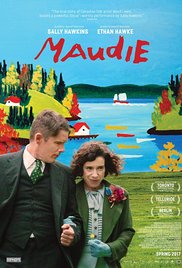
Maudie (2016), directed by Aisling Walsh

maudieMy wife is an artist. She has perfected a technique called fabric fusion. She starts off with a gray scale photograph and then overlays it with acrylic paints and hand-dyed silks. She has had exhibits of her work at the Tel Aviv Opera House and at the Jerusalem Theatre, both prestigious locations to show art. She sells her work, but she primarily paints because it satisfies her creative urge.

What is important is not the money she earns through her art, but the creative experience of producing art that people can enjoy. She regards her artistic work as part of her divine mission.

Occasionally, she asks me to critique a painting, but I feel inadequate to the task. I very much feel that art is in the eye of the beholder. I cannot predict what someone will like.

In the final analysis, enduring art can spring from anywhere, even from a remote country village in Nova Scotia. This is what happens in Maudie, the true story of Maudie Dowley, a woman with severe arthritis who develops an iconic ability to paint flowers and birds that appeal to a broad cross-section of people that appreciate her simple but powerful expressions of nature’s beauty.

Rather than live with her highly judgmental Aunt Ida, Maudie decides to strike out on her own and find a job that will enable her to support herself and live independently. Serendipitously, she meets Everett Lewis, a coarse and laconic fish peddler who is seeking a cleaning lady for his home in return for providing room and board and a meager salary. Maudie applies for the job and Everett agrees to try her out.

While employed at his home, Maudie begins to paint parts of the house including shelves, walls, and windows with decorations of flowers and birds. One of Everett’s customers, Sandra, who lives in New York City, is fascinated by Maudie’s art and offers to pay her money for her cards and paintings. Her patronage of Maudie’s art leads to more and more commissions, eventually reaching the eyes of Richard Nixon, who purchases one of her works.

Eventually, Everett and Maudie marry and learn to love one another even though they have totally different temperaments and worldviews. Their marriage is stormy, but in the end it is satisfying to both. Maudie’s ability to see beauty in the ordinary cycle of nature sustains her as she manages her tumultuous relationship with Everett.

In the daily Jewish liturgy, God is described as renewing the creation every day. The message of the prayer is to understand that the beauty of nature manifests itself in ordinary days. It is not a special event. Each day is an opportunity to proclaim the significance of daily miracles, which inform our lives all day long. The challenge is to view nature with fresh eyes. Maudie is able to do this especially when she sees nature through a window. She reflects: “How I love a window. It’s always different. The whole of life. The whole of life already framed. Right there.”

The great medieval sage Maimonides viewed the natural world as a testament to God’s grandeur. In discussing the foundational principles of the Jewish faith, he writes that we can get close to God not only by studying holy words, but also by observing holy works, the everyday miracles that present themselves through natural phenomena. A mountain, a flower, a river, a tree can remind us of the inherent beauty in the world and bring us close to God.

Maudie, a simple soul, is able to transcend her physical limitations when she sees nature in a multi-faceted way. Nature for her is never random or chaotic. Rather it reflects a divine beauty hidden in the flora around us.

Purchase this movie from Amazon.com.

The Village (2004), directed by M. Night Shyamalan

villageI live in a city in Israel where there are many charedim, ultra-Orthodox Jews. I do not wear the same clothes as they do. They wear mostly black coats and white shirts and live in a different neighborhood. But occasionally I meet them in the local synagogue since both of us are obligated to pray with a quorum of ten men, a minyan, three times a day.

Although we pray to the same God, observe the same commandments, and study the same Torah, we do not have a lot in common outside of a synagogue setting. I engage the outside world and study secular texts. They fear the outside world and stay away from it to maintain the purity and integrity of their way of life. They have no televisions and very limited access to the Internet. They see the outside world and secular studies as corrupting their faith and family values and want to remain as far away from it as possible.

This attitude is similar to the attitude of the inhabitants of a 19th century community in Pennsylvania depicted in The Village, a film that explores the consequences of leading an isolated life without interactions with the larger world around it. The surrounding woods are forbidden to the villagers because they are populated by harmful demons.

One day, however, a young man dies because of a lack of medicine to treat him. This motivates Lucius Hunt, a sincere and kind member of the community, to offer to travel to the “towns” to bring back medicine to prevent another tragedy. The elders reject his request.

Lucius is troubled by the lack of openness of the elders and their secretive ways. In particular, he is interested in knowing the origins of their isolated community, but the elders do not respond positively to his desire to explore the world beyond the village.

Lucius, reticent and shy, forms a friendship with Ivy Walker, an attractive girl who has been blind since a very young age. Their relationship becomes romantic and Lucius and Ivy decide to marry. Tragedy strikes when Lucius is mortally wounded. The only remedies that can possibly save him are medicines from the ominous towns that threaten the existence of the village. Furthermore, it is only Ivy who volunteers to make the treacherous journey to secure the needed medicine for Lucius to survive.

There is a community dilemma. If Ivy goes, there is a possibility that the secret of the community’s existence will be discovered and the community’s way of life will cease to exist. If she does not go to get medicine, Lucius will probably die of his wound.

Herein lies the dilemma facing the ultra-Orthodox Jews as well. Isolation is a positive value because it enables them to maintain their unique lifestyle in a world where moral rudders are absent. However, isolation makes them vulnerable because they never learn how to function in the modern world or how to take advantage of the good things the modern world offers. Either option presents risks. The question is which risk do you prefer. Or is there a balance to be struck between the two?

Footsteps, an organization founded in 2004, attempts to help the ultra-orthodox who have left the fold to adjust to the modern world without necessarily abandoning the old one. For the first time, these people are discovering themselves anew and wrestling with new freedoms. These new freedoms sometimes are corrupting and lead to further estrangement from family and friends. At other times, they enable people to enter the modern workplace, obtain jobs, and learn skills that enable them to survive in an unfamiliar world. Footsteps tries to be a bridge between those two worlds.

The Village illustrates the perils of isolation, even when it is understandably motivated for good reasons. The best answer, reflected in the response of the inhabitants of the village to Lucius’s grave condition, is to find a balance between the ideal and real worlds.

Purchase this movie from Amazon.com.