 Being a parent is challenging, but it often brings out one’s best self. Let me explain. One of my children once asked me a question of Jewish law. I felt it was a simple question and I responded quickly with an answer. Months later, I realized the answer I gave him was wrong. I apologized to my son and then I told him the correct answer.
The relationship with my son was strong and life moved on, but I was deeply troubled by the fact that I had given him an answer that was not accurate. The incident still haunts me thirty years later. I had wanted my son to feel he could always rely on me to give him the best advice, the most accurate information; and in my own mind, I had let him down. From then on, I resolved never to be quick when a question is posed to me. Lesson learned: Allow some time to think things through carefully.
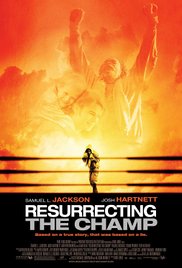
I realized then and I realize now that we are always role models for our children, and we have to make good decisions not only for ourselves, but good decisions that will stand the test of scrutiny by our children. Such is one dilemma in Resurrecting the Champ, a story about a successful prizefighter who, in the twilight of his life, becomes a homeless person, living on the streets.
Erik Kernan Jr., a sports reporter for a major newspaper, is upset that his editor, Ralph Metz, buries his stories in the last pages of the paper. Metz tells Erik that his articles are boring and lack interest, and Erik begins to think of doing regular reporting rather than sports.
On one fateful night, Erik serendipitously encounters a homeless man who calls himself “Champ,” and discovers that he once was a professional boxer named Bob Satterfield, who had been in the ring with such boxing luminaries as Ezzard Charles and Jake LaMotta. In truth, Satterfield is a forgotten man and most boxing aficionados thought him dead. Erik sees Satterfield’s story as a ticket out of his current job and as a way to become a feature writer at a weekly sports magazine. He pitches the idea to the magazine editor, who is intrigued with what might be a major article about the rise and fall of a contender for boxing royalty.
In his quest for success as a writer, Erik becomes careless in fact-checking Satterfield’s story, and thereby hangs the moral crux of the narrative. Erik’s moral dilemma is highlighted in his relationship with his son, Teddy. Erik is separated from his wife, Joyce, and only sees Teddy periodically. To maintain his iconic status in his son’s eyes, he often tells him of his friendship with sports celebrities, but Erik does not really know them. He only covers their athletic events, and his relationships with them are superficial. Nonetheless, Teddy believes his father.
This belief is tested when his father is openly accused of lying to promote his professional career as a writer. How the Satterfield story is ultimately regarded and how Erik’s relationship with his son is resolved is the stuff of real life compromise. The resolution may not be neat, but it is emotionally satisfying.
Jewish tradition has much to say about how parents should serve as role models. The patriarchs of the Jewish people were mindful that they were role models for an entire people, not just their own families. The Bible states regarding Abraham: “For I have chosen him, so that he will direct his children and his household after him to keep the way of the Lord by doing what is right and just, so that the Lord will bring about for Abraham what he has promised him (Gen. 18: 19).”
A key aspect of the parental relationship is honesty. In depicting the relationship between fathers and sons, honesty emerges as a critical bond that unites the generations, a connection that is sacred between parent and child.
In truth, no one is perfect. All parents possess flaws, but Resurrecting The Champ suggests that we can still love and respect our parents in spite of any flaw. Rabbi Jonathan Sacks poetically describes the function of parents as role models: “Judaism, more than any other faith, sees parenthood as the highest challenge of all. Judaism takes what is natural and sanctifies it. What Darwin saw as the urge to reproduce, what Richard Dawkins calls ‘the selfish gene,’ is for Judaism high religious art, full of drama and beauty. Abraham the father, and Sarah the mother, are our enduring role models of parenthood as G-d’s gift and our highest vocation.”
 At the Sabbath table here in Israel, we often invite guests, some of whom do not speak English. When we run out of words, I find that music, Sabbath melodies even without words, can sustain the conversation. We do not have to understand one another in a conventional sense. The music and its harmonies bring us together and we are communicating on another level. Music becomes the universal language. Close Encounters o the Third Kind deals with a visit of aliens from another planet. Although they share no common language with earthlings, they are able to communicate with harmonic tones. Music brings them together.
 One of the many things I enjoyed during my years of serving as principal of a high school was working with a top notch staff, a group of teachers who were mission-driven, focused on doing the best for their students. They were not limited by their job descriptions. I recall that, on several occasions, we needed someone to drive a van to pick up kids to come to school for several weeks. Teachers eagerly volunteered. They understood my dilemma and just did what was needed to get the task done. They did not simply stand on the side, waiting for someone else to do the job.
 I have a friend who never fails to miss an opportunity. Although talented and possessing charisma, at age 45 he is still single and without a steady job. Occasionally, he asks me for a loan and I give him small pocket change; but his life, on the whole, is a mess.
 As I get older, I reflect upon the life I have led. Although I cannot change the past, I sometimes feel that I could have made different decisions that might have led to different outcomes. For example, if I had decided to become the chief rabbi of a small synagogue instead of an assistant rabbi at a large synagogue, my career path might have been different. In Atlanta, circumstances allowed me to switch my professional direction, and I became a high school principal instead of a pulpit rabbi. The opportunity would probably never have come to me if I began my rabbinic career as the chief rabbi in a small town.
 When I taught the Holocaust to high school students, I often would show the students a documentary that would make the statistical information more vivid and meaningful. Night and Fog was a frequent choice. On occasion, I would show excerpts from Shoah, Claude Lanzmann’s 11-hour documentary.
 When I was a teenager, I was smitten by a beautiful girl from the Bronx. I thought we were going to get married, and I prayed to God that it all would work out. Thank God, God did not answer my prayers. If He did, I would have led a very different life from the one I lead now.
 I recently read The Fortunate Ones, a novel by Ellen Umansky, about a child sent by her parents on a kinderstransport to England to escape the Nazi regime and its persecution of Jews. Fifty Children deals with an American couple from Philadelphia, Gilbert and Eleanor Kraus, who arranged for 50 children to travel from Vienna to the United States in 1939 to rescue them from almost certain death in German concentration camps.
 In the course of my career as a high school principal, I had many faculty meetings. I would present a list of agenda items and the staff would give me their thinking on them. On occasion, a teacher would say to me that the problem under discussion was simple. All we had to do was one thing and then things would be fine. This kind of simplistic thinking in most cases did not work. The failure to see complexity doomed the suggested solution.
 As a young married man, I do not recall ever praying to have a boy or a girl, but I do remember praying for a healthy child. My parents had a Downs Syndrome child and I understood viscerally what that means to parents. It changes their lives forever. Every decision made has to factor in what the consequences are for the special needs child. Life is no longer “business as usual.”
 Kosher Movies