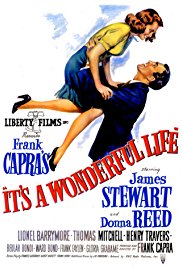
 My wife and I recently had dinner with a family that warmly welcomed us to Israel seven years ago when we moved to Beit Shemesh. My friend’s wife asked me why we joined the synagogue of which they were members. I responded: “Because your husband smiled at me.” It seemed a superficial answer, but it really was not. The answer highlighted the impact of a small gesture that made a big difference in our lives.
And that is what happens oftentimes in life. We frequently do not realize the powerful effect of a kind gesture, how it can change what happens in the future even though the act itself seems minor at the time. This is the narrative arc of It’s a Wonderful Life, a classic film that considers the good that we do which has a ripple effect unto eternity even when we are not aware of the wisdom or generosity of our actions.
The film begins with a conversation between angels about the fate of George Bailey, a man on the verge of suicide. The angels decide to send one angel, Clarence, down to earth to convince George to live again and not let difficult circumstances overwhelm him.
George’s story is told via flashback. As a boy of twelve, he rescued his younger brother Harry from drowning on an ice-covered pond. We also see him save a pharmacist from making a major mistake by giving a customer poison instead of the proper medicine.
We later see George articulating his dreams. As a young man, he had thoughts of leaving his small hometown of Bedford Falls and becoming a builder in a large metropolitan area. But life is put on hold when George’s father suddenly dies and George is asked to manage his father’s savings and loan association. Instead of George going to college, his younger brother Harry goes and returns a married man with a job given to him by his father-in-law in another city. Later when World War II breaks out, Harry fights as a pilot and saves a transport ship carrying a boatload of soldiers. The rescue earns Harry the Congressional Medal of Honor.
George’s main business adversary in Bedford Falls is the greed-driven Henry Potter, who charges people exorbitant rents for his apartments and owns much of Bedford Falls. When the Great Depression arrives, George, now happily married to Mary Hatch, is hard pressed to loan his customers money to sustain them through the crisis. Potter, sensing George’s desperate plight, offers to buy George’s savings and loan. Miraculously, George weathers the financial storm and his business continues to grow and provide affordable housing for his community.
All is good until the day before Christmas when a bank auditor arrives to examine the bank’s finances. Unfortunately, he discovers a loss of $8000, and George is threatened with bankruptcy and possible prison time. After leading a life filled with good deeds, George is depressed and lashes out at those he loves. In the midst of this crisis, Potter again offers to buy out George and declares to George: ‘You’re worth more dead than alive.” This is the catalyst for George to contemplate suicide so that his heirs can inherit the life insurance money.
In the midst of his mental turmoil, Clarence, George’s guardian angel arrives and gives George an opportunity to reevaluate his life and reconsider his plan to kill himself. Clarence takes George on an imaginary journey looking at life in Bedford Falls as if George never existed, and subsequently viewing life as it actually happened. In that way, George understands that his life has been filled with good deeds and with blessings for himself, his family, and his friends. Clarence reminds him: “Strange, isn’t it? Each man’s life touches so many other lives. When he isn’t around he leaves an awful hole, doesn’t he?”
The Talmud tells us that it is important to greet everyone with a smile. It seems simple, but the Sages are telling us a profound lesson. When we smile at others, they smile back at us, and so a community of friends is formed. The small kindnesses that we do today, whether we recall them or not, implicate many tomorrows. It’s a Wonderful Life reminds us to appreciate the blessings of everyday, to value our friendships, to be kind, and to know that good deeds have a ripple effect into the future.
 Being a parent is challenging, but it often brings out one’s best self. Let me explain. One of my children once asked me a question of Jewish law. I felt it was a simple question and I responded quickly with an answer. Months later, I realized the answer I gave him was wrong. I apologized to my son and then I told him the correct answer.
 At the Sabbath table here in Israel, we often invite guests, some of whom do not speak English. When we run out of words, I find that music, Sabbath melodies even without words, can sustain the conversation. We do not have to understand one another in a conventional sense. The music and its harmonies bring us together and we are communicating on another level. Music becomes the universal language. Close Encounters o the Third Kind deals with a visit of aliens from another planet. Although they share no common language with earthlings, they are able to communicate with harmonic tones. Music brings them together.
 One of the many things I enjoyed during my years of serving as principal of a high school was working with a top notch staff, a group of teachers who were mission-driven, focused on doing the best for their students. They were not limited by their job descriptions. I recall that, on several occasions, we needed someone to drive a van to pick up kids to come to school for several weeks. Teachers eagerly volunteered. They understood my dilemma and just did what was needed to get the task done. They did not simply stand on the side, waiting for someone else to do the job.
 I have a friend who never fails to miss an opportunity. Although talented and possessing charisma, at age 45 he is still single and without a steady job. Occasionally, he asks me for a loan and I give him small pocket change; but his life, on the whole, is a mess.
 As I get older, I reflect upon the life I have led. Although I cannot change the past, I sometimes feel that I could have made different decisions that might have led to different outcomes. For example, if I had decided to become the chief rabbi of a small synagogue instead of an assistant rabbi at a large synagogue, my career path might have been different. In Atlanta, circumstances allowed me to switch my professional direction, and I became a high school principal instead of a pulpit rabbi. The opportunity would probably never have come to me if I began my rabbinic career as the chief rabbi in a small town.
 When I taught the Holocaust to high school students, I often would show the students a documentary that would make the statistical information more vivid and meaningful. Night and Fog was a frequent choice. On occasion, I would show excerpts from Shoah, Claude Lanzmann’s 11-hour documentary.
 When I was a teenager, I was smitten by a beautiful girl from the Bronx. I thought we were going to get married, and I prayed to God that it all would work out. Thank God, God did not answer my prayers. If He did, I would have led a very different life from the one I lead now.
 I recently read The Fortunate Ones, a novel by Ellen Umansky, about a child sent by her parents on a kinderstransport to England to escape the Nazi regime and its persecution of Jews. Fifty Children deals with an American couple from Philadelphia, Gilbert and Eleanor Kraus, who arranged for 50 children to travel from Vienna to the United States in 1939 to rescue them from almost certain death in German concentration camps.
 In the course of my career as a high school principal, I had many faculty meetings. I would present a list of agenda items and the staff would give me their thinking on them. On occasion, a teacher would say to me that the problem under discussion was simple. All we had to do was one thing and then things would be fine. This kind of simplistic thinking in most cases did not work. The failure to see complexity doomed the suggested solution.
 Kosher Movies